You spend a lifetime building a legacy.
You work the double shifts, you skip the vacations, and you tuck every spare cent into a trust so that when you’re gone, your kids don’t have to struggle the way you did. You think the law is there to protect that legacy. You think a judge is a neutral arbiter of truth.
Then you meet probate court, and the illusion cracks. The law starts looking less like a shield and more like a private menu for insiders who know exactly how to carve up an estate while the family is still trying to process a funeral.
Welcome to the world of asset stripping, where your family’s inheritance is treated like a carcass and the vultures are billing by the hour. This is the probate plot. In Texas, the stench of cronyism is no longer subtle. It is loud, documented, and getting harder to hide.
The feeding frenzy: How the probate plot begins
Probate court was supposed to resolve disputes. In too many cases, it becomes the place where disputes are stretched, monetized, and weaponized. The pattern is familiar: a wealthy parent dies, conflict erupts between heirs and a surviving spouse, the estate freezes, and a feeding frenzy begins.
This is where fee harvesting starts.
Instead of moving the case toward resolution, the process drags. Motions multiply. Hearings stack up. Discovery expands. Experts appear. Bills rise. Not into the thousands, but into the millions. The estate becomes the target, and every delay creates another invoice.
In the Allison probate fight, Caroline and Rich Allison say they were pulled into a legal machine that consumed the value their father spent a lifetime building. When they concluded their own lawyers may not have protected them, they sued for malpractice. That decision exposed what many families never see until it is too late: the case behind the case, where the real money is made.

For families trapped in probate, the damage is not just financial. It is psychological. You are grieving, outmatched, and forced to fund the very process that is draining your inheritance. That is why this pattern deserves a name: fee harvesting through litigation pressure.
The arbitration trap: Signed away rights in a private room
That pressure often leads to the next phase: private dispute resolution with almost no meaningful safety valve.
The Allisons’ malpractice claims were pushed into mandatory arbitration, a process sold as faster and cheaper but too often used to bury public scrutiny. Once families enter this room, they are no longer in front of a jury of citizens. They are in a closed system where the rules of disclosure, review, and accountability are far weaker.

This is the ARBITRATION TRAP: rights signed away, review severely limited, and families left with almost no path back to a real court.
Under current Texas law, undoing an arbitration award is extraordinarily difficult. Even serious questions about bias or nondisclosure may not be enough to trigger relief. That makes arbitration attractive to profiteers. If the process is tainted, the family still carries the burden. If the ruling is catastrophic, the public may never know what happened behind closed doors.
The Anne Ashby connection: A rigged game under investigation
Imagine sitting down to a card game and learning afterward that the dealer had ties to the players across the table. That is the concern raised in the Allison matter.
Former Dallas judge Anne Ashby served as the arbitrator in the malpractice dispute. On paper, arbitration looks neutral. In practice, the neutrality alleged in this case has been challenged as a façade hiding undisclosed professional overlap and conflicts that should have triggered serious scrutiny from the start.

Investigative reporter Wayne Dolcefino has driven that scrutiny in his reporting. His video work has laid out the allegations in plain English and forced public attention onto a system that usually operates in the shadows. The reporting focuses on professional connections, disclosure failures, and the enormous consequences that followed for the Allison family.
Among the issues raised in public reporting:
- Firm overlap: Ashby disclosed work at a firm with a lawyer connected to the dispute, but critics argue the disclosure was incomplete and failed to convey the depth of the relationship.
- Registered agent connection: Reporting has highlighted that a lawyer tied to the opposing side’s orbit was listed as registered agent for Ashby’s firm as recently as 2023.
- Expert witness overlap: Reporting also raised questions about Ashby’s work relationship with an expert later compensated in the arbitration.
When the arbitration ended, Ashby issued a reported $4.5 million award, including approximately $600,000 to one attorney even though Rich Allison has publicly argued he never signed a contract with that lawyer. That result is why judicial review matters. If conflicts were not fully disclosed, a family should not be trapped by a private ruling with no real avenue for correction.
The concerns have now moved beyond public criticism. The State Bar of Texas has reportedly confirmed an investigation into Dallas arbitrator Anne Ashby. See the State Bar investigation update and the evading service update.
Wayne Dolcefino’s Damn Lawyers investigation series
Wayne Dolcefino’s reporting has become a running case file on how probate and arbitration can be used to strip families of control, money, and due process. The four key investigative videos map the progression of the scandal.
- Damn Lawyers – Allison Family Probate Case
Exposes a Texas inheritance battle where families allege lawyers exploited probate disputes and drained inheritances. Watch on YouTube, Facebook, TikTok, and Instagram. - Damn Lawyers – Rigged Arbitration – the Stench of Cronyism
Investigates alleged arbitration cronyism and hidden conflicts involving Houston probate lawyers. Watch on YouTube, Facebook, TikTok, and Instagram. - Damn Lawyers – A Deception
Exposes alleged fraud in a widening Houston probate investigation. Watch on YouTube, Facebook, TikTok, and Instagram. - Damn Lawyers – The Probate Plot
Exposes how Houston probate lawyers allegedly trap families and drain inheritances through fees. Watch on YouTube, Facebook, TikTok, and Instagram.
Gail Echols: “How did my lawyers make more money off of my inheritance than I did?”
The Allison case is not standing alone. Gail Echols has raised a question that cuts straight to the heart of probate abuse: “How did my lawyers make more money off of my inheritance than I did?”
Her account describes how she and her brother were pressured into a settlement by three attorneys whose bigger payday depended on ending the dispute on terms favorable to fees, not fairness. Her public story reinforces the same pattern seen across these cases: grief leveraged into pressure, pressure converted into settlement, and settlement turned into profit for the people controlling the process.
Watch Gail Echols’ testimony on YouTube and review the case record on UniCourt.
The 93% club: Why bar accountability keeps failing
Families are told there is always oversight. File a grievance. Trust the process. Wait for accountability. Then they discover how rarely the system disciplines its own.

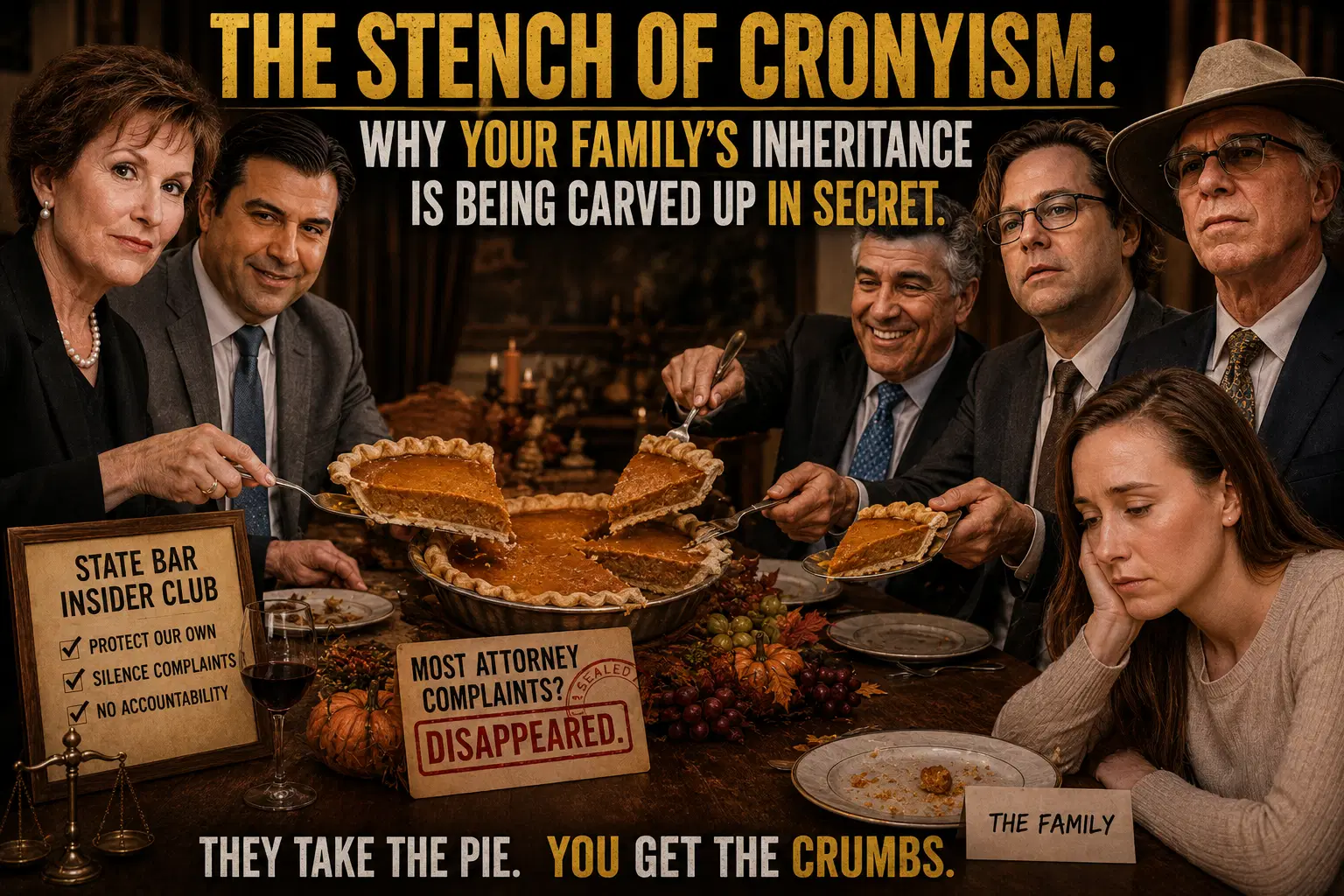
Critics call it the 93% club for a reason: most complaints go nowhere, and too many lawyers facing serious allegations are protected by delay, procedure, or professional courtesy. That is why the reported State Bar investigation into Anne Ashby matters. If regulators are finally paying attention, the legislature should be paying even closer attention.
This is not just about one arbitrator or one probate fight. It is about a structure that allows attorneys, retired judges, and insiders to operate with minimal transparency while families bear the cost.
In the news
This story has broken beyond court filings and family testimony. Coverage and public discussion have spread across consumer and legal media, including Yahoo Finance, GlobeNewswire, Law360, and ReviewFraud.org.
The fix: Legislative reform, real review, real consequences
The problem is clear. The exposure is mounting. The discussion is now public. The fix has to be legislative.
At Stop Legal Bullying, we are calling for reforms that match the scale of the abuse:
- Mandatory judicial review of arbitration awards when evidence of undisclosed conflicts, fraud, or material bias emerges.
- Automatic vacatur for disclosure failures by arbitrators handling consumer, probate, and malpractice disputes.
- Full transparency on professional relationships among arbitrators, experts, firms, and repeat players.
- Meaningful discipline for fee-driven litigation abuse in probate cases where legal strategy appears designed to exhaust the estate.
- Legislative hearings on mandatory arbitration in legal malpractice and probate-related disputes.
Families should not have to finance their own destruction and then be told the ruling is final because it happened in private.
Are you a victim of the probate plot?
The system depends on silence. It counts on families being exhausted, intimidated, and broke before they can tell the story.
If you have been pushed into secretive arbitration, blindsided by undisclosed conflicts, or drained by probate fee harvesting, speak up. If you have information involving Anne Ashby or similar Dallas-area arbitrations, we want to hear from you.
Visit VICTIMS OF ANNE ASHBY and share your story.
Have you experienced this type of legal bullying? Send this reel to someone you know in an estate or probate case so they can be aware.
This is your sign to never go into an arbitration agreement knowingly or blindly… Watch on YouTube or Instagram.
Your experience could be the evidence that finally forces a legislative debate on arbitration abuse, probate exploitation, and the cronyism poisoning public trust in the justice system.
Your experience could be the piece of evidence that finally forces the legislature to take action. It’s time to wash away the stench of cronyism and return the law to the people it was meant to protect.