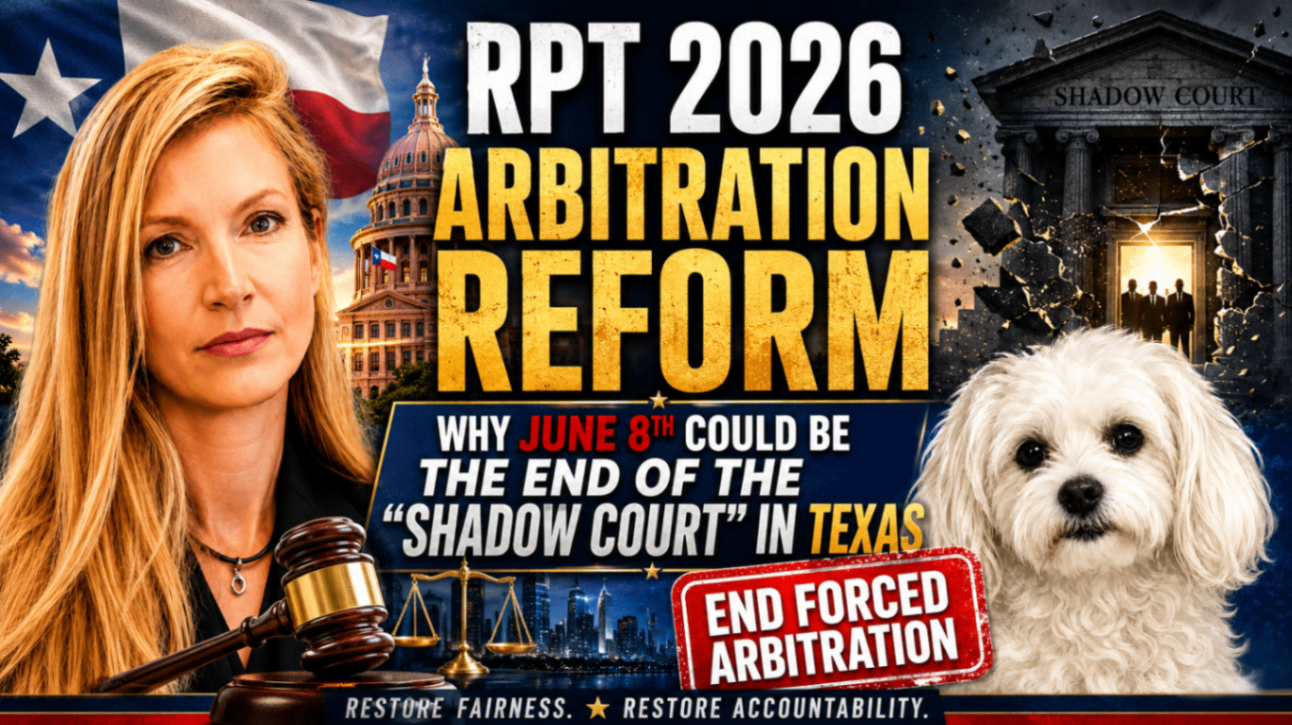
The George R. Brown Convention Center in Houston is about to become a battlefield for the soul of the Texas justice system. On June 8th, thousands of delegates will gather for the Republican Party of Texas (RPT) Convention, and at the center of the fray is a resolution that could finally dismantle the “Shadow Court” that has haunted Texas families for decades.
For years, a silent predator has been lurking in the fine print of attorney-client fee agreements. It is a clause that strips you of your 7th Amendment right to a jury trial before you even realize a conflict exists. This is the arbitration trap, a system of private, secret proceedings where accountability goes to die and the “stench of cronyism” is masked by closed doors and redacted transcripts.
The RPT 2026 Arbitration Reform Resolution is more than just a policy update; it is a desperate cry for the restoration of the rule of law. It is the first real step toward passing the Texas Attorney-Client Arbitration Fairness Act, a piece of legislation designed to ensure that no Texan is ever forced into a rigged system without their informed, explicit consent.
The silent theft of the 7th Amendment
The American legal system was built on the foundation of the jury trial. It is the great equalizer: the one place where a single citizen can stand against a powerful institution and expect a fair hearing. But in Texas, that right is being signed away in high-rise law offices every single day.
The problem starts with the mandatory arbitration clause. When families are at their most vulnerable: dealing with a complex probate case like the Allison case or fighting to protect a loved one’s legacy: they turn to attorneys for help. They are handed a stack of papers and told to sign. Tucked away in that stack is a provision that forbids them from ever taking that attorney to court if things go wrong.

If the attorney overcharges, mismanages the case, or engages in outright misconduct, the client is barred from a public courtroom. Instead, they are forced into the “Shadow Court” of private arbitration. That danger is laid out bluntly in this arbitration warning reel, a short reminder that rights signed away in fine print are rights that may never be recovered.
Inside the Shadow Court: Where evidence disappears
The term “Shadow Court” isn’t hyperactive rhetoric; it is a literal description of how arbitration functions in the Texas legal world. Unlike a public courtroom, there is no court reporter unless you pay thousands extra for one. There is no public record. There is no jury of your peers.
Instead, you are judged by an “arbitrator”: often a retired judge or another attorney who travels in the same social and professional circles as the person you are accusing. The potential for undisclosed conflicts is staggering. In the investigation led by Wayne Dolcefino, the lead investigator who has spent years pulling back the curtain on this rigged system, we have seen time and again how these “private judges” operate with zero oversight. Dolcefino’s Damn Lawyers – Rigged Arbitration – the Stench of Cronyism lays out the pattern in stark terms, with additional coverage available on Facebook, TikTok, Instagram, and the full Dolcefino investigation page.
In the Allison probate case, the systemic failures were on full display. When the “trio” of attorneys involved in a case are allowed to hide behind arbitration, the truth never sees the light of day. There is no judicial review. Even if an arbitrator makes a glaring error of law, Texas courts are notoriously hands-off, leaving victims with no path for appeal. It is a legal dead end. That broader warning is now reaching the public through national coverage, including “CONSUMER ALERT: Mandatory Arbitration Enables Predatory Lawyers…” and “CONSUMER ALERT: Growing Calls for Arbitration Reform…”, both of which underscore how quickly constitutional rights can vanish behind closed doors.
The Houston convention: A line in the sand
On June 8th, the delegates in Houston have a choice. They can allow this system of exploitation to continue, or they can stand up for the 7th Amendment. The RPT 2026 Arbitration Reform Resolution specifically targets the predatory nature of these clauses.
The goal is simple: ensure that arbitration is a choice, not a mandate. The proposed Texas Attorney-Client Arbitration Fairness Act would require attorneys to clearly disclose the implications of an arbitration clause and require a separate signature from the client, acknowledging they are waiving their constitutional right to a jury trial.
This isn’t just about legal theory; it’s about real people. Consider the victims of Anne Ashby, who have found themselves trapped in a cycle of endless fees and zero accountability. The pressure has now reached the disciplinary level, with a State Bar investigation into Anne Ashby confirmed here. When the system is designed to protect its own, the only solution is systemic reform.

Why the “trio” fears June 8th
Predatory lawyers and the firms that protect them rely on the silence of arbitration. It allows them to turn a family’s inheritance into their personal payday through fee-switching traps and inflated billing that no jury would ever authorize. They fear the RPT resolution because it threatens the “stench of cronyism” that keeps their business model alive.
Wayne Dolcefino has documented the “evidence” of this betrayal: the redacted text, the bold stamps of “VOID” on justice, and the hand-drawn arrows pointing to the money trail that leads away from the victims and into the pockets of the legal elite. His investigative work has shown that when these systems are exposed to the light, they crumble.
The Houston GOP convention is the place where we can finally demand that arbitration be subject to judicial review. If a private arbitrator fails to follow the law, a real judge in a real court should have the power to fix it. Without this check and balance, arbitration is nothing more than a tool for legal bullying.
A call to action for Texas delegates
If you are a delegate heading to Houston this week, you are carrying the hopes of every Texan who has been bullied by the very system meant to protect them. The “Shadow Court” has operated in the dark for too long.
We are calling on all delegates to:
- Support the RPT 2026 Arbitration Reform Resolution: Make it a priority on the convention floor.
- Demand transparency: Ensure that the Texas Attorney-Client Arbitration Fairness Act moves from a resolution to a legislative reality in the next session.
- Protect the 7th Amendment: Refuse to let the constitutional rights of Texans be traded for the convenience of unethical attorneys.
The time for quiet reform is over. The “stench of cronyism” has become unbearable, and the Allison case stands as a permanent reminder of what happens when we allow the legal system to police itself in secret.
On June 8th, let’s send a clear message from Houston to every law office in the state: The Shadow Court is closed. The rule of law is back.
For more information on the fight for legislative change and to see the evidence for yourself, visit our legislation resource page. If you or someone you know has been harmed by these practices, share your story on our story wall. Accountability starts with us.