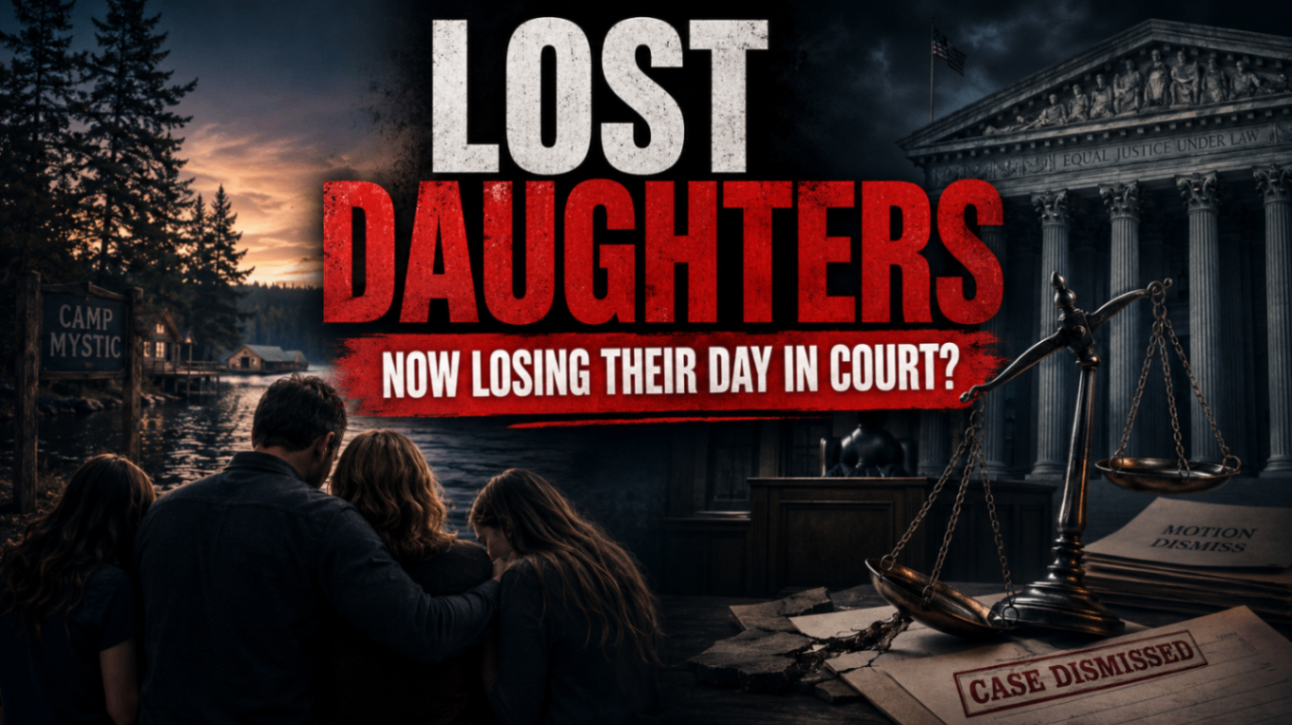
The rain in the Texas Hill Country doesn’t just fall; it attacks. On July 4, 2025, the sky opened over the Guadalupe River with a biblical fury, turning a summer sanctuary into a death trap. While families across the state were lighting fireworks, parents of the campers at Camp Mystic were about to receive the phone call that ends a life before it’s over. Twenty-five little girls and two counselors never came home. The grief is fathomless, a silent scream that echoes through the halls of every home where a bedroom remains exactly as it was left that June morning.
For Caroline Allison, this story does not live at a distance. She attended Heart of the Hills in the Texas Hill Country as a child. Her camp director, Jane Ragsdale, died in that same July 4, 2025 flood. Now Caroline’s 9-year-old daughter associates camp with tragedy and fears the very idea of going. That is what disasters like this do when institutions fail: they do not just take lives; they poison memory, trust, and the ordinary milestones of childhood for the families left behind.
But for the families seeking accountability, the tragedy didn’t end when the floodwaters receded. It was just beginning. In the cold, mahogany-paneled world of high-stakes litigation, the “stench of cronyism” is rising. These families, still reeling from the unimaginable loss of their daughters, are now facing a secondary assault: a calculated, ruthless effort to strip them of their Seventh Amendment right to a jury trial.
Through a series of tactical maneuvers that have drawn the ire of the bench, Camp Mystic and its high-powered legal team are attempting to drag these grieving parents into the shadows of secret proceedings. They aren’t just fighting for their lives anymore; they are fighting for the very soul of the American justice system.
The Fine Print of a Nightmare
When parents signed their daughters up for a summer at Camp Mystic, they thought they were signing up for canoeing, campfire songs, and lifelong friendships. They didn’t realize they were signing away their right to hold the camp accountable in a court of law. Buried deep within the registration packet: somewhere between the packing list and the dietary restriction forms: was a clause that has become a weapon of mass destruction for civil rights: binding forced arbitration.
This is the arbitration trap in its most predatory form. By clicking “agree” or signing on the dotted line, these families unknowingly entered a private, pay-to-play system where the rules of evidence are suggestions, and the results are kept hidden from the public eye. Wayne Dolcefino’s arbitration trap investigation has shown how these clauses become weapons when institutions decide the public should never see what happened behind closed doors.
In a standard courtroom, a jury of peers decides the value of a life and the depth of a company’s negligence. In arbitration, a single individual: often a retired lawyer or judge whose livelihood depends on being selected by corporations again and again: decides everything. There is no jury. There is no public record. There is no news cameras to show the world the evidence of “gross negligence” that allegedly led to the deaths of twenty-seven people.
The Midnight Maneuver
The legal defense for Camp Mystic, led by Mikal Watts of the Watts Law Firm, hasn’t just leaned on the arbitration clause; they’ve wielded it with a clinical precision that has left veteran observers stunned. In a move that Judge Maya Guerra Gamble famously criticized as a “midnight maneuver,” the camp’s legal team withdrew their motion to compel arbitration just hours before a scheduled ruling, only to refile amended versions shortly after.
It is a classic example of legal bullying designed to exhaust the plaintiffs, burn through their resources, and delay the inevitable day of reckoning. While the families wait for justice, the defense plays a game of jurisdictional chess. It is the same pattern seen in the Dolcefino investigation, where delay, pressure, and procedural gamesmanship become tools to break the people with the least power.
The strategy reached a new level of aggression when Camp Mystic filed for Chapter 11 bankruptcy. In the world of corporate litigation, bankruptcy isn’t always about being broke; it’s about being protected. By entering bankruptcy court, the camp triggered an “automatic stay,” effectively freezing the wrongful death lawsuits and funneling them into a federal system where the primary goal is the “reorganization” of debt: as if the lives of twenty-five little girls could be treated like a line item on a balance sheet.
Why Secret Justice is No Justice At All
Why is Camp Mystic fighting so hard to avoid a Travis County jury? Because they know that in a public courtroom, the evidence of their alleged failures would be broadcast to every parent in the country. They know that a jury, seeing the photos of the cabins placed in a known FEMA floodplain and hearing the testimony about ignored flood warnings, might return a verdict that would resonate through the entire youth camp industry.
In secret arbitration, that risk vanishes. The proceedings happen behind closed doors. The witnesses aren’t protected by the same public scrutiny. Most importantly, the award: if there is one: is usually kept confidential. This lack of transparency is the oxygen that allows new alleged victims and attorney self-dealing to flourish. The same sealed machinery appears in reports on rigged arbitration, where repeat-player advantage and hidden relationships tilt the field before the first word of testimony is ever spoken.
As we have seen in the investigations conducted by Wayne Dolcefino, the system of mandatory arbitration has become a shield for the powerful. It is a forum where the Damn Lawyers series can negotiate away the rights of victims without the “pesky” interference of the Constitution. When justice is privatized, the public is the ultimate loser. The families of the Camp Mystic victims are soon going to discover that they are walking into a forum where the deck is stacked against them, and the “referee” is often a business associate of the defense. Stop Legal Bullying has documented that pattern of bias before, and the record keeps pointing in the same direction: institutional wins, consumer losses, and a pipeline of insiders protecting insiders.
The Stripping of the Seventh Amendment
How did we get here? How did the Seventh Amendment: the right to a trial by jury: become a luxury that can be signed away in a summer camp packet? The answer lies in five decades of judicial activism by the Supreme Court. Through a series of rulings that favored corporate efficiency over individual rights, the court has effectively allowed the Federal Arbitration Act of 1925 to swallow the civil justice system whole.
We are now living in an era where forced arbitration is the default, not the exception. It is a system that allows institutions to commit fraud, negligence, and even physical harm, and then force their victims into a “forum” that the institution itself chose and paid for. Families caught in that machinery start to look like the victims of forced arbitration and other probate victims who learned too late that private justice can be tailored to protect the insiders.
The tragedy at Camp Mystic highlights the human cost of this legal evolution. These parents have already suffered the ultimate loss. To tell them that they cannot speak their truth before a jury of their neighbors is a second betrayal. It is a message from the state that the interests of a corporate entity’s “reorganization” and “contractual rights” outweigh the sanctity of human life. The warning signs are not theoretical. Dolcefino’s inheritance theft warning and the broader Damn Lawyers episode both expose how fast rights disappear once powerful people move the fight into a private room.
The Path to Arbitration Reform
The “STENCH OF CRONYISM” that surrounds these private proceedings must be aired out with legislative action. We cannot wait for the courts to fix a problem they created. Stop Legal Bullying is leading the charge to restore the rights of Texans and all Americans to access their courts.
True arbitration reform requires three fundamental pillars:
- Mandatory Opt-Out Provisions: No consumer, parent, or employee should be forced into arbitration as a condition of receiving services. The right to a jury trial should be the default, and any waiver must be clear, conspicuous, and fully informed.
- Vacatur for Fraud and Bias: Currently, it is nearly impossible to overturn an arbitration award, even if the arbitrator was blatantly biased or if fraud was discovered during the process. We need laws that allow for judicial review and the vacating of judgments when the “private” system fails to meet the basic standards of justice.
- Transparency in Adjudication: If a company kills twenty-seven people through gross negligence, the public has a right to see the evidence. Arbitration in cases of public safety, wrongful death, and systemic fraud should never be secret.
The demand for arbitration fairness is growing because Texans are tired of watching insiders grade their own misconduct. Even the side stories around these cases raise serious questions about credibility and control, including allegations of review manipulation surrounding the Damn Lawyers featured in the Dolcefino investigation.
A Call for Accountability
The families of Virginia “Wynne” Naylor, Hadley Hanna, Jane “Janie” Hunt, and the twenty-four others who perished on that horrific July morning deserve more than a “midnight maneuver” and a bankruptcy stay. They deserve the truth.
We must demand that our legislators stop cowering before the lobbying power of the legal elite and start legislative reforms that protect the most vulnerable among us. If we allow Camp Mystic to hide behind the arbitration shield today, which school, hospital, or nursing home will use it tomorrow?
Three more reforms belong on that legislative agenda before another family is shoved into secret justice:
- Arbitrator Restitution: Any arbitrator who fails to disclose a conflict or is discovered to have colluded with a party must pay restitution to all parties, and the colluding party must also be required to make full restitution.
- Mandatory Criminal Referral: Any judge who discovers proof of fraud must immediately refer the arbitrator to a criminal prosecutor, not the State Bar, for criminal investigation and prosecution.
- Judicial Complaint System for Arbitrators: Arbitrators should be subject to the same complaint system as Texas judges under the recent judicial accountability reform, where the public can file complaints, public hearings are held, and an independent council with public members can render punishment.
Justice should not be a secret. It should not be a commodity bought and sold in private conference rooms. It belongs to the people, in the light of day, before a jury of twelve citizens. It is time to close the “arbitration trap” once and for all.
Join us in demanding a legislative debate on the fairness of forced arbitration in Texas. The memory of the daughters lost at Camp Mystic demands nothing less than the restoration of the justice they were promised by the Constitution.