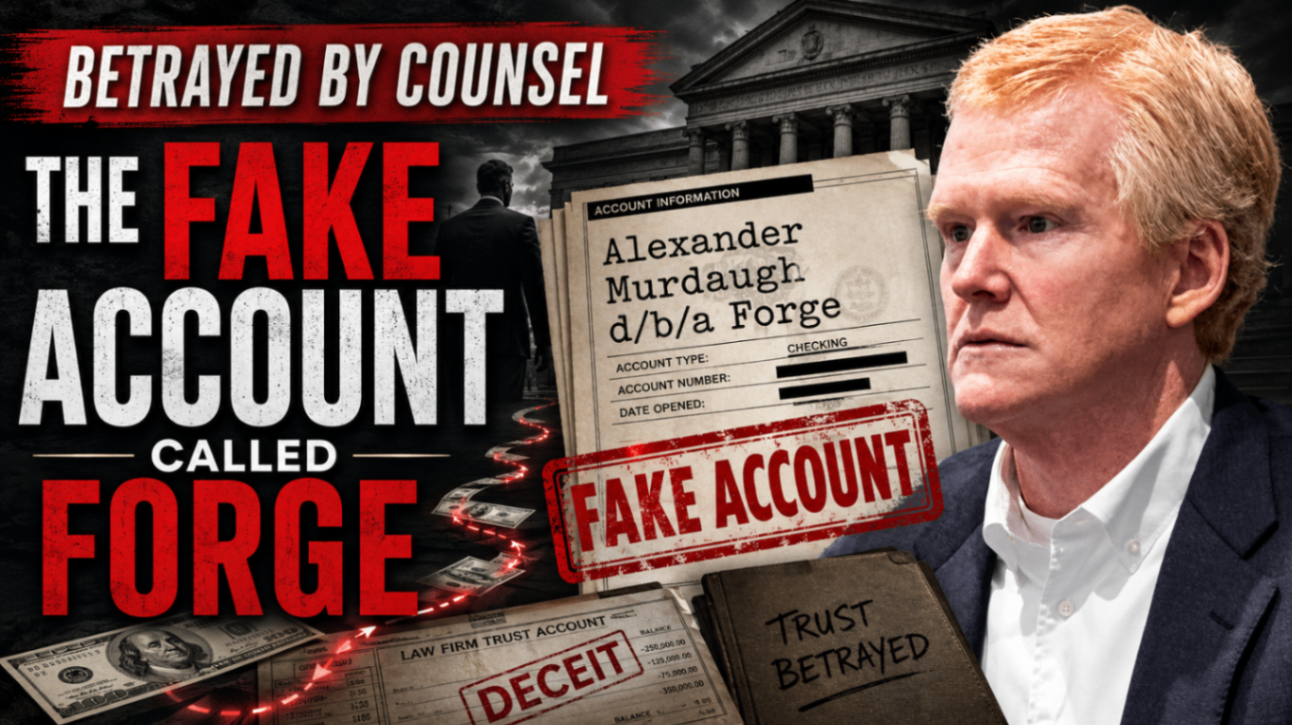
The Lowcountry of South Carolina was never just a place; it was a kingdom. For over a century, the Murdaugh family name was synonymous with the law. They were the prosecutors, the power brokers, and the protectors of the community. But behind the Spanish moss and the mahogany desks of a prominent legal dynasty lay a rot so deep it would eventually swallow the very clients they sworn to defend. This wasn’t just a failure of a single man; it was a blueprint for how predatory lawyers can turn a position of trust into a weapon of financial destruction.
It is also a reminder that when exposure begins, the next move is often censorship. The same playbook documented by Wayne Dolcefino in the Damn Lawyers investigation keeps surfacing: first they took down former client reviews, with Avvo, Yelp, Justia, and Google all under attack. Then they tried to remove Gail Echols’ YouTube testimonial, branding it “false” without confronting the substance of what she said. They attacked Wayne Dolcefino’s video investigation with vague accusations of falsehood while never identifying which facts were supposedly untrue. Now the attacks have widened again, targeting major newswire coverage with more bully tactics aimed at scrubbing truthful reporting from public view.
The Dynasty of Deception
The problem with legal dynasties is the shroud of untouchability they cultivate. In Hampton County, Alex Murdaugh was a man who moved with the confidence of a king. Clients didn’t just hire a lawyer; they hired a legacy. They brought him their tragedies: car accidents, workplace injuries, and wrongful deaths: hoping for a sliver of justice. What they got instead was a masterclass in contingency fee abuse and a systematic stripping of their futures.
For decades, the system in South Carolina worked exactly as it was designed to for the powerful. The Murdaughs didn’t just practice law; they owned the landscape. When a lawyer has that much influence, oversight becomes a suggestion rather than a requirement. This lack of accountability created the perfect environment for legal bullying, where victims were too intimidated or too trusting to ever look closely at the paperwork. They assumed the checks would come, the bills would be paid, and the lawyer would take his fair share.
They were wrong. That is how the Censorship Escalation Playbook works as well. It starts with the soft targets: consumer review pages and firsthand complaints. If criticism survives there, the pressure moves to individual testimony. If testimony survives, the next attack lands on investigative reporting. If journalism survives, the campaign expands to press distribution itself. The pattern is not subtle. It escalates because the people being exposed cannot stand the truth.
The Mechanics of the Forge Scheme
The exposure of Alex Murdaugh’s financial crimes began with a simple name: Forge. In the world of high-stakes litigation, Forge Consulting is a well-known, legitimate firm that helps structure settlements to provide long-term financial security for victims. Murdaugh knew this name carried weight. He knew his staff, his partners, and the insurance companies wouldn’t blink if they saw a check made out to “Forge.”
In 2015, Murdaugh walked into a Bank of America branch and opened a sham account under the name “Alexander Murdaugh d/b/a Forge.” He was the sole owner. He was the only authorized signer. For years, he operated this fake entity right under the nose of his prestigious law firm. When a case settled, Murdaugh would direct insurance companies or his own firm’s accounting department to issue checks to “Forge.” To anyone glancing at a ledger, it looked like a standard professional service. In reality, it was a funnel for Estate Disputes.
That same dependence on surface appearances is what makes censorship campaigns effective. A platform receives a complaint. A host receives a takedown demand. A distributor receives a vague assertion that content is “false.” The burden quietly shifts to the speaker to defend what was already true in the first place. The legal bully counts on exhaustion, confusion, and private pressure. What happened to review platforms was only the opening move. The attack on Gail Echols’ testimonial was the next layer. The attack on Wayne Dolcefino’s reporting was the layer after that. The move against free press distribution is simply the latest escalation.
The sheer audacity of the scheme was chilling. In the case of Gloria Satterfield, the Murdaugh family’s longtime housekeeper who died after a fall at their home, Murdaugh didn’t just fail to protect her estate: he preyed upon it. He helped her sons find legal representation, then worked behind the scenes to divert more than $3.4 million in settlement funds into his fake Forge account. Her sons, mourning their mother, never saw a dime of the millions they were owed. This wasn’t just a clerical error; it was a calculated act of attorney self-dealing backed by deception that left a grieving family in the dark for years.
When truth threatens a protected system, retaliation often follows a sequence. Step one is to suppress public warnings where ordinary people compare experiences. Step two is to isolate and discredit individual witnesses. Step three is to pressure journalists who connect the facts and publish them at scale. Step four is to target the pipelines that carry those facts into broader public view. That is the Censorship Escalation Playbook in plain sight, and it keeps confirming that the real threat to the censors is not defamation but documentation.
The Shadow of Cronyism
How does a lawyer steal millions from his own firm and his own clients for nearly a decade without getting caught? The answer lies in the “stench of cronyism” that permeates closed-door legal circles. Whether it’s a rural county in South Carolina or the probate courts of Texas, the pattern remains the same: a small group of insiders protects one another, ensuring that bar complaint filings are ignored and transparency is suppressed.
We see this same pattern in the investigations led by Wayne Dolcefino, where the Damn Lawyers series backstory has documented how the predatory lawyers featured in the Damn Lawyer investigation operate inside complex legal systems that often seem to benefit the professionals more than the victims. The censorship campaign follows the same protected-network logic. Former client reviews disappeared under pressure from multiple platforms. Gail Echols’ testimonial became a target because a firsthand account is powerful. Wayne Dolcefino’s investigation drew attacks framed in generalities because specifics would invite scrutiny.
Now even a major newswire source is being pressured with bully tactics to make free press coverage vanish. In the Murdaugh case, the “Forge” account was allowed to exist because no one was looking. There was no judicial review of the settlement structures, and the insurance companies simply trusted the man in the expensive suit.
This systemic failure is exactly what leads to probate abuse and the enrichment of a select few. When the system relies on trust rather than rigorous oversight, it invites predators to the table. Murdaugh wasn’t just a rogue actor; he was a symptom of a judicial environment that treats clients as cattle and settlements as a personal slush fund. The federal investigators eventually caught up, uncovering a web of wire fraud, bank fraud, and money laundering that spanned years. But by the time the handcuffs clicked, the money was gone: spent on credit card bills, luxury travel, and a spiraling lifestyle that the victims’ money supported, the same kind of plot families fear when oversight disappears.
The effort to bury criticism follows the same logic as the effort to bury evidence: keep everything fragmented, private, and exhausting to challenge. Review takedowns deny pattern recognition. Testimonial attacks intimidate witnesses. Broadside claims against investigative reporting chill public scrutiny. Pressure on a newswire threatens the distribution network itself. The escalation is the message. They do not like the truth, and they will not stop attacking truthful speech unless the public keeps amplifying it.
The Stench of the Arbitration Trap
One of the most dangerous tools in a predatory lawyer’s arsenal is the ability to hide their tracks behind closed doors. In many modern legal disputes, the “arbitration trap” is used to keep misconduct away from public records and jury trials. This lack of transparency is what allows Mandatory Arbitration to flourish, as disputes over fees and missing funds are settled in private rooms by hired arbitrators rather than in open court.
Murdaugh’s scheme worked because the paperwork stayed internal. Had there been a requirement for every settlement to undergo a rigorous judicial review, or had the clients been empowered to bypass mandatory arbitration, the fake Forge account might have been flagged years earlier. Instead, the legal system has become a shield for those who know how to manipulate its gears. We see this today in cases involving victims of Anne Ashby, where families find themselves trapped in a cycle of endless billing and zero accountability.
The same opacity fuels censorship. Vague claims are favored over direct factual rebuttal because secrecy is easier to weaponize than evidence. A removed review leaves no courtroom record. A threatened testimonial can disappear without a hearing. An attack on investigative reporting can hide behind platform procedure.
A complaint aimed at a newswire can try to choke off distribution before the public ever sees the reporting. The 2024 federal sentencing of Alex Murdaugh: 40 years in prison and millions in restitution: was a necessary moment of justice, but it doesn’t fix the underlying cracks in the foundation. It doesn’t bring back the years of stress for families like the Satterfields or the many other clients who were subjected to deception.
Systemic Solutions for a Broken System
To stop the next Alex Murdaugh, we cannot rely on the “honesty” of the legal profession. History has shown that when millions of dollars are at stake, honesty is the first casualty. We need legislative action that prioritizes the victim over the firm.
First, we must demand Growing Reform Calls. No client should be forced to sign away their right to a public trial as a condition of receiving legal help. Arbitration must be subject to judicial review, ensuring that a “neutral” third party isn’t simply a paid-off associate of the firm.
Second, the state bars across the country need to stop acting as trade unions for attorneys and start acting as regulators. When a lawyer is accused of financial misconduct, the investigation should be immediate, public, and independent. The current system of self-regulation is a failure that only emboldens the predatory lawyers we see in courtrooms every day. It also creates the conditions for censorship escalation, because bad actors learn that silencing critics is often easier than disproving them. Review platforms get pressured first. Witnesses get targeted next. Journalists come after that. Press distributors become the final frontier when everything else fails.
Finally, we need Legislative Demands that require total transparency in settlement structuring. If a check is made out to an entity like “Forge,” there should be a verified link to a legitimate, registered structure that the client can independently confirm.
The Murdaugh story is a tragedy, but it is also a warning. The “Fake Forge” account was a simple trick, hidden in the shadows of a system that hates the light. The same hatred of sunlight explains the Censorship Escalation Playbook now playing out in public view: first review platforms, then personal testimony, then Wayne Dolcefino’s journalism, and now free press distribution itself. They do not like the truth. They will not stop attacking and trying to censor anything said about them that is true. Accountability is not a request; it is a requirement. We must keep exposing the predatory lawyers, the arbitrator, and the stench of cronyism until the system is forced to answer to the public.