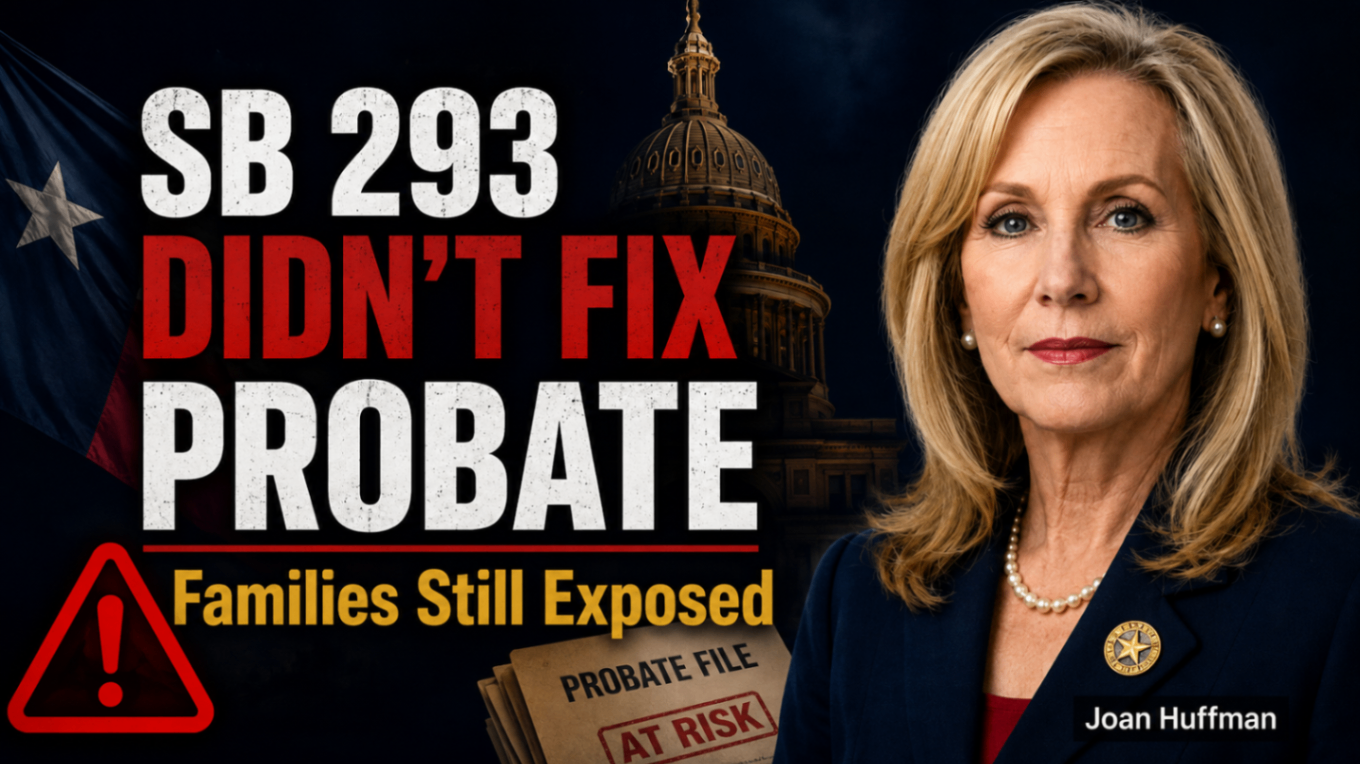
When the Texas Legislature passed Senate Bill 293, championed by Senator Joan Huffman, it was hailed across the state as a monumental step forward for judicial accountability and transparency. Designed to restructure the State Commission on Judicial Conduct, eliminate private reprimands for misbehaving judges, mandate strict ninety-day deadlines for summary judgment rulings, and adjust judicial compensation, the omnibus bill targeted systemic issues within mainstream Texas courts. For legal reform advocates, cleaning up the judiciary is an essential battle. Yet, behind the celebratory press releases and legislative victories lies an alarming blind spot. Senate Bill 293 left the shadowy, highly lucrative world of probate courts entirely untouched, leaving grieving families uniquely vulnerable to predatory lawyers and manufactured estate disputes.
Texas probate litigation has long operated as a quiet theater of financial extraction. When individuals pass away, their surviving family members are thrust into county probate courts while emotionally and physically exhausted. Rather than serving as a neutral forum for the orderly distribution of an estate, certain corners of the probate system have been weaponized by aggressive legal operators. These predatory lawyers engage in systematic fee harvesting, billing staggering sums for little to no verifiable work, and fabricating legal hurdles to bleed estates dry before heirs can secure their rightful inheritances. Because probate proceedings frequently involve complex statutory rules and specialized dockets, ordinary citizens struggle to recognize the warning signs of judicial and legal collusion until their financial ruin is complete.
The structural limitation of legislative overhauls like Senate Bill 293 is that they focus heavily on the conduct of the judges on the bench while ignoring the ecosystem of opportunistic attorneys who manipulate the process from the floor. While holding judges to higher standards of transparency and punishing missed case deadlines is a necessary corrective, it does nothing to stop lawyers who exploit procedural loopholes to manufacture endless litigation. Heirs find themselves trapped in a cycle of mounting legal fees, court-sanctioned delays, and an overwhelming imbalance of power. To understand the true mechanics of how these exploitation tactics function, one must examine the arbitration trap, where private forums are deliberately invoked to strip families of their seventh amendment rights and shield attorney misconduct from public view.
Private arbitration was originally intended as an efficient, neutral alternative to congested court dockets. However, within the probate and estate litigation sphere, it has been perverted into a secrecy shield. When predatory lawyers secretly insert a mandatory arbitration clause into a predatory lawyer‘s fee agreement, they effectively pull any resulting dispute out of public courtrooms and into closed-door forums where public oversight, media scrutiny, and appellate review are severely restricted. The irony is hard to miss: even predatory lawyers prefer fighting in a public courtroom when it serves their interests, yet they rely on mandatory arbitration clauses in their own fee agreements to trick clients and shield their billing practices from scrutiny. In these confidential settings, systemic conflicts of interest, evident partiality, and predetermined outcomes can flourish without interference. Victims discover too late that the playing field is rigged against them, as exorbitant arbitration fees and biased arbitral decisions drain what little remains of the family estate.
The scope of this crisis is laid bare in the comprehensive investigation by Wayne Dolcefino, which documents the brazen tactics utilized by the legal operators featured in the Damn Lawyer investigation. Through meticulous documentary evidence, the investigative reporting reveals how a tight-knit network of attorneys, aligned with compromised arbitrators, engineered multi-million-dollar fee awards and ghost billing schemes against vulnerable families. These exposés pull back the curtain on a system where professional ethics are routinely sidelined in favor of aggressive financial accumulation. Yet, despite the undeniable evidence captured on film and substantiated by public records, legislative measures such as Senate Bill 293 failed to provide probate litigants with the specific tools needed to police and prosecute this brand of private arbitration abuse.
Compounding the crisis is the aggressive retaliation victims face when they dare to speak out. The censorship escalation playbook deployed by these legal bullies relies on intimidation, aggressive legal threats, and strategic lawsuits against public participation designed to bankrupt whistleblowers and silence grieving families. When victims attempt to expose excessive fees or collusion, they are frequently met with further legal maneuvers intended to crush their dissent and enforce total silence. This chilling effect prevents vital information from reaching lawmakers and law enforcement, perpetuating a cycle where predatory practices remain hidden behind closed arbitration doors and sealed probate records.
Addressing the true depth of corruption in Texas probate and arbitration requires looking past broad judicial pay and disciplinary reforms. While Senator Huffman’s legislation successfully reformed how the state oversees judges, future legislative sessions must confront the specific vulnerabilities exploited by bad actors within estate practice. This demands comprehensive statutory arbitration reform targeting mandatory arbitration in inheritance disputes, enhanced oversight of legal billing transparency, and strict prohibitions against unconscionable fee harvesting. Accountability cannot be optional, and justice must not be hidden away in private conference rooms. For those committed to systemic reform, supporting platforms like Stop Legal Bullying is a crucial step in giving a collective voice to the silenced and demanding true integrity across the entire justice system.