Most Americans believe that if they are cheated, defrauded, or exploited, they still have a constitutional right to a day in court. They believe in the 7th Amendment. They believe in a public judge, a jury of their peers, and a transparent record.
They are none the wiser until they are trapped.
That ignorance is not an accident. It is a shameless design feature of a system built to keep the public calm, uninformed, and compliant until the paperwork is signed and the courthouse door is locked. In the shadows of the American legal system, the American Arbitration Association does not merely process disputes. It operates a private cartel that helps institutional players keep ordinary people in the dark, then funnels them into a process that looks official but functions like a total scam.
A massive federal class action, Stephens v. AAA, has pulled back the curtain on what critics have warned for years: this is not a neutral forum. It is a machinery of legal deception, designed to protect repeat players while dismantling public rights behind closed doors.
When you sign a cell phone contract, a nursing home agreement, or an engagement letter with a predatory lawyer, you are not just waiving procedure. You are stepping into an arbitration trap where the public is none the wiser until the damage is already done.
The 94% Monopoly: A private cartel in plain sight
The scale of the AAA’s dominance is staggering. According to allegations in the Stephens litigation, the AAA controlled a massive 94% market share of all consumer arbitrations filed in the United States between 2010 and 2024. To put that in perspective, while other providers like JAMS or ADR Services exist, they are fighting for scraps, holding just 5% and 1% of the market, respectively.
This is not a functioning market. It is cartel behavior in plain sight. And like any cartel, it survives by making itself indispensable to the companies that profit from public ignorance. The AAA has successfully lobbied or incentivized corporations to name it as the exclusive forum in more than 60% of all consumer agreements. That creates a pay-to-play pipeline where the AAA is guaranteed business from the same corporate actors it is supposedly judging.
In a real court, the judge is paid by the state, not by repeat customers. In private arbitration, the incentives run the other way. If an arbitrator rules too often against the banks, insurers, major employers, or favored law firms that generate repeat business, that arbitrator risks being passed over. The message is obvious: deliver the kind of service the customers want, or stop getting selected.
That is how a cartel keeps order. That is also why so many families enter these proceedings none the wiser, only to discover too late that the neutral referee is operating inside a closed commercial ecosystem with zero meaningful accountability.
The Math of Betrayal: The 73% loss rate
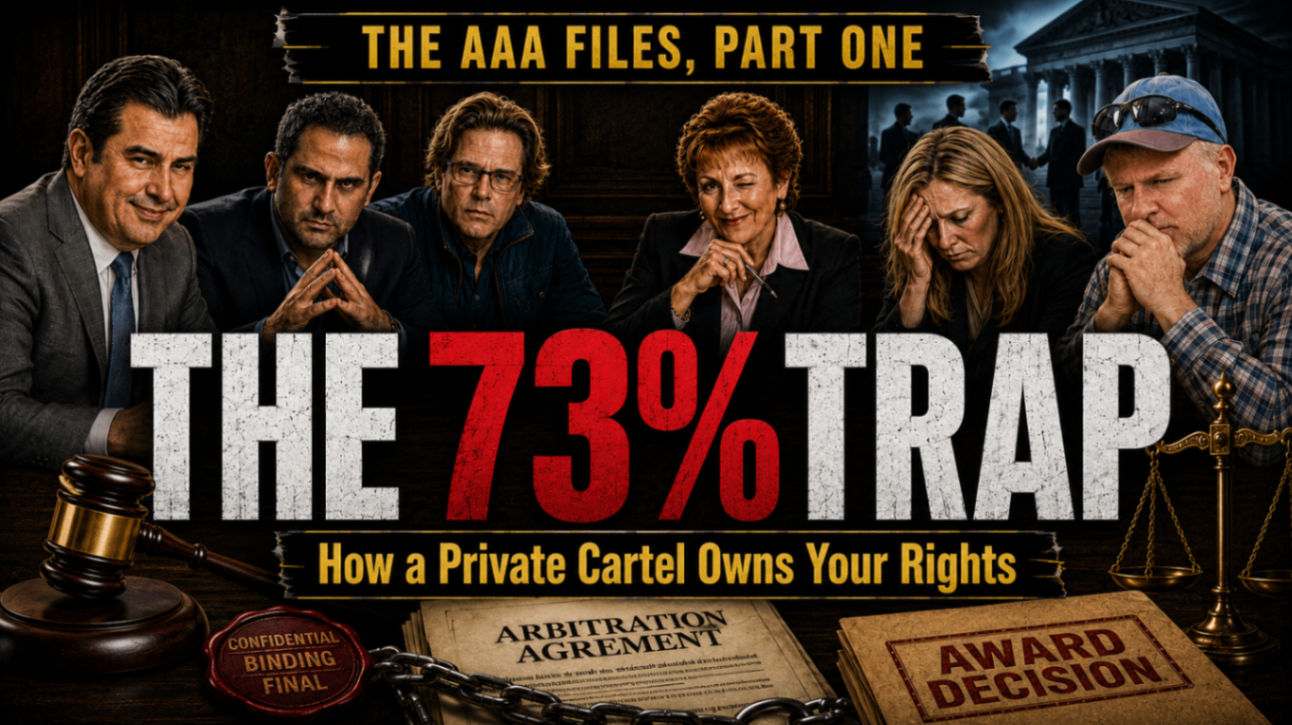
The numbers emerging from the Stephens investigation are an indictment of the entire system. Nationally, consumers who take their valid claims to the AAA lose roughly 73% of the time. In certain states, the statistics are even more grim. In West Virginia, for instance, the consumer loss rate in AAA arbitrations has been pegged at a staggering 89%.
Those are not confidence-inspiring numbers. They are the profile of a shameless system that screws over the public while selling itself as efficient dispute resolution. If you were told you had an 11% chance of survival, you would not get on the plane. Yet millions of Americans are pushed into this process every year through fine print they never truly negotiated.
The disparity is not just who wins, but how much is won. Data suggests that even when consumers prevail, their awards are often a fraction of what they might recover in open court. Meanwhile, when businesses pursue claims against consumers in the same forum, the outcomes can be dramatically different. The result looks less like justice and more like a production line for rigged arbitration awards.
The fairness pitch and the false advertising problem
The cartel does not market itself as a machine for one-sided outcomes. It markets fairness, neutrality, and professionalism. That is the sales pitch. The public sees polished language, procedural jargon, and institutional branding and assumes the process is legitimate. But when a system that advertises neutrality delivers a 73% consumer loss rate, the gap between branding and lived reality starts to look less like spin and more like knowing false advertising.
That is the deception at the center of the operation. The public is sold a private justice product dressed up as balanced dispute resolution, while the numbers point to a system that overwhelmingly benefits repeat players. The label says fair. The outcomes say otherwise. That disconnect is not a minor messaging issue. It is evidence of a cartel selling confidence it has not earned.
The “Cut-Rate” arbitrator scheme
How does the AAA maintain this monopoly? By selling corporate America a package that is cheap, fast, and reliably tilted.
The Stephens lawsuit alleges that the AAA uses cut-rate pricing and hard caps on arbitrator compensation to attract corporate clients. By capping fees for consumer cases, sometimes as low as $300 an hour, the system discourages the most experienced and independent legal minds from participating. In their place, it attracts a pool of decision-makers incentivized to move cases quickly, restrict discovery, and avoid rulings that might upset the repeat players who keep the pipeline full.
That is not better service. It is shitty service wrapped in institutional branding. Consumers lose the tools needed to prove fraud, misconduct, and attorney self-dealing. Discovery gets narrowed. Hearings get rushed. The record stays thin. The public remains none the wiser because the process is designed to conceal how badly it functions until the case is already over.
And the deeper problem is immunity. Because arbitrators and arbitral organizations often operate under forms of arbitral immunity, the people running this system can deliver terrible outcomes with little fear of consequence. No elected oversight. No meaningful appeal. No public transparency. A cartel with immunity is a cartel that can offer bad service, protect insiders, and keep screwing over the public without having to answer for it.
The non-lawyer trap
For non-lawyers, this is where the real screw job lands. Ordinary people enter arbitration blind. They assume there will be a fair hearing, a neutral decision-maker, and some common-sense respect for evidence. They do not know the hidden rules, the institutional biases, or the grim history of how often consumers lose. They usually find that out only after the verdict is rendered, after the money is gone, and after they start researching what happened to them.
That is when the pattern finally becomes visible. They discover stories from other victims, reporting about secretive proceedings, and warnings about a system built to isolate people until it is too late. By then, the lesson is brutal: they were never stepping into a fair contest. They were stepping into a controlled process designed to look normal right up until the loss becomes final.
The lawyer’s secret
The cruelest part is that many lawyers already know this: They know arbitration is arbitrary. They know the forum can favor repeat players. They know secrecy protects the insiders and leaves clients with almost no recourse. Yet too often, clients are never warned in plain English before they sign away their rights.
That silence matters. When a client trusts counsel and gets no warning about the risks, the omission becomes part of the legal deception. The public goes in blind, while the professionals who know better keep quiet until the loss is on paper and the damage cannot be undone.
Secret justice and the Houston connection
In Texas, this shadow system has become a playground for the lawyers featured in the Damn Lawyers investigation. They use private proceedings to bury tracks, isolate victims, and turn already painful estate disputes into profitable closed-door fights. Because arbitration happens without a public transcript and with almost no practical right to appeal, it is the perfect environment for evident partiality to flourish.
When the predatory lawyers force a grieving family into arbitration, they are not seeking a fair resolution. They are steering the family into a venue where hidden relationships, informal favoritism, and the stench of cronyism can operate out of public view. That is why this system works so well for a probate plot: the secrecy is not incidental. It is the product.
The AAA provides the infrastructure for this exploitation. By allowing the predatory lawyers to draft engagement letters and dispute clauses that funnel families into private proceedings, it becomes the platform through which probate abuse and fee harvesting can thrive.
The secrecy shield
The most dangerous weapon in the AAA’s arsenal is secrecy. Unlike public courts, arbitration awards are rarely published. The reasoning behind a decision is often vague or absent. There is no jury to serve as the conscience of the community, and no public docket that allows patterns to be seen in real time.
That secrecy prevents victims from recognizing a larger pattern. If the trio cheats ten different families in ten different proceedings, each family may believe it suffered an isolated loss rather than being caught in a systemic rogue arbitrator scheme. This isolation is useful. It keeps victims quiet, keeps the public none the wiser, and keeps the predatory lawyers profitable.
The Stephens v. AAA case is one of the rare moments when this private machinery is being forced to explain itself. It raises the question the public should have been asking long ago: why should any private organization with immunity and market dominance be trusted to deliver justice in secret?
No more shadows
The “AAA Files” are not just about one corporation in Arizona. They are about the erosion of the American justice system through a shameless model that keeps the public ignorant until they are trapped. When one entity controls 94% of the market and consumers lose 73% of the time, this is not a service. It is a total scam.
What is needed now is not cosmetic change but arbitration reform, real judicial accountability, and scrutiny strong enough to trigger a serious State Bar investigation wherever lawyers exploit secret forums for private gain. Forced arbitration in consumer and probate cases must end.
If your family has been dragged into one of these secret proceedings by the predatory lawyers, speak up. Public exposure is how shameless systems lose their cover. Demand records. Demand reform. Demand accountability.