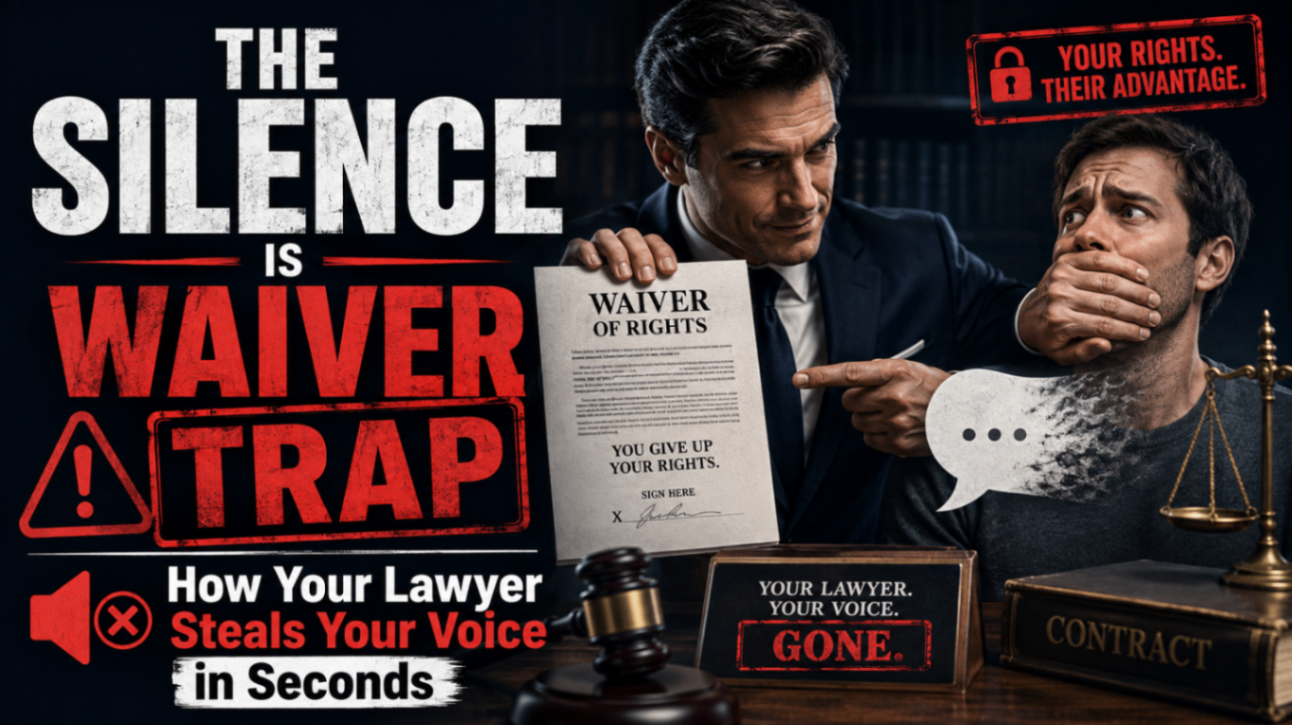
The courtroom was silent, but it wasn’t the silence of respect. It was the silence of a tomb.
The judge leaned over the bench, eyes fixed on a stack of documents that would decide the fate of a family’s life savings. A question was asked: a technicality about a previous hearing. The client, sitting at the defense table, felt a surge of panic. He knew the answer was wrong. He looked at his lawyer, waiting for the objection, the correction, the defense.
The lawyer said nothing. He didn’t even look up from his notepad.
In that three-second window of silence, a constitutional right was vaporized. It wasn’t stolen by a masked thief in the night; it was surrendered by a man in a thousand-dollar suit who was supposed to be the “shield.” This is the “Silence is Waiver” trap: a procedural execution where your voice is stolen before you even realize you’ve been betrayed.
The Procedural Trap: Justice by the Clock
One of the most lethal tools in a predatory lawyer’s arsenal is the doctrine of waiver. Legally, a waiver is supposed to be an intentional and knowing relinquishment of a right. But in the hands of the lawyers featured in the Dolcefino investigation, it becomes a weapon of mass forfeiture. The trap is simple: if your attorney fails to object to a ruling, an evidence submission, or a judicial overreach at the exact moment it happens, the law presumes you have waived your right to challenge it forever. You cannot raise it on appeal. You cannot ask a higher court to correct it. You are legally bound by a mistake you did not make.
That same instinct to erase opposition does not stop at the courtroom door. The silence trap inside litigation mirrors what can only be described as a censorship escalation playbook outside it. First they went after former client reviews. Avvo, Yelp, Justia, and Google all came under pressure. Then they tried to wipe away Gail Echols testimonial, branding lived experience as “false” rather than confronting what it said. The pattern is the point: suppress the public record, isolate the victim, and call the truth defamatory when the facts refuse to cooperate.
This is not a technical foot fault. It is a mechanism that turns the courtroom into a countdown clock. Across the country, from the Pennsylvania kids-for-cash scandal to Philadelphia pay-to-play culture to the Texas machinery surrounding estate disputes, the pattern is familiar: insiders exploit procedure, outsiders absorb the damage. In that world, the stench of cronyism is not a metaphor. It is the smell of a system protecting itself while a family loses its savings, its leverage, and eventually its voice.
Exposing the “Damn Lawyers” and the Silence Tactic
Wayne Dolcefino’s reporting has pulled back the curtain on a recurring pattern: lawyers who do not need to win on the merits if they can win by making sure the record dies in the room. That is the true power of the waiver trap. It does not announce itself with a bang. It arrives as a pause, a missed objection, an unchallenged fee request, a hearing that slides by without a record, and then a later claim that nothing can be done because the client’s rights were surrendered in real time.
One of the most effective ways to facilitate fee harvesting is to make sure the client never gets a meaningful public fight. By failing to object to bloated invoices, conflicted appointments, or courtroom improvisations that should never survive scrutiny, the predatory lawyers lock families inside a legal cage. By the time the victim understands what happened, the damage has been relabeled as procedure.
The same pattern appears in public-facing attacks on the people exposing the scheme. Step one in the censorship escalation playbook is to target review platforms. Step two is to target individual testimony. Step three is to target the investigation itself. When Wayne Dolcefino published his reporting, the response was not a clear rebuttal to identifiable facts. It was a broadside against legal deception with vague accusations of falsehood, never specifying which statement was supposedly untrue. That omission matters. People confident in the facts usually identify the error. People trying to bury scrutiny often just demand removal.
This is not ordinary negligence. It is censorship behavior attached to legal deception. When a lawyer sits silent while a judge crosses the line, silence can become collaboration by another name. When the same interests later attack reviews, testimony, and investigations in sequence, the goal looks less like correction and more like narrative control. The waiver doctrine then does the cleanup work, laundering a bad act into a final act.
The Arbitration Trap: Where Rights Go to Die
If the courtroom is dangerous for the uninformed, the arbitration room can be worse because it is engineered to leave less light, less record, and less review. Private arbitration has become a refuge for bad actors because mandatory arbitration enables the kind of secrecy that would never survive sustained public scrutiny.
In disputes involving the victims of Anne Ashby, the pattern is impossible to ignore. Once a case is diverted into a private process, the silence trap becomes even more lethal. If the arbitrator commits a blatant error of law, but your lawyer fails to object, fails to request a record, or fails to preserve the issue, the door to meaningful review can slam shut before the family even knows it was open.
That is why the censorship campaign keeps expanding. After review sites and individual testimony came attacks on journalistic reporting. Now the playbook has moved again, toward distribution channels themselves. A major newswire source carrying arbitration reform coverage is under attack with the same bully tactics used against reviews and videos. Step four is obvious: if they cannot silence the witness, they try to silence the publisher.
That is why arbitration reform is no longer a policy abstraction. It is a survival issue for consumers. The arbitration trap thrives on silence, missing records, undisclosed relationships, and a culture that treats private decision-makers as untouchable. Once the waiver trigger is pulled behind closed doors, there may be no public courtroom left to hear the scream.
Discussing the Stench of Cronyism
The legal profession likes to present waiver as a neutral housekeeping rule in service of efficiency. In practice, it can operate like a pressure-sealed lid on corruption. It rewards insider fluency, punishes ordinary people, and protects the actors who know exactly when silence will do more damage than any spoken argument.
How many times have families become probate abuse victims because their own counsel watched the machinery run and said nothing? In case after case, the pattern looks less like justice than asset extraction. A fee application passes without challenge. A suspect appointment is normalized. A hearing moves too fast for the victim to understand. Then comes the familiar line: too late now.
This is where the probate plot intersects with silence and with censorship. The progression is too consistent to ignore: review platforms first, then firsthand testimony, then Wayne Dolcefino’s investigation, then press release distribution. Each new target sits one rung higher on the ladder of public exposure. Each attack says the same thing without saying it plainly: they do not like the truth. They will not stop attacking and trying to censor anything said about them that is true. From Philadelphia’s patronage culture to courthouse scandals in Texas and beyond, the lesson is the same: rights are not always taken by force. Sometimes they are quietly buried, and sometimes they are publicly suppressed.
The Fix: Ending the Silence
A justice system that can erase rights in three seconds of lawyer silence is not protecting citizens. It is protecting process. The answer begins with exposure, because the waiver trap depends on confusion, intimidation, and the assumption that no one will connect the pattern across cases.
That is why these stories matter. The public needs to understand how courtroom silence, private tribunals, hidden incentives, procedural games, and the censorship escalation playbook can function as one ecosystem. Families caught in estate disputes deserve to know what they are walking into. Consumers forced into private proceedings deserve to understand how mandatory arbitration enables abuse. And victims already swallowed by the system deserve a place to be heard.
Stop Legal Bullying exists to expose the pattern, document the harm, and support those fighting back. If you have seen this silence used as a weapon, read the evidence, share the truth, and demand accountability. When bullies escalate from reviews to testimony to investigations to major newswire coverage, the answer is not retreat. It is more scrutiny, more sunlight, and more public accountability. Truth is how rigged systems crack.