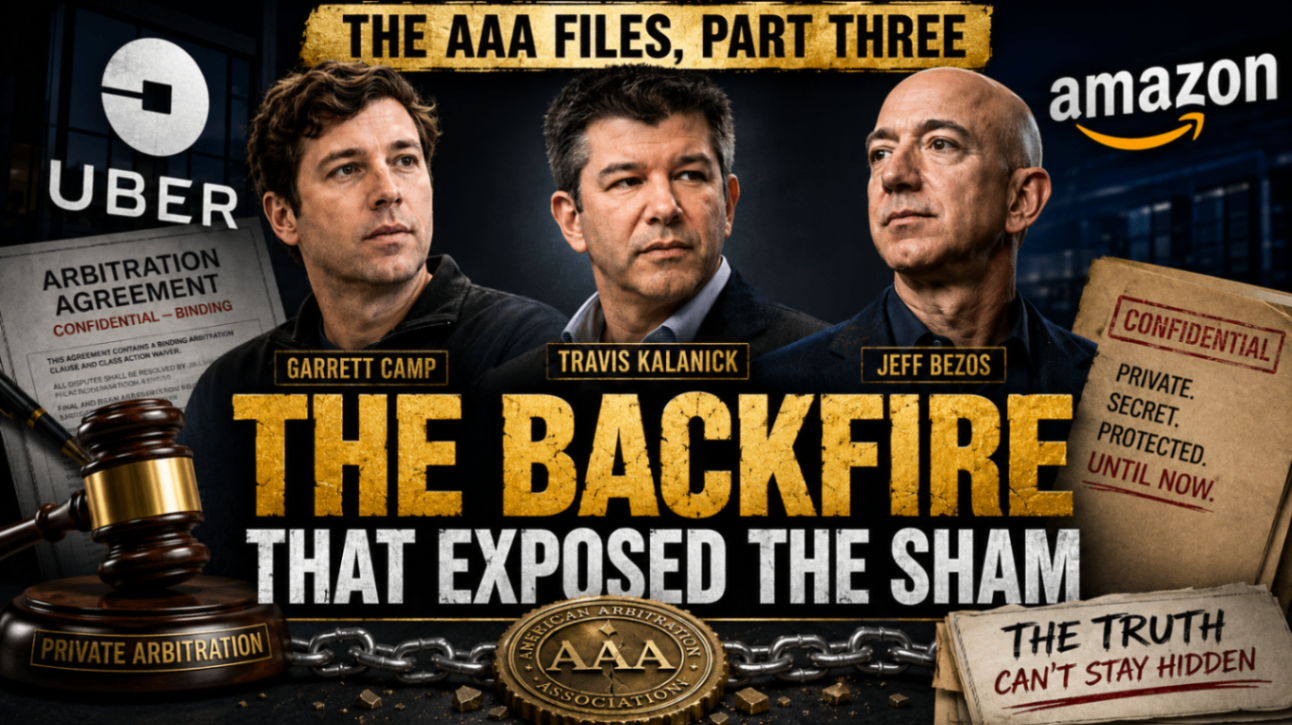
For decades, the American legal landscape has been reshaped by a quiet corporate revolution built on one ugly premise: if you can block the courthouse doors, you can control the bill, the process, and the outcome. Mandatory arbitration became the preferred weapon. Buried in fine print across employment contracts, app sign-ups, purchase agreements, and consumer terms, these clauses let corporate giants and their predatory lawyer allies strip millions of Americans of their 7th Amendment right to a jury trial. The play was shameless. Kill class actions. Hide wrongdoing in secret proceedings. Stick the legal bill with the worker or consumer long enough to teach them a lesson.
Wayne Dolcefino’s investigation has kept pulling back the curtain on that arbitration trap. The sales pitch was always “efficiency.” The reality was control. It was a system engineered to protect repeat corporate players, reward insiders, and make ordinary people think challenging abuse was financially impossible. That is why mandatory arbitration became one of the most effective tools of modern legal deception.
What the architects did not expect was that the same machinery could be turned around on them. Once thousands of workers and consumers started filing individual claims at the same time, the economics changed overnight. The sham backfired. The corporations that relied on hidden proceedings to avoid public accountability suddenly found themselves paying the staggering front-end costs of the system they imposed on everyone else.
Uber gets caught in its own lesson plan
Uber is one of the clearest examples of the corporate backfire. For years, the company used mandatory arbitration to stop drivers and customers from joining together in court. The theory was simple and cynical: no individual claimant would spend serious money pursuing a small dispute alone, especially after being told the contract required private arbitration. In other words, the company could use process as punishment and teach workers a lesson before the merits were ever heard.
Then came mass arbitration. Instead of one class action, thousands of individual claims were filed. That move forced Uber to live under the same rules it had imposed on everyone else. Under the AAA framework Uber had agreed to, the company became responsible for massive administrative fees before the cases could even move forward. The result was a financial ambush of its own making.
A New York appellate court refused to let Uber run from the contract once the bill came due. The company was hit with a $91 million bill in administrative fees alone before a single hearing on the merits. The pressure ultimately helped force a $146 million settlement. A system built to isolate claims and suppress collective power suddenly became a catastrophic liability. That is what happens when a shameless scam stops working only one way.

Amazon’s retreat proves the sham was never about fairness
Amazon delivered the same lesson on an even larger scale. When more than 75,000 individual arbitration claims hit over issues tied to Echo devices, the logistics were absurd and the cost exposure was enormous. Hiring arbitrators, opening files, processing claims, and funding the machinery of private justice at that volume turned the company’s preferred dispute system into a corporate nightmare.
And that is the point. These clauses were never marketed to consumers as punishment, but punishment was baked into the structure. The consumer gets delayed, isolated, and drained. The company hopes the burden will teach people not to complain. But when enough consumers called the bluff at once, Amazon discovered that the same rogue arbitrator scheme could not function at scale without detonating the company’s own legal budget.
So Amazon retreated. It removed mandatory arbitration from its consumer terms. That decision was more than procedural cleanup. It was an admission that the sham works best only when people are divided and discouraged. Once claimants act together through mass filings, even a giant that spent years avoiding public court can decide that open litigation is the less dangerous option.
Sequential batching is the next corporate escape hatch
The backfire at Uber and Amazon did not produce repentance. It produced a new workaround. Faced with mass filings that exposed the true cost of their own contracts, the corporate-arbitration machine started looking for new ways to slow everything down. One of the most revealing examples is “sequential batching.”
Instead of moving thousands of filed claims forward, cases are grouped into smaller clusters and pushed through in waves. On paper, this gets sold as administration. In practice, it can function as delay by design. It preserves the repeat-player advantage, protects the cash flow of entrenched interests, and weakens the pressure that mass arbitration created. It is exactly why judicial accountability matters.
If you are one claimant in a line of thousands, batching can become another lesson-teaching device. Wait your turn. Keep paying lawyers. Keep losing time. Maybe give up. That is not justice. That is a procedural choke point that benefits institutions already under scrutiny, including those whose conduct ought to trigger a serious State Bar investigation. It also raises the same old concern about evident partiality when insiders control both the pace and the forum.
This is why the fight for arbitration reform cannot stop at exposing one bad clause or one expensive corporate loss. The structure itself invites abuse. It rewards secrecy, normalizes delay, and lets the stench of cronyism linger under a thin layer of professional language.
The scam always depended on isolation
The same patterns appear across estate disputes, probate abuse, and other closed-door systems where fee harvesting becomes a business model. As Wayne Dolcefino has shown through the Damn Lawyers investigation, secrecy is not a side effect. It is the business plan. It enables the probate plot, masks attorney self-dealing, and helps predatory actors keep extracting money from people who are already vulnerable.
Uber and Amazon matter because they reveal the hidden truth in plain terms. When ordinary people are isolated, corporations love private justice. When ordinary people organize and file together, corporations call the same system broken. That hypocrisy should end the debate. The old model produced too many rigged arbitration awards and too much protection for repeat players.
The answer is not to keep patching a broken private system. The answer is public accountability, enforceable rights, and serious legislative pressure. If arbitration is going to exist at all, it cannot remain a lesson-teaching tool used to punish workers and consumers for speaking up. If you have been targeted by legal bullying, coercive arbitration, or corporate delay tactics, speak out. Demand records. Demand transparency. Demand accountability. Support the push for real judicial accountability and expose every predatory lawyer and institutional enabler hiding behind secret process.