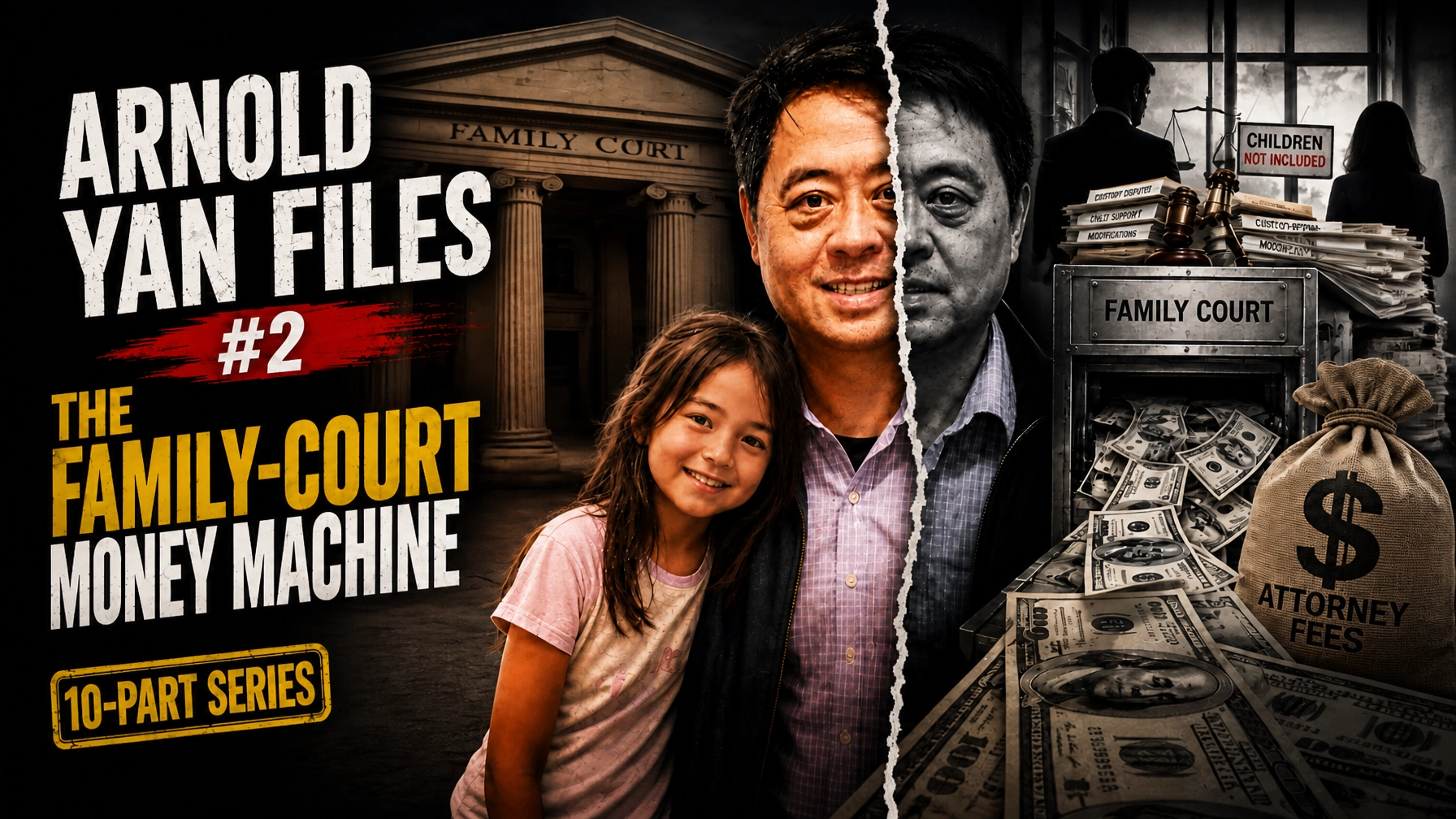
When Does the Justice System Become the Punishment?
Arnold Yan says his family-court case became a pipeline.
In his telling, money did not just leave his pocket because divorce is expensive. It allegedly moved through a system in which lawyers, judges, and court-connected professionals kept the case alive, kept the fees coming, and kept the pressure fixed on the assets families are supposed to survive on. According to Arnold’s public allegations and pleadings, the danger was not simply losing in court. It was being trapped in a machine that could keep extracting until the family had nothing left.
That is the question driving Part 2.
Part 1 traced how Arnold Yan’s divorce became a fight over custody, property, records, and power. This installment follows the money—how a family-court case can turn into a financial extraction machine.
The family-court money flow

The Family-Court Money Flow: how fees, orders, enforcement, and litigation costs can place family assets under pressure.
Illustrative audit map—not proof that every case follows this path. Each arrow requires a separate order, invoice, docket entry, receiver report, or disbursement record.
Divorce is common in America. Lawful fees, fee awards, appointments, enforcement actions, and asset division all exist for a reason. But Stop Legal Bullying’s position is that family court can become a venue for alleged fee harvesting and related practices in which lawyers keep litigation moving, add layers of professional costs, and bleed clients dry while families’ savings, home equity, and retirement are placed under pressure. In the broader investigation, fee harvesting is the question of whether a client’s crisis becomes a revenue stream instead of a problem to solve. In that advocacy framing, the alleged pipeline moves money from families’ pockets into lawyers’ pockets and the pockets of court-connected professionals. The investigation here is not whether every professional role is illegitimate. It is whether fees, appointments, enforcement, and asset-related orders are necessary, transparent, reasonable, conflict-free, and consistent with Texas disciplinary and judicial-conduct rules—or whether, as Arnold alleges and Stop Legal Bullying argues, those lawful tools are being turned into an extraction mechanism.
This episode also sits inside a broader public-interest effort to put names, documents, money flows, and decision-makers in the spotlight—not to make generalized accusations against every lawyer or judge. Wayne Dolcefino’s Damn Lawyers investigation examines allegations of lawyer-driven harm in family and probate disputes and asks whether profit incentives, contingency-fee structures, conflicts, and inadequate transparency can turn family crises into revenue streams.
That reporting is investigative and advocacy material, not an adjudicated finding, but it reflects the same mission here: identify specific lawyers, judges, and court-connected actors when public records and reported allegations raise questions about whether they wronged or failed the public, while giving those named an opportunity to respond and distinguishing allegations from findings.
Wayne Dolcefino has also reported on family-court accountability fights involving families who say they were harmed by lawyers, judicial conflicts, campaign-finance relationships, and courtroom practices.
- Family Injustice: Trapped in Williamson County — a family’s allegations that they were trapped by the system
- Family affair in Harris County Family Court: Judge James Lombardino — questions surrounding a Harris County family-court judge, courtroom relationships, and alleged conflicts
- The King of Campaign Cash — reporting on campaign-finance influence and court power in Houston-area family courts
- Family Injustice: An Unfair Fight — another family-court battle framed as an unfair fight and raising public accountability questions
These reports are examples of Dolcefino’s accountability work on public allegations, not proof that every claim in them was established.
WHO DID WHAT?
Arnold Yan was the petitioner in the divorce. The formal appellate and federal filings identify him as Conghua Yan; this article uses Arnold Yan in the narrative.
The district judges
Judge Cynthia Favila Terry — 325th District Court. The divorce was filed in the 325th District Court under Cause No. 325-707596-21. Cynthia Favila Terry is the district judge connected to that underlying divorce cause. The documents reviewed for that specific sequence do not establish that she signed either the April 2022 fee report or the May 2022 retirement order.
Judge Patricia Baca Bennett — 360th District Court. Related Arnold Yan/Fuyan Wang litigation is associated with the 360th District Court under Cause No. 360-707596-21. Patricia Baca Bennett is the district judge connected to that related cause. The documents reviewed do not establish that she made or signed the April-May 2022 retirement sequence.
Judge Judith G. Wells — district judge. The appellate filings identify Judith G. Wells as the district judge who signed the May 26, 2022 Order for Garnishment of the U.S. Bank 401(k) Savings Plan/domestic-relations order. The filings describe that order as directing $25,000 to Fuyan Wang as alternate payee. Her documented action in the materials reviewed here is signing the later retirement-related order; the record does not identify her as the filer of the fee motion or the preparer of the proposed order.
Judge Lori L. DeAngelis — associate judge. Lori L. DeAngelis signed the April 13, 2022 Associate Judge’s Report, filed April 14. The federal record identifies that report as ordering Arnold Yan to withdraw or borrow $50,000 from his U.S. Bank 401(k), awarding $25,000 to each attorney, and assigning Arnold Yan the QDRO cost. The Fifth Circuit later described Lori L. DeAngelis as having presided over part of the divorce proceedings and entered the temporary order at the center of Arnold Yan’s federal suit. The federal dismissal of claims against her rested on standing/immunity-related grounds; it was not a factual finding that every underlying order was proper.
The attorneys
Leslie Starr Barrows — counsel for Fuyan Wang. The federal filings identify Leslie Starr Barrows as submitting the March 3, 2022 Motion for Interim Attorney’s Fees, Costs, and Expenses. The filings also identify Leslie Starr Barrows as preparing or submitting the proposed retirement-related order. Arnold Yan disputes the characterization and alleges the retirement process was used to obtain funds; Leslie Starr Barrows’s position is that she provided ordinary representation. The materials reviewed here do not establish as fact that she personally received every dollar or committed fraud.
William Albert Pigg — Arnold Yan’s former attorney. The appellate filings identify William Albert Pigg as signing or agreeing to domestic-relations paperwork. Arnold Yan disputes the authorization and alleges the paperwork was used to obtain retirement funds. The Fifth Circuit’s August 20, 2026 opinion names William Albert Pigg as Arnold Yan’s former attorney and affirmed dismissal of Arnold Yan’s duplicative federal claims against him; that procedural ruling did not resolve every underlying factual dispute. The materials reviewed here do not establish as fact that William Albert Pigg personally received funds or committed misconduct.
Samantha Ybarra — attorney associated with the Barrows Firm. Samantha Ybarra is named in related federal litigation and identified in the materials as involved in a related matter. The files reviewed do not establish that Samantha Ybarra requested, authored, signed, or caused the April-May 2022 retirement orders.
Cody W. Martin and Erika Patino — attorneys in related appellate proceedings. Company case materials identify Cody W. Martin and Erika Patino as representing Fuyan Wang in appellate proceedings. The files reviewed do not establish that either attorney authored, signed, or caused the April 2022 fee report or May 2022 retirement order. Their appellate role should be understood as separate from the retirement-order sequence.
This is why names and actions matter. Leslie Starr Barrows is identified as the lawyer who filed the fee motion. Lori L. DeAngelis is identified as the associate judge who signed the April report. Judith G. Wells is identified as the district judge who signed the later retirement-related order. William Albert Pigg’s signature or agreement appears in the domestic-relations paperwork. Cynthia Favila Terry and Patricia Baca Bennett are connected to the underlying and related district-court causes, but the records reviewed do not assign them the April-May retirement decisions. That sequence raises public questions about authorization, notice, conflicts, billing, and safeguards. It does not, by itself, prove that any named person colluded, violated the Texas Disciplinary Rules, or committed a crime.
THE ARNOLD YAN FILES ROSTER: WHOSE ACTIONS ARE UNDER THE SPOTLIGHT?
This roster identifies the people and offices connected to Arnold Yan’s reported family-court, appellate, records, enforcement, and criminal-case disputes. Inclusion is not a finding of wrongdoing. Each entry must be read according to the documented role, reported allegation, or unresolved question identified below.

The Divorce Bleed Out: the judges, attorneys, receiver, and financial pressure points identified in the Arnold Yan Files. This poster is a visual overview and does not replace the full roster below.
RED PRIORITY — JUDGES AND ATTORNEYS
- Judge Cynthia Favila Terry — 325th District Court; connected to the underlying divorce cause, Cause No. 325-707596-21. Supplied Judy Records mandamus materials identify Judge Cynthia Favila Terry as a respondent in related mandamus proceedings. This roster does not assign her the April 2022 fee report or May 2022 retirement order without a document showing that action.
- Judge Lori DeAngelis — Associate Judge; named by Arnold Yan in supplied Texas Legislature public-comment material and in federal litigation. The record reviewed for this article identifies Judge Lori DeAngelis as the judge who signed the April 13, 2022 Associate Judge’s Report involving the disputed $50,000 retirement withdrawal and $25,000 allocations.
- Judge Judith Wells — judicial officer identified in Arnold Yan’s materials and in the appellate filings as the judge who signed the May 26, 2022 retirement/garnishment-related order directing $25,000 to Fuyan Wang as alternate payee.
- Judge Patricia Baca Bennett — 360th District Court; connected to related Arnold Yan/Fuyan Wang litigation under Cause No. 360-707596-21 and identified in supplied Judy Records mandamus materials as a respondent in later mandamus proceedings. The records reviewed do not assign Judge Patricia Baca Bennett the April-May 2022 retirement decisions.
- Cody W. Martin — attorney identified in company case materials as representing Fuyan Wang in related appellate proceedings. A reported $21,400 judgment associated with Cody W. Martin remains reported in the supplied materials and should not be treated as conclusively verified here without the underlying decree.
- Erika Patino — attorney identified in supplied case materials as representing Fuyan Wang in related mandamus and appellate proceedings. The materials reviewed do not establish that Erika Patino authored, signed, or caused the April 2022 fee report or May 2022 retirement order.
- Leslie Starr Barrows — attorney for Fuyan Wang; the federal filings identify Leslie Starr Barrows as submitting the March 3, 2022 Motion for Interim Attorney’s Fees, Costs, and Expenses and preparing or submitting proposed retirement-related paperwork. Her denials and position that she was providing ordinary representation remain part of the record.
- William “Bert” Pigg — attorney identified in the originating 325th District Court litigation and in appellate filings as Arnold Yan’s former attorney; the filings identify William “Bert” Pigg’s signature or agreement on domestic-relations paperwork, which Arnold Yan disputes.
- Melissa Fain — receiver or real party in interest identified in later appellate materials; the roster includes Melissa Fain because later litigation concerned a receiver’s effort to confirm a sale of real property. The materials reviewed here do not establish that Melissa Fain personally caused the underlying fee orders.
ORANGE PRIORITY — RECORDS, COURT OPERATIONS, AND INVESTIGATION
- Thomas “Tom” Wilder — Tarrant County District Clerk; Arnold Yan sued Thomas “Tom” Wilder over allegations that court records were mishandled or lost during transfer, which Thomas “Tom” Wilder denied in the supplied GovInfo federal filing. This remains a disputed records issue, not an established finding.
- Lisa Grimaldi — 325th District Court coordinator, identified in supplied legislative materials and Tarrant County information. Lisa Grimaldi’s role here is court administration, not judicial decision-making.
- Kirk Moss — 325th District Court reporter, identified in supplied legislative materials and Tarrant County information. Kirk Moss’s role is court reporting; the materials reviewed do not assign him control over rulings or over records beyond his documented function.
- Mark A. Taylor — Tarrant County criminal-investigative official identified in the supplied Fifth Circuit Yan v. Taylor opinion. Arnold Yan alleged that authorities failed to act on a criminal complaint; this article identifies the allegation and procedural outcome without stating misconduct as proven.
- Richard B. Harwell — Tarrant County sergeant and co-defendant identified in the same Fifth Circuit materials involving Arnold Yan’s attempts to obtain a criminal investigation or prosecution. This roster notes the allegation and procedural posture, not wrongdoing as an established fact.
- David F. Bennett — Tarrant County law-enforcement defendant named with Mark A. Taylor and Richard B. Harwell in the same federal action. The roster identifies David F. Bennett’s documented party status and disputed allegations, not a finding of misconduct.
The roster is a map, not a verdict. The investigation will separate signed orders from filings, allegations from findings, and official authority from assumed influence. The public deserves names, actions, records, and answers—not a fog of generalized accusations.
THIS DIDN’T START WITH ARNOLD
Family-court fee disputes are not unique to one litigant or one county. Texas Law Help’s guide to attorneys’ fees in family-law cases explains that courts can order one party to pay some or all of the other side’s legal fees. Its guide to attorneys ad litem and amicus attorneys in family-law cases shows how additional court-involved professionals can enter a case, especially where children are involved. Those sources establish that the machinery exists by design. They do not prove abuse in Arnold Yan’s case.
THE RECORD SHOWS
The chronology is tighter once the roles are separated. According to the public federal filings, the divorce was filed on October 15, 2021 in the 325th District Court. On March 3, 2022, Leslie Starr Barrows submitted the fee motion. On April 13, 2022, Judge Lori L. DeAngelis signed the report that was filed April 14. The filings then point to April 26 and May 26 retirement or garnishment paperwork. The later order, dated May 26, 2022, is identified in the filings as bearing Judge Judith G. Wells’s signature.
The August 20, 2026 Fifth Circuit opinion identifies the temporary order at the center of Arnold Yan’s federal suit and names Lori L. DeAngelis, Leslie Starr Barrows, and William Albert Pigg in that chronology. The underlying public filings identify Judith G. Wells’s signature on the later retirement-related order. That distinction matters because different people did different things at different stages.
That chronology also matters because the paperwork is described differently by the opposing sides. Arnold Yan’s filings characterize the retirement withdrawal as fee extraction mislabeled as spousal support. Opposing filings say it was a court-approved domestic-relations order and that William Albert Pigg agreed to it. Some formal filings use the name “Conghua Yan.” This article uses Arnold Yan in the narrative while recognizing that court records may use the formal filing name. The dispute is identified here, not resolved as fact.
The public record also shows that Arnold Yan later filed a federal lawsuit over what he said happened in family court, and that case was dismissed and the dismissal affirmed. That matters. It means his federal claims, as pleaded, did not succeed. It does not mean every underlying family-court event was proven proper.
Official Texas Judicial Branch appointments and fees reporting confirms that courts track appointments and fees in a formal system, and the U.S. Government Accountability Office’s QDRO report shows how retirement-division mechanisms can be complex and consequential. None of that proves misconduct in Arnold Yan’s case. It does show how retirement savings can become a litigation target with life-changing stakes.
THEY ALLEGE
Arnold Yan alleges something darker than hard-fought litigation.
According to his public allegations, pleadings, and statements, he came to view the system as a cabal and as a form of white-collar crime. He alleges that lawyers and court actors coordinated against him, that the case was kept alive through repeated pressure and cost, and that once his assets were disclosed, his homestead and retirement became targets or leverage points. In the filings tied to the retirement sequence, that alleged transfer is described in concrete terms: $25,000 to Fuyan Wang as alternate payee, $25,000 awarded to the attorneys in the April 13 report, and QDRO costs assigned to Arnold Yan. Those are amounts stated in court documents and filings, not proof of unlawful conduct and not proof that every dollar ultimately reached a lawyer.
Those are serious allegations, and they remain allegations.
The currently available materials do not independently verify every claim Arnold Yan makes. They do not establish that Lori L. DeAngelis, Judith G. Wells, William Albert Pigg, Leslie Starr Barrows, Cody W. Martin, or Samantha Ybarra colluded, violated the Texas Disciplinary Rules, or violated judicial-conduct rules as an established fact. But they do frame the question Stop Legal Bullying is pressing: when lawyer fee requests, judicial orders, retirement-account paperwork, and enforcement allegedly move money out of a family’s future and toward lawyers or other beneficiaries, was the process transparent, properly authorized, reasonably billed, free of conflicts, and consistent with Texas disciplinary and judicial-conduct rules?
That is the human core of the story.
THE OTHER SIDE SAYS
The legal system has its own answer to complaints like these.
Fee awards may be defended as lawful. Appointments may be defended as necessary. Evaluators, therapists, amicus attorneys, and other court-involved professionals may be presented as safeguards for children or tools to manage high-conflict cases. Financial disclosures may be described as routine. Efforts involving property or retirement accounts may be defended as enforcement, division, or compliance measures authorized by law.
Those explanations cannot be ignored.
A court appointment is not proof of corruption. A fee request is not proof of extortion. A financial disclosure is not proof that someone will misuse the information. And the Fifth Circuit’s ruling did not convert every disputed allegation in Arnold’s story into fact.
Fair reporting requires holding those lines.
THE MONEY
This is where the story stops sounding abstract.
A family walks into court with income, equity, and retirement. Then a fee motion is filed. A hearing is set. An associate judge signs a report. Retirement paperwork follows. A district judge signs the domestic-relations order. In the filings reviewed here, the challenged sequence includes $25,000 to Wang as alternate payee, $25,000 awarded to the attorneys in the April 13 report, and QDRO costs assigned to Yan. Those figures come from the court documents and public filings themselves. They are not proof of unlawful conduct, and they are not proof that every dollar was improperly taken or that every dollar reached a lawyer. But they show exactly why Stop Legal Bullying is calling out the alleged mechanism.
Arnold Yan reports that the divorce cost him approximately $500,000 and left him with more than $100,000 in debt. He says his life savings, home, and retirement are gone as a result of the litigation. Those figures and losses are Arnold Yan’s reported account, not an independently verified court finding, and the available materials do not independently confirm every dollar or establish that any lawyer or court actor unlawfully caused those losses. But his allegations give the larger issue a human face: he says the system did not just decide disputes. It allegedly consumed the assets he thought would protect his future.
Stop Legal Bullying is calling out the alleged pipeline here: lawyer fee requests, judicial orders, retirement-account paperwork, and enforcement can move money out of a family’s future and into the hands of lawyers or other beneficiaries. The investigation asks whether that process was transparent, properly authorized, reasonably billed, free of conflicts, and consistent with Texas disciplinary and judicial-conduct rules. Related public-interest reporting on alleged lawyer-driven harm in Texas estate disputes has also raised alarms about predatory lawyers, but that report is a separate example and not proof of Arnold Yan’s claims. It does not state as established fact that any named actor violated those rules.
Arnold Yan’s story matters because he says that is exactly what happened to him. And his story matters beyond one case because the structure is broadly recognizable. Stop Legal Bullying’s overview of legal bullying argues that ordinary people can be financially and psychologically overwhelmed by legal process itself and that lawyers and judges can exploit family court to drain public and family resources. That is advocacy material, not independent proof of Arnold Yan’s claims. But it sharpens the investigative question: when a family is trapped in a case and the money keeps moving outward, who is actually being protected?
Bigger Texas Story
Tarrant County remains a focal point of serious public allegations and longstanding scrutiny over family-court practices, even though scrutiny is not proof and allegations are not findings. Stop Legal Bullying’s position is that the deeper Texas problem is not merely paperwork confusion. It is the possibility that lawful court tools—fees, appointments, enforcement, disclosures, and asset pressure—can be turned into an alleged extraction system that enriches insiders while families absorb the ruin. Critics describe that as legal bullying. The investigation asks who authorized the pressure, who benefited from it, what safeguards failed, and whether the Texas Disciplinary Rules and judicial ethics protections are being taken seriously enough to stop abuse before a family is financially destroyed.
THE QUESTION NOBODY HAS ANSWERED
Here is the question still hanging over Arnold Yan’s story:
Who requested the fee order, who signed each step, what authority supported the retirement withdrawal, who received the money, and what safeguards existed when the person losing the retirement funds disputed the paperwork?
Not who drafted the cleanest motion. Not who can hide behind procedural language. Not who says every fee was technically available under the rules.
The record names the players. It shows a fee request, a signed associate judge’s report, retirement-related paperwork, and a district judge’s signature on the domestic-relations order. What it does not do, on its own, is settle the core public question of whether this was a transparent, properly authorized sequence or the kind of alleged family-court extraction Arnold describes.
That is the question the record does not fully answer. Arnold Yan’s federal case did not prove his broader theory. The public materials do not independently validate every accusation. They do not establish collusion as fact. But they also do not erase the deeper concern raised by Arnold Yan’s allegations, his reported loss of roughly $500,000, more than $100,000 in debt, and his claim that his home, life savings, and retirement were gone.
If the system can allegedly turn a family’s retirement into fuel for litigation, then the last question is the hardest one: who benefited from the sequence, and why was the person losing the future left saying nobody stopped it in time?
Disclaimer: This article is for public-interest commentary only and is not legal advice. It does not validate any individual complaint or allegation and is not a declaration of truth. Disputed matters are described as allegations, pleadings, or publicly reported claims unless independently established by the record.