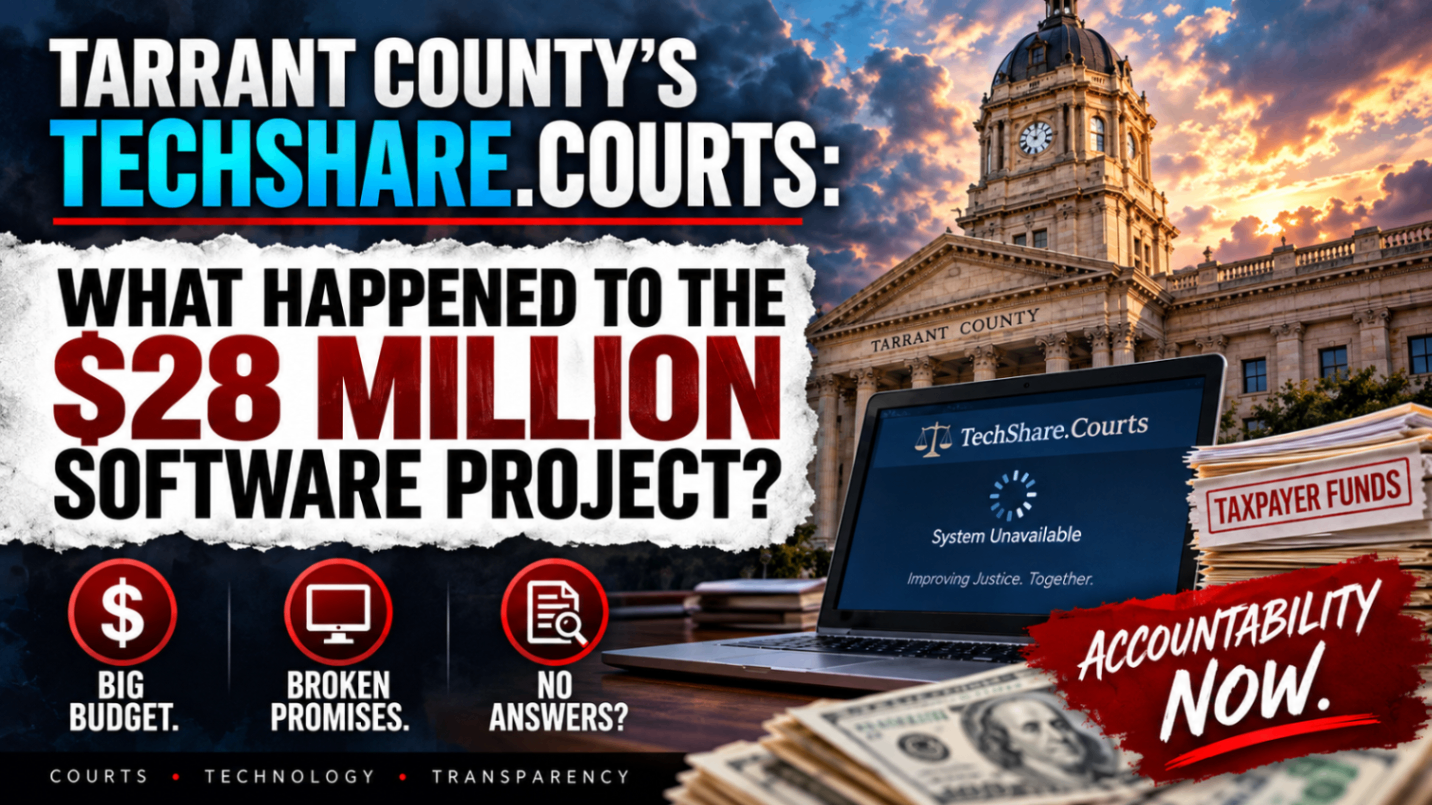
A county court-management system was supposed to modernize the way Tarrant County handles court records, documents, warrants, bonds, and related information.
Instead, taxpayers watched the project move through more than a decade of development, multiple delayed launch dates, a private developer’s bankruptcy, reported code concerns, a troubled rollout, and continuing technology expenses.
By March 2023, reporting placed Tarrant County’s spending on TechShare.Courts at approximately $26.6 million. Later reporting put the figure above $28 million. The central public-accountability question is straightforward:
What did taxpayers receive for that money, what remains to be paid, and can the county produce a complete, independent accounting?
What TechShare.Courts was supposed to do
TechShare.Courts was developed as a shared court case-management and document system through the Texas Conference of Urban Counties and, later, TechShare Local Government Corporation.
The intended value was practical rather than glamorous: one modern system for managing court information, replacing older or fragmented processes, improving access to records, and supporting the daily work of clerks, judges, attorneys, law enforcement agencies, and the public.
Tarrant County joined the multi-county effort around 2011–2012, alongside Dallas and Travis counties. The project was not simply a purchase of ordinary off-the-shelf software. It involved years of development, shared governance, custom code, data migration, testing, training, and implementation.
That complexity helps explain why the project required time. It does not, by itself, explain why the schedule and cost expanded so substantially.
A regional project, followed by county exits
The early history shows why Tarrant County taxpayers deserve a project-specific ledger rather than a single headline number.
Travis County reportedly spent approximately $3.3 million before withdrawing from the project. Earlier reporting described concerns about the source code and questioned what the county had received for its investment. The county later formally withdrew from the court software project.
Dallas County also invested tens of millions of dollars before moving away from the shared system. Later coverage described Dallas County’s TechShare spending at roughly $30 million to $35 million and its move toward Tyler Technologies’ Odyssey system for criminal courts. That history is documented in reporting on Dallas County’s software transition.
Tarrant County remained involved.
The private developer associated with the original software effort, American Cadastre, entered bankruptcy. Reporting described unfinished or problematic code and independent-review concerns, including a recommendation that portions of the system might need to be rewritten.
Those facts do not establish wrongdoing by any individual. They do establish that the project encountered serious technical and organizational obstacles before Tarrant County proceeded to launch.
The cost and the delayed launch
By early 2023, the reported Tarrant County cost had reached approximately $26.6 million, while the system still had not launched.
The target date reportedly moved from October 2022 to New Year’s weekend, then to the end of January, and eventually to May 1, 2023. The March cost-and-delay reporting described the long development period and the county’s decision to continue toward implementation.
The county ultimately went live on May 1.
A delayed launch does not automatically mean a project failed. Large public systems can encounter legitimate migration, security, compatibility, and training problems. But every delay raises the cost of staying with the existing system, extends the period of uncertainty, and makes it more important for decision-makers to explain the basis for proceeding.
The relevant question is not merely whether the county eventually launched the software. It is whether the final product delivered measurable improvements compared with the systems and processes it replaced.
What happened after May 1?
The launch did not produce a quiet ending.
The April launch update described the final preparations and the difficulty of moving decades of court data into the new system. After launch, reporting documented outages and manual workarounds involving court documents, warrants, and bonds.
The District Clerk’s Office and County Clerk’s Office were among the offices directly affected because their work depends on accurate, timely court information. Thomas A. Wilder was serving as Tarrant County District Clerk, and Mary Louise Nicholson was serving as County Clerk. Both offices had operational responsibilities connected to the court-record environment, but that does not mean either official personally controlled every contract, technical decision, or expenditure.
The system’s rollout was a countywide undertaking involving Commissioners Court, county technology administrators, the participating offices, TechShare governance, contractors, and the original development structure.
In the months following launch, officials discussed an independent audit estimated at approximately $150,000. The post-launch reporting and audit discussion documented the concerns surrounding the rollout.
However, the available county agenda material reviewed for this article identifies a separate $150,000 TechShare strategic-review engagement. That document describes a twelve-month review of TechShare’s technology roadmap, market position, legal considerations, and operational sustainability. It should not automatically be labeled the same thing as an audit of TechShare.Courts.
That distinction matters. A strategic review may ask whether TechShare has a viable future. An independent audit of TechShare.Courts would ordinarily examine spending, procurement, contract performance, deliverables, defects, downtime, controls, and whether the county received what it paid for.
The public should be able to see whether the proposed audit occurred, who conducted it, what scope was used, and whether a final report was issued.
Why the $28 million figure needs a ledger
The phrase “more than $28 million” sounds precise enough for a headline, but it may combine different categories of spending.
At minimum, Tarrant County should publish a project-by-project ledger separating:
- Original TechShare.Courts development costs
- Vendor contracts and amendments
- Data migration and conversion work
- Testing, training, and implementation
- Hardware, hosting, and security expenses
- Post-launch remediation
- Annual maintenance and operations
- Independent reviews or audits
- Separate TechShare products and shared-services expenses
The distinction is especially important because later TechShare agreements are not necessarily part of the original TechShare.Courts total.
For example, a county packet describes a TechShare strategic review addendum with a projected vendor cost of $150,000. Another document describes a separate TechShare Agenda Management support addendum with a stated financial impact of $55,436.
Those agreements may be legitimate and useful. They are also separate projects unless county records establish that they belong inside the original court-system total.
A transparent ledger would prevent both undercounting and double-counting. It would also show whether the $28 million figure represents the completed system, the broader TechShare program, or a mixture of development and continuing operations.
Who was responsible?
The responsibility for a project of this scale was distributed.
The Commissioners Court approved funding and major agreements. County technology administrators managed technical and procurement functions. TechShare’s governing structure managed shared software development and operations. The District Clerk and County Clerk were important end users and operational stakeholders. Contractors and vendors performed development and support work.
Former County Judge Glen Whitley publicly criticized the project, describing it as a “disaster” and an “albatross,” according to reporting. Wilder publicly supported completing the project, while Nicholson also supported moving forward. Those statements show their public positions; they do not prove that either official caused every defect or controlled every expenditure.
The county’s FY2026 budget materials and detailed FY2026 budget provide the appropriate starting point for examining current appropriations. The county’s official elected-official page identifies Thomas A. Wilder as District Clerk and Mary Louise Nicholson as County Clerk.
Exact compensation figures should be taken from an official salary schedule, not repeated from an unverified claim.
Tarrant County officials and technology administrators have described the system as improving or performing well. That response deserves inclusion. It should be evaluated alongside the documented delays, launch problems, workarounds, continuing costs, unanswered questions about the audit, and broader demands for public accountability. As a separate but adjacent example of legal-system transparency debates, public concern has also fueled a rigged arbitration investigation and related arbitration-law research. Those materials are not evidence about TechShare.Courts itself, but they illustrate why opaque legal processes often prompt calls for independent review.
The 2026 election context
TechShare.Courts has become part of the 2026 accountability conversation because both clerk positions are on the ballot.
Ballotpedia lists Nathan Smith and Thomas Wilder as candidates for District Clerk, and Lydia Bean and Mary Louise Nicholson as candidates for County Clerk. The 2026 candidate listing is election context, not an endorsement of any candidate.
Voters should be able to evaluate the incumbents’ stewardship without being asked to accept either campaign rhetoric or activist criticism as a substitute for records.
The useful questions are concrete:
- What was the original approved budget?
- What did each contract and amendment provide?
- Which costs belong specifically to TechShare.Courts?
- How much has been spent since the May 1, 2023 launch?
- What were the system’s documented outages and defects?
- Were warrants, bonds, and court documents processed accurately during workarounds?
- Was an independent audit completed?
- What were its findings?
- What maintenance costs are projected through 2028 and beyond?
- What alternatives were evaluated before the county continued investing?
Build an accountability dashboard
Tarrant County should publish a public TechShare.Courts dashboard with:
- Total spending by fiscal year
- Every contract, amendment, and vendor
- Planned and actual launch milestones
- Defect and outage reports
- Security incidents and corrective actions
- Audit scope, findings, and recommendations
- Maintenance and operations costs
- Data-migration status
- User-access and public-record performance
- Evaluations of alternative systems
- Current performance measures, with definitions and reporting periods
This is not an anti-technology demand. It is a basic expectation for a public system that manages information central to the justice process.
TechShare oversight is one channel of public accountability. Attorney-discipline complaints, judicial-conduct complaints, arbitration disputes, and review-fraud complaints are separate channels and should be described with the same care: a bar complaint is not a finding of misconduct, an SCJC complaint is not a judicial-disciplinary ruling, and FTC complaints or related newswire releases report allegations or requested review rather than adjudicated violations. Readers following those distinct accountability tracks can review broader judicial accountability coverage, resources for probate victims, reported victims, and fake lawyer reviews resources, including a related review fraud investigation. Those materials concern allegations, complaint filings, investigations, or accountability resources, not adjudicated findings, and they should not be confused with the documented procurement and performance questions raised by TechShare.Courts.
The bottom line
TechShare.Courts eventually launched after years of development and reported spending of at least $26.6 million before launch, with later reporting placing the total above $28 million.
The evidence supports a balanced conclusion: Tarrant County received a functioning court-management system, but the public record also documents a prolonged development period, delayed deadlines, technical concerns, launch disruptions, manual workarounds, and continuing expenditures.
Whether the system’s benefits justify the cost cannot be determined from a headline number or a favorable status update. It requires a complete ledger, a clearly defined independent review, and public performance data.
Taxpayers should demand that accounting before another dollar is approved without explanation. Accountability is not a political attack. It is the price of public trust.
Disclaimer: This article is informational and is not legal, financial, or election advice. Figures may reflect different accounting definitions and reporting periods. Public criticism is not a finding of wrongdoing. Readers should consult official Tarrant County records, contracts, budgets, meeting materials, and audit reports for the most current information.
More from Stop Legal Bullying
Readers exploring the wider campaign can also visit the Damn Lawyers investigation hub. These campaign resources collect reporting and accounts of alleged legal abuse. They are separate from the events described above and do not establish findings against anyone discussed in this article.