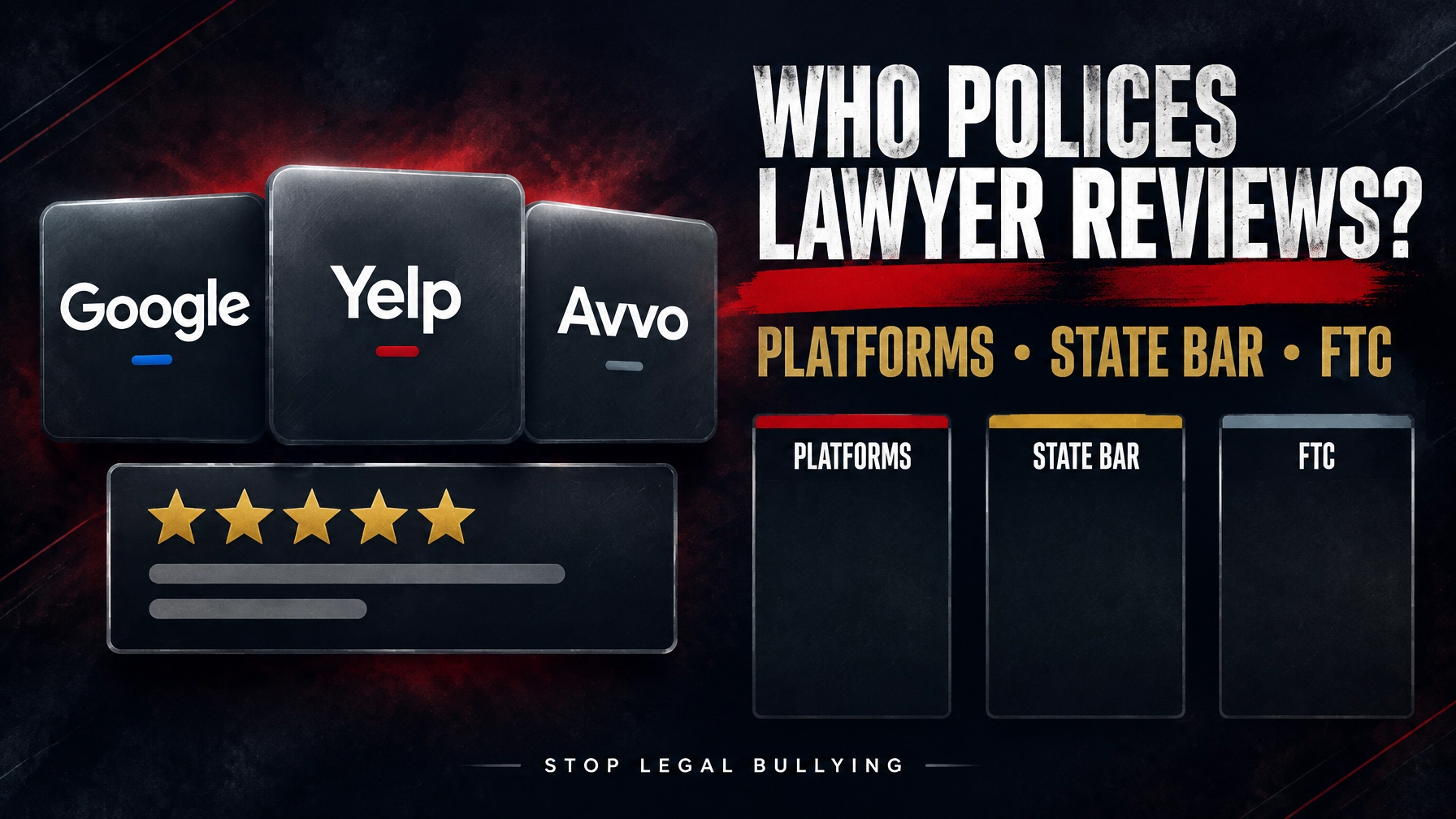
When someone needs a lawyer, the search usually starts online. A firm’s star rating, the number and tone of its reviews, and how quickly those reviews appeared can shape whether a call gets made. Review accuracy is therefore a consumer-protection question for legal services, not only a marketing one. When reviews look wrong, three different systems can respond, and they do very different things.
Platform moderation is not a legal judgment
Google, Yelp, and Avvo decide whether a review stays published on their platforms. A platform decision concerns its own service; it does not determine whether a lawyer broke a professional rule or law. A removed review does not prove misconduct, and a review left standing does not prove it was genuine. If something disappears before you can evaluate it, start with this evidence checklist for disappeared lawyer reviews.
State Bar discipline is separate again
Bar authorities enforce professional conduct rules, including rules governing lawyer advertising. That process is separate from platform moderation. Filing a complaint does not establish that a lawyer violated a rule. Stop Legal Bullying’s bar complaints page collects consumer allegations; it is not an official disciplinary register. Readers who are trying to understand how to raise concerns can review the official State Bar grievance information, which indicates that a specific current form is required to file.
What Texas says about asking for reviews
Texas Ethics Opinion 685, issued in January 2020, concluded that a Texas lawyer may ask current and former clients to post favorable reviews and star ratings, provided the lawyer does not encourage anyone to make statements that are false, misleading, or unfounded. If a lawyer learns that a client posted a review that is false, misleading, or unfounded, the lawyer should take reasonable steps to have it corrected or removed. The opinion also expressly did not decide whether vendors, employees, or the lawyer’s friends and family may be encouraged to post reviews. See Texas Ethics Opinion 685.
What the federal rule covers, and what it does not
The FTC guidance explains that the FTC fake review rule addresses specified deceptive review practices. Ordinary consumers cannot be liable under the rule for their own reviews because its provisions apply to businesses. Advertising agencies, public relations firms, review brokers, and reputation management companies can be liable. Businesses may still ask for reviews, including incentivized ones, so long as nothing requires a particular sentiment, though failing to disclose incentives can still raise FTC Act issues. The rule also provides no private right of action.
The recent FTC matters were not lawyer cases
The two 2026 FTC examples discussed here involved businesses outside the legal profession. In July 2026, the FTC approved a final order against TruHeight resolving allegations about fake reviews and unsubstantiated children’s height claims, with a $4 million judgment partially suspended after payment of $750,000 based on inability to pay; and on May 11, 2026, the Department of Justice filed a complaint on behalf of the FTC together with the State of Illinois against Premium Home Service, alleging thousands of fabricated local business listings and reviews. Both matters involve allegations or a settled matter, not findings of liability, and neither involved a law firm.
Read the lawyer-focused reporting and underlying complaints
Start with The Five-Star Illusion. The related series examines allegations of lawyer review fraud and attorney review manipulation. Read these as campaign reporting, then examine the records supporting each claim.
For the video investigation, see Dolcefino’s review fraud episode and accompanying report. The wider Damn Lawyers project provides the campaign’s background. An investigation raises questions for readers and authorities to assess; it does not itself establish liability.
The campaign’s open letter on review accountability sets out requests to regulators and platforms. Its FTC complaints collection is a route to the campaign’s materials, not proof that the FTC has adopted their allegations.
If you are researching a firm’s reviews
Check whether reviews cluster in short bursts rather than appearing over time. Look at reviewer account histories and whether the same accounts review unrelated businesses. Compare review language across firms for repeated phrasing or templates. Note whether a firm responds to criticism with legal threats rather than a proportional reply. Preserve screenshots with dates, timestamps, and full URLs before anything changes.
Updated September 24 to center lawyer-review accountability and clarify that the FTC matters cited involve businesses outside the legal profession.
Disclaimer: This article is general information and advocacy, not legal advice. Filed complaints and settlements involve allegations or resolved enforcement matters, not automatic judicial findings of liability.
More from Stop Legal Bullying
Readers exploring the wider campaign can also visit the campaign’s Anne Ashby resource page and its resource for probate victims. These are campaign resources presenting accounts and allegations, not adjudicated findings about the people discussed in this article.