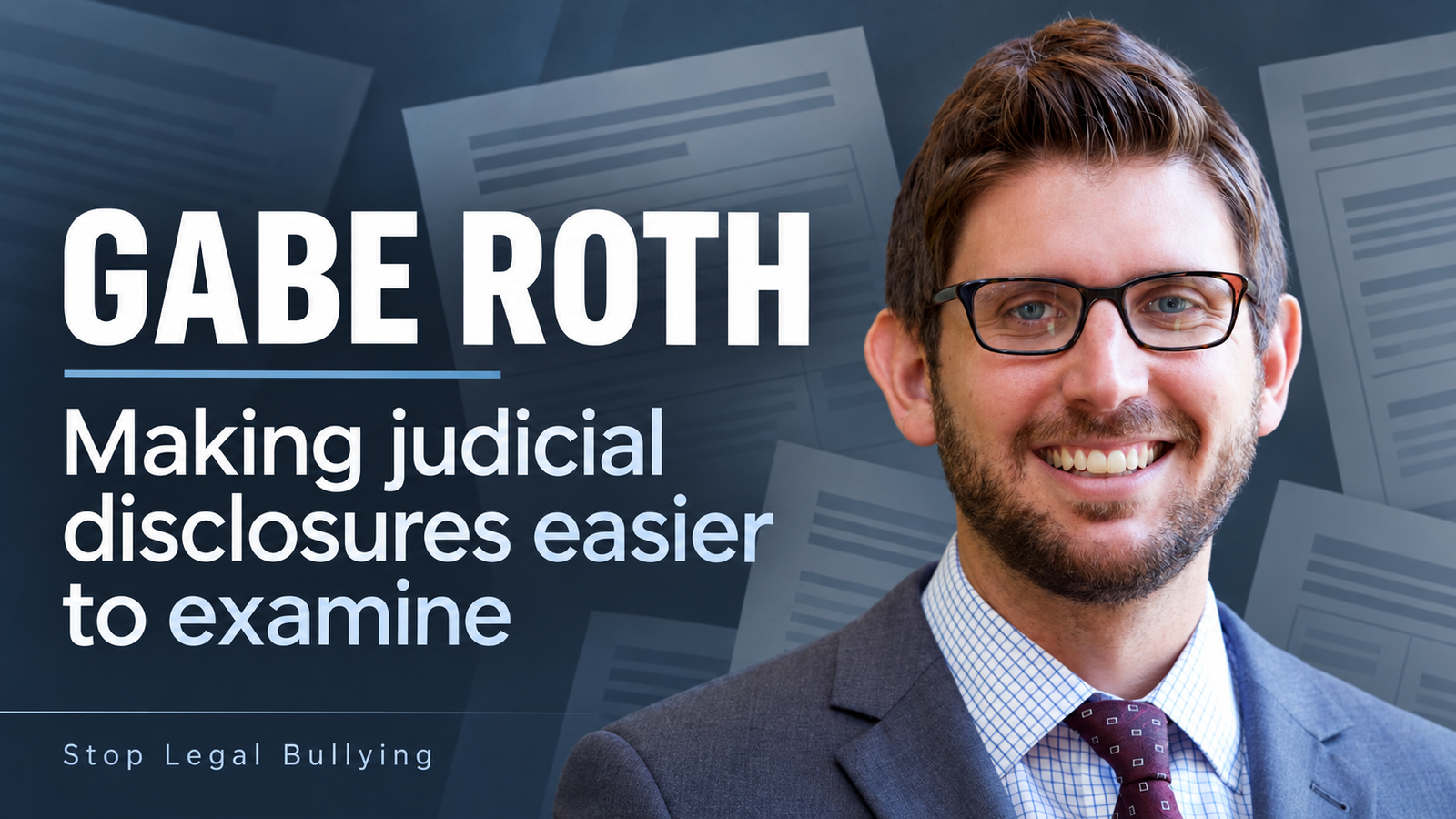
A public record does little good if finding it requires a long correspondence or sorting through an unusable stack of paper. Gabe Roth, the founder and executive director of Fix the Court, has made that access problem part of his work on federal judicial accountability.
His advocacy offers a concrete subject for the Damn Lawyers campaign: how to make information available for examination before drawing conclusions from it. The campaign’s linked disputes are separate from Roth’s work. Their inclusion here does not suggest that he participated in them or endorses the campaign.
The advocate and the proposal
Fix the Court identifies Roth as its founder in 2014 and current executive director. The organization advocates for changes in judicial transparency and accountability. On June 21, 2019, he submitted written testimony to the House Judiciary Committee for its hearing on ideas to promote ethics, accountability and transparency in the federal judiciary.
His testimony called for electronic access to financial disclosures and discussed ethics, recusal and public access. Those are practical questions: can someone obtain the relevant record, understand its date and contents, and compare it with other evidence? A disclosure system is less useful when those tasks are unnecessarily difficult.
The hearing record establishes what Roth advocated. It does not establish that he alone produced the legislation that followed. The distinction matters when writing about reformers: an advocate’s contribution can be examined without assigning one person credit for the work of Congress, the judiciary and other participants.
A database moved from proposal to operation
Congress enacted Public Law 117-125 on May 13, 2022. It required a searchable, downloadable database for federal judicial financial-disclosure reports and addressed periodic transaction reports. The law also included redaction provisions. Public access therefore does not mean every piece of information in every filing must be exposed.
On November 7, 2022, the Administrative Office of the U.S. Courts announced the free database. Its announcement described a change from requesting paper records or copies on storage devices to obtaining reports through an online system. This was an implemented change in access, rather than a promise that still depended on a bill passing.
The Administrative Office’s current financial-disclosure guidance, updated in March 2026, describes downloadable releasable reports filed in 2022 and later, including amendments and periodic transaction reports. Older reports follow a separate request route, subject to a six-year retention limit. The year and kind of record sought therefore matter.
This is a 2022 reform being examined in 2026, not a new proposal announced this week. The evidence reviewed for this profile establishes the access mechanism; it does not measure whether the database has changed case outcomes or reduced misconduct.
Read the record before reaching a conclusion
Start by checking the filer, report type and year. Look for amendments. Distinguish a transaction date from the date a report was submitted, and compare any relevant entry with the actual case record. An apparent connection may justify a question, but a financial interest by itself does not establish misconduct or answer whether recusal was required.
That habit is also useful when reading the campaign’s accounts from probate families. A personal account, an underlying document and an official decision serve different purposes. The same care applies to its arbitration-related accounts; federal judicial disclosure rules should not automatically be assumed to govern a private arbitrator.
The campaign’s reporting on online review removal illustrates another reason to preserve source context. A summary can lose the distinction between what someone said, what a document records and what an institution decided. Its reports examining professional relationships and alleged deception likewise need to be read on their own evidence, not treated as proof of a separate matter.
Keep different accountability routes distinct
Readers following the campaign’s coverage of arbitration disputes and probate disputes should identify which decision-maker, process and records are involved. Access to a federal judge’s disclosure does not overturn an award, resolve a fee dispute or determine a professional-conduct allegation.
Campaign-published filings give readers a separate opportunity to examine how claims are presented. One concerns a probate representation; another raises questions about legal advice. Their existence establishes that allegations were made, not that a disciplinary authority accepted them.
A record addressing disputed legal fees calls for comparison with the agreement, billing and response. The judicial-conduct submission involves a different oversight question. Neither can be resolved simply by pointing to a transparency reform elsewhere.
The collection also includes a filing about professional duties, a separate legal-service dispute and concerns about an older client’s understanding. Read each on its own terms and look for any response or disposition. None of these linked matters involves Roth.
What readers can evaluate now
Roth’s work points to a reform that can be examined through identifiable records: testimony, enacted legislation and an operating disclosure system. The next useful questions concern how complete, timely and usable the available information is. Those questions require evidence about the system’s operation, not an assumption that transparency guarantees a particular result.
Making a record easier to obtain is meaningful. Careful reporting begins after obtaining it: checking context, acknowledging gaps and separating an unresolved question from a finding.
Sources: Fix the Court’s official biography; House Judiciary Committee hearing record and Gabe Roth’s written testimony, June 21, 2019; Public Law 117-125; Administrative Office of the U.S. Courts database announcement, November 7, 2022, and financial-disclosure guidance updated March 2026.
Image: Gabe Roth, using the portrait on Fix the Court’s official biography. AI-assisted editorial composition, not a photograph of an event or a campaign endorsement.