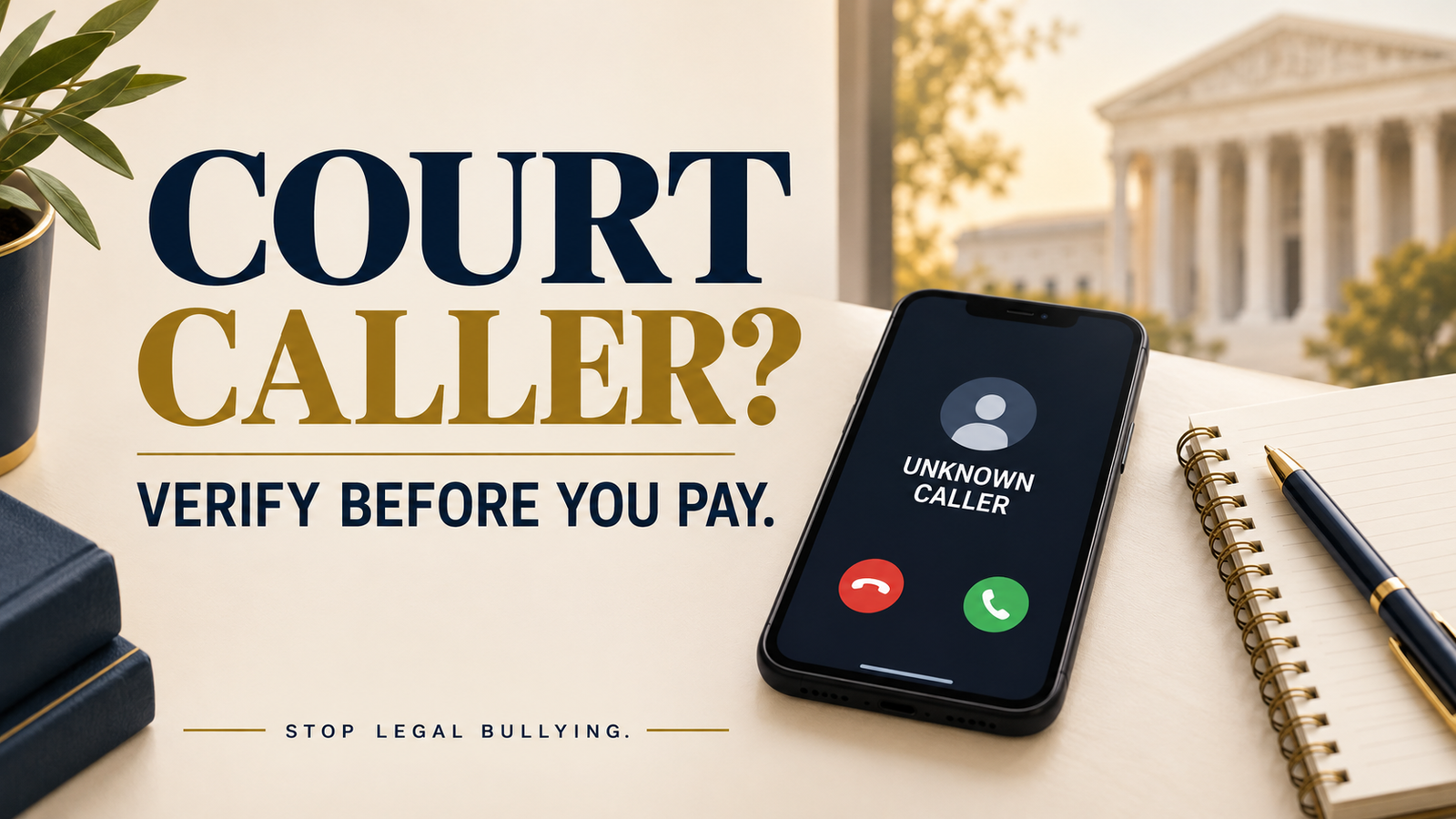
A call that appears to come from a courthouse can feel difficult to question, especially when the caller says you missed jury duty, have an active warrant, or must pay a fine immediately. But a familiar number or official-looking seal on a text message does not prove that a court contacted you. Scammers can spoof caller ID and copy court imagery to make a demand seem legitimate.
The Damn Lawyers campaign encourages readers to check the source behind a claim of legal authority. This guide addresses federal court-impersonation warnings. The campaign’s separate disputes discussed later are not evidence of involvement in those scams.
The U.S. Courts’ Federal Court Scams page warns that fraudulent calls and messages may pressure people for money or personal information, sometimes threatening fines or jail. A District of Oregon warning, updated August 20, 2026, describes communications using spoofed court names, numbers, and seals. The U.S. Courts’ Juror Scams page also cautions about demands tied to supposed missed jury service.
Recognize the pressure tactics
A caller may insist you act at once to avoid arrest, clear a warrant, or prevent a penalty. They may ask for your Social Security number, date of birth, banking details, or payment by gift card or cryptocurrency. Treat those demands as serious warning signs. Do not provide sensitive information, click links, or open attachments sent by an unknown caller.
Do not rely on the number on your screen, a number the caller gives you, or a link in a message to verify the story. Spoofing can make a call appear to come from a real court. A copied seal or official-sounding title can be just as easy to fake.
Verify independently
Hang up. Then locate the court’s contact information independently, using its official website or the federal court finder. Call the clerk’s office using that independently obtained number and ask whether a summons, case, or other court matter exists. Do not call back using the caller’s number or use contact details from a suspicious message.
If the caller claims the issue concerns jury service, verify it with the court rather than paying or sharing information. At the same time, do not ignore a genuine jury summons or other real court obligation. The U.S. Courts says jury service is an important civic responsibility; the safe response is to check through official channels, not to assume every court communication is fake.
If you already paid or shared information
Stop communicating with the caller. Keep existing messages, call details, and payment information in a private place; do not send additional information or click anything else they provided. If you paid, contact the actual payment provider promptly and ask what steps may be available. Recovery is not guaranteed, so act quickly without trusting anyone who promises they can retrieve the money for a fee.
Report the suspicious contact to the relevant court and consider contacting local law enforcement, the U.S. Marshals Service, or the Federal Trade Commission, consistent with the court’s guidance. Do not post private account details or identity information publicly while seeking help.
Make the verification call on your terms
Write down what the caller claimed without agreeing that it is true. If you already have a legitimate case number or summons, use that record when contacting the clerk. Ask the office to explain how it normally communicates and how to verify the particular demand. The point is to reach the real institution independently, not to persuade a suspicious caller to prove an identity.
A threat can make an ordinary pause feel dangerous. A trusted person can help locate the official number while you keep financial and identity details private. Do not send money merely to keep someone on the phone from escalating a threat. A real court obligation should be checked promptly through the actual court.
Keep the record useful and private
Save the message, displayed number, date and time, the name the caller used, and any payment receipt already in your possession. Describe what you observed and what you were told separately. A displayed number can be spoofed, so it is not reliable evidence of the person who called.
Readers encounter that same need to preserve context in the campaign’s separate accounts from probate families and arbitration-related accounts. Those collections address their own disputes. They do not establish who made a suspicious call or whether a court communication is genuine.
Read separate campaign records on their own terms
Campaign-published filings raise questions about representation terms and advice during a legal matter. Read each alongside its underlying documents and any response. A filing records allegations; it does not establish that an authority accepted them.
A record concerning disputed legal charges requires its own agreement and billing context. The judicial-conduct submission concerns a separate oversight process. Neither is a report about court impersonation.
The collection also contains a filing addressing professional duties, a separate legal-service dispute and concerns about an older client’s understanding. Their subjects are not connected here to court impersonation. A shared place in an archive does not combine distinct allegations into one case.
Check the full account, not a short summary
Related campaign reporting examines online review removal and professional relationships. Read the full report to distinguish an interviewee’s statement from a documented event or an official finding.
The same care applies to reporting on alleged deception, arbitration disputes and probate disputes. These are separate campaign materials, not evidence about a caller claiming to represent a courthouse. Their inclusion implies no endorsement by the people discussed.
For the immediate call, the practical response remains straightforward: stop the pressured conversation, reach the real court independently, and verify the demand before sharing information or paying.
Sources: U.S. Courts, Federal Court Scams and Juror Scams; U.S. District Court for the District of Oregon, Warning: Be Aware of Court-Related Phishing Scams, updated August 20, 2026. General consumer information; court procedures vary.
AI-generated conceptual illustration. No actual caller, case or personal document is depicted.