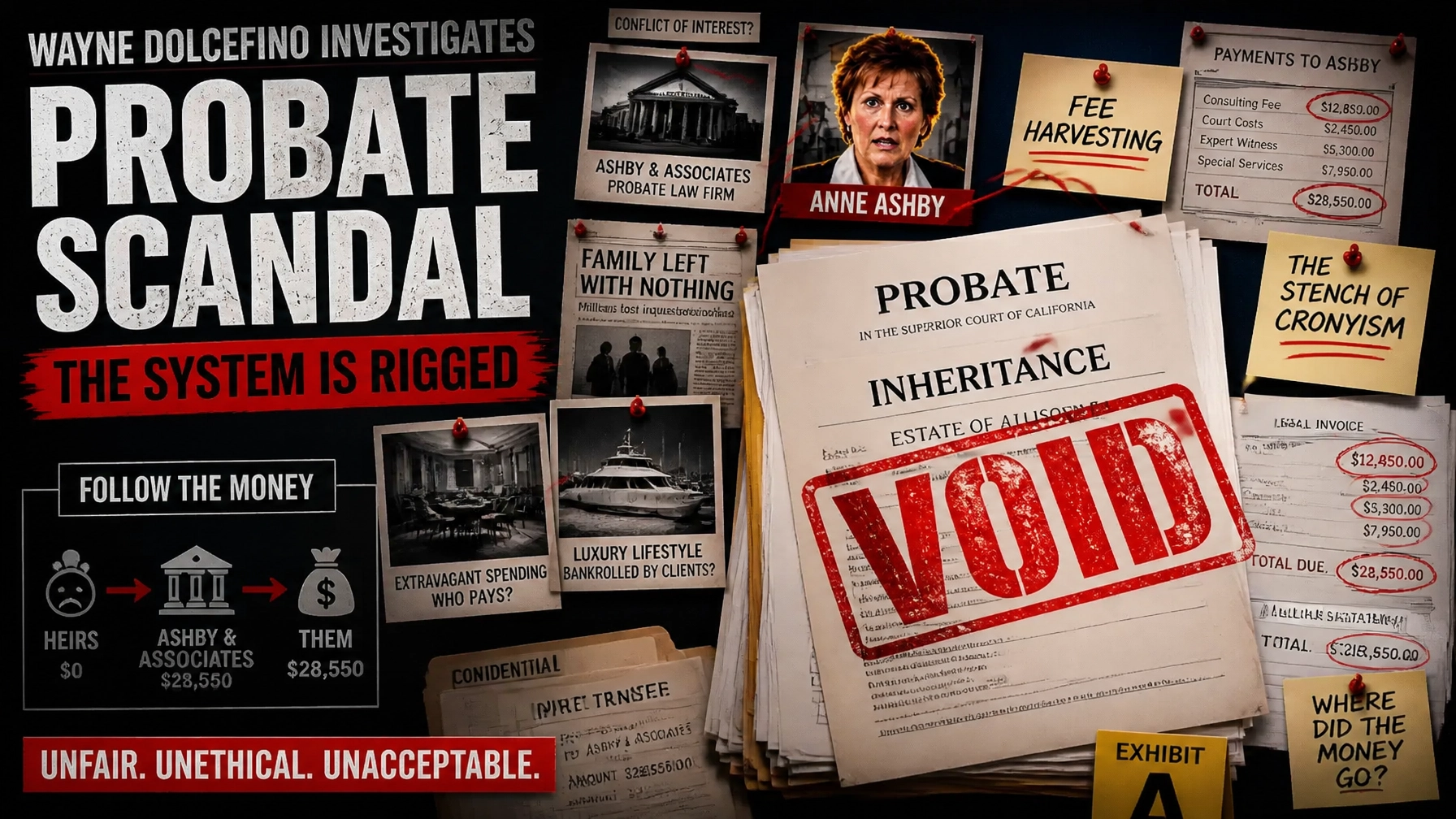
It starts with a loss. A death in the family, a disabled relative, or an aging parent who can no longer manage their affairs. In a perfect world, the legal system would act as a shield, protecting the assets left behind for the next generation. But in the high-stakes world of Texas probate courts, that shield is often replaced by a vacuum, one designed to suck every last cent of an inheritance into the pockets of the very people hired to "protect" it.
This is the probate fee machine. It is a courthouse economy where grieving families aren’t clients: they are the revenue stream. From Harris County to the furthest corners of the state, inheritance disputes Houston-wide have become a feeding frenzy for a select group of "insider" attorneys who have turned the court system into a personal ATM.
The $8.5 million attorney fee bonanza
The numbers are staggering. In a single year, investigative reports uncovered that Harris County probate judges approved a jaw-dropping $8.5 million in fees to private, court-appointed lawyers. This wasn't just for complex litigation; this was for a system of appointments where the same handful of professionals were repeatedly hand-picked by judges to oversee the estates of the dead and the vulnerable.
This "bonanza" represents more than just a large bill. It represents the systematic draining of family legacies. When a judge appoints an attorney or a guardian to an estate, they grant that individual enormous power. They can sell assets, liquidate bank accounts, and charge the estate for every minute they spend doing so.
Wayne Dolcefino, the lead investigator behind the Damn Lawyers series, has spent years exposing how these rigged systems operate. What he found wasn't just high fees: it was a stench of cronyism that should haunt every Texan with a will.
When lawn mowing costs $200 an hour
The true horror of the probate fee machine is found in the line items of the legal invoices. This is called "fee harvesting," a predatory practice where attorneys bill professional rates for tasks that require zero legal expertise.
Imagine checking an invoice for your late father’s estate and seeing a charge for $200 an hour: not for arguing in court, but for arranging to have the lawn mowed. In Harris County, records show appointees billing the estates of vulnerable people for selling cars, visiting pawnshops, and even performing basic administrative tasks that a clerk could do for minimum wage.
In one particularly stomach-turning instance, a judge approved $1,000 in fees for a lawyer to attend a ward’s funeral and burial. The grieving family didn't just lose their loved one; they were forced to pay a stranger a four-figure sum to stand by the grave. This is the definition of legal bullying. When the court approves these fees, they aren't just rewarding the attorney: they are robbing the heirs.
The tragic cases of Susan Conte and Ugo di Portanova
If you think your family is safe because you have a trust or a clear will, the case of Susan Conte should serve as a chilling warning. Susan found herself in a nightmare fight in Harris County Probate Court No. 1. Despite being the rightful beneficiary, a judge's order removed her from her own family trust and replaced her with a bank.
It took an expensive, years-long battle through the appellate system for Susan to finally win her rights back. Her words at the end of the ordeal ring true for thousands of others: “I hope to God we are one of the families that is able to break away from the probate courts.”
Then there is the case of Ugo di Portanova. Ugo was a disabled heir to a massive oil fortune, but that wealth made him a target. The court system around him became financially self-sustaining, with guardians, trustees, and lawyers spending millions of his dollars on their own disputes and fees. In one year alone, a single judge approved over $302,000 in payments to attorneys in his case. As one former trustee put it, “A lot of people are making a lot of money off of him.”
When a person has wealth but limited power, the system doesn't protect them: it consumes them.
Receiverships: The surprise raid tactic
The probate fee machine often uses a secondary weapon to finish the job: the receivership. Think of a receivership as a court-approved "surprise raid." Under the guise of "protecting" assets during a dispute, a judge can appoint a receiver to take total control of a family’s property, business, or bank accounts.
Once the receiver is in place, the family is locked out. The receiver: often a friend or crony of the attorneys involved: has the power to sell the family home, liquidate investments, and, of course, bill the estate for every second of it. It is a shock-and-awe tactic used to scare families into handing over assets or settling on terms that favor the lawyers.
By the time the receivership is lifted, there is often nothing left to fight over. The estate has been harvested until the bones are picked clean.
The stench of cronyism and the need for reform
This isn't just a failure of individual lawyers; it is a systemic rot. The "trio" of attorneys often seen in these cases: the firm and their associates: thrive in an environment where mandatory arbitration and undisclosed conflicts are the norm. They use arbitration to hide their conduct from public view, ensuring that no jury ever sees the invoices for $200-an-hour lawn mowing or the coercion tactics used to secure high-percentage contingency fees.
In the Damn Lawyers 2: The Stench of Cronyism investigation, the depth of these relationships is laid bare. When lawyers, judges, and arbitrators all belong to the same "courthouse economy," the client doesn't stand a chance.
How we fix the broken machine
We cannot continue to allow the judicial system to be a playground for profiteers. The justice system should protect people, not destroy them. To stop the probate fee machine, we are advocating for urgent legislative solutions that bring transparency and accountability back to the courtroom.
- Robin’s Law (The Texas Family Integrity and Probate Fairness Act): This proposed legislation would extend the ban on contingency fees: currently used in divorce and custody cases: to probate and estate disputes. No lawyer should be allowed to walk away with a bigger piece of a family's inheritance than the heirs themselves. You can support this effort here: Robin's Law Petition.
- The Texas Legal Consumer Protection and Attorney Accountability Act: Attorneys must be held to a higher standard. This act would require malpractice insurance and ensure that when lawyers cross the line, there is a clear path for victims to seek justice.
- Ending Mandatory Arbitration Abuse: We must require that arbitration involving attorney-client disputes be subject to judicial review. The "black box" of arbitration is where accountability goes to die.
Demand accountability now
The probate court scandals in Houston and across Texas are a warning to us all. If it could happen to a billionaire like Janice McNair, who was forced to fight a guardianship attempt to keep control of her own life, it can happen to you.
It is time to stop the legal bullying. It is time to demand that our judges follow the law and that our legislators protect families from the predatory "courthouse economy." We must expose the truth and fight for a system where a family’s inheritance belongs to the family: not the firm.
Watch the full investigation into how these systems are rigged in Damn Lawyers 3: A Deception and join the fight for reform.
5 Responses