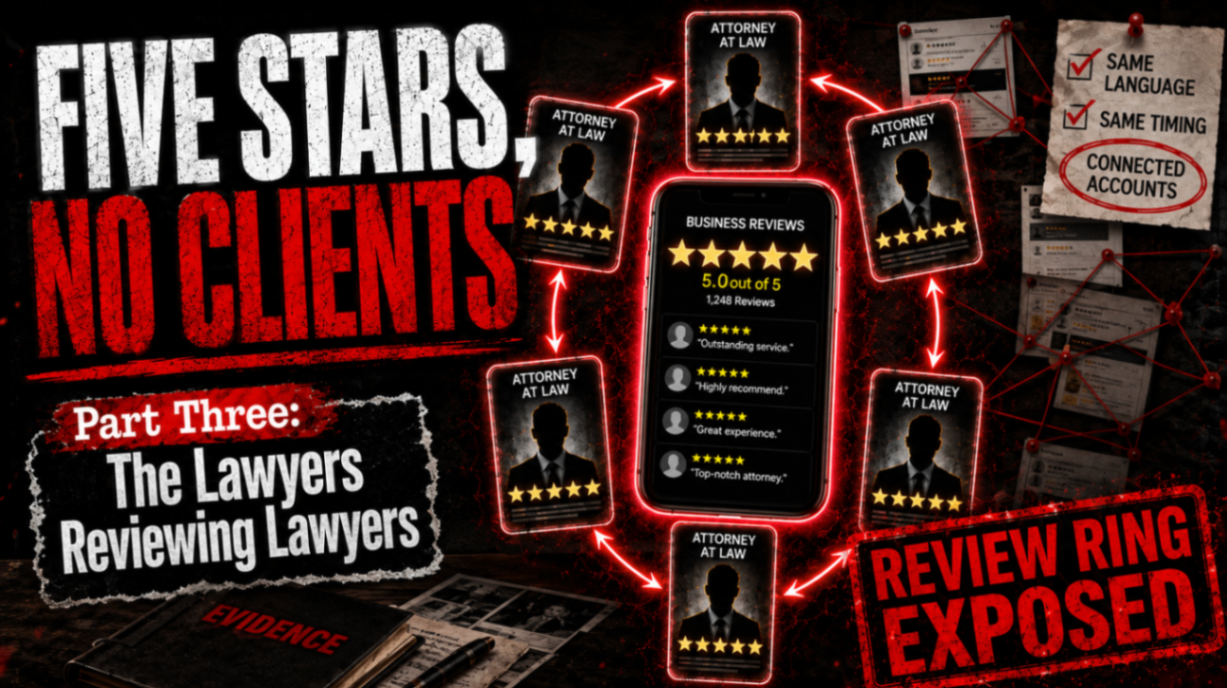
The courtroom isn’t the only place where the truth is under oath. In the digital age, the jury is the unsuspecting public, and the testimony is the Google review. When a grieving widow or a desperate heir looks for a champion, they don’t see the backroom handshakes or the “stench of cronyism” that investigative journalist Wayne Dolcefino has spent years exposing. They see a shimmering wall of gold stars. But as our ongoing investigation into the Damn Lawyers reveals, those stars aren’t always earned in the heat of trial: sometimes, they’re manufactured in the comfort of a colleague’s office.
This is the third chapter in our “Five Stars, No Clients” series, a deep dive into the architecture of deception. While our previous reports focused on the fee harvesting tactics that strip estates bare, this investigation targets the very foundation of how these firms lure victims into the arbitration trap. For readers who want to see the scheme unfold on camera, the probate plot and legal deception add critical context.
The problem: a mirage of professional praise
In the traditional legal world, professional praise has a recognized place. A lawyer may endorse another lawyer for a directory. A colleague may speak about courtroom skill. A professional organization may give an award. The source of the praise is usually obvious. Online, those distinctions collapse.
A five-star Google review written by a fellow attorney looks exactly like one written by a widow who hired the lawyer to handle her husband’s estate. To the average consumer, a star is a star. They don’t see the attorney self-dealing that often goes on behind the scenes to bolster a digital reputation. This lack of transparency is a primary tool for predatory lawyers looking to build a facade of trust before their next big “catch.”
The expose: inside the review ring
The complaint involving the trio shows how little information the platform provides. In a screenshot attached to the filing, one of the lawyers featured in the Damn Lawyer investigation gave another member of the trio five stars and described him as a great trial lawyer. Allison’s complaint says the reviewer was a co-attorney and professional associate: not a client recounting a legal service he had purchased.
The review may have reflected an honest opinion. But honesty is not the only issue. Context determines what the reader believes the review means. When legal bullying begins, the victim often feels isolated, unaware that the lawyer’s stellar reputation may be built on a foundation of mutual back-scratching rather than client satisfaction.
The complaints describe other overlapping relationships. One member of the trio’s business partner allegedly reviewed him. One member of the trio’s wife allegedly reviewed both her husband and another member of the trio. The filing identifies a business associate sharing office space among the people whose praise allegedly strengthened the rating. This pattern of behavior is why we are calling for massive bar complaints to hold these individuals accountable.
Each relationship should be independently verified. Each reviewer should be asked whether legal services were provided, whether anyone requested the review and whether the relationship was disclosed. Without this verification, the digital marketplace becomes a playground for contingency fee abuse, where the promise of “no win, no fee” is actually a gateway to a coordinated asset raid.
Discussing the broader machinery of fake influence
The broader practice is not confined to law firms. In 2019, the FTC brought a case against Devumi, a company that sold fake social-media followers, subscribers, likes and views. The agency said the company’s customers included law-firm partners seeking the appearance of greater influence. The buyers were not publicly identified, and the enforcement action focused on the seller.
That pattern is revealing. Regulators may punish the machinery that sells artificial credibility while the professionals who purchase or benefit from it remain unknown. For lawyers, online stature has become a business asset. Reviews improve visibility in search results. Ratings reassure frightened clients. Social-media followers suggest authority. The appearance of public confidence can be converted directly into new cases and legal fees.
This is especially dangerous in the realm of probate abuse. Families facing the loss of a loved one are uniquely vulnerable. They rely on these ratings to choose a guide through the darkest moments of their lives, only to find themselves ensnared in a system that prioritizes inheritance theft over justice. We’ve seen this time and again with the Probate Victims who come to us for help after being bled dry by the very people they trusted to protect them. The human cost is impossible to ignore when you hear the victim testimony firsthand.
That makes disclosure more than a courtesy.
The FTC’s review rule expressly addresses insider testimonials that fail to clearly reveal a material connection to the business. The agency has said a business may face liability when it creates or knowingly uses reviews that falsely represent the reviewer’s experience. Lawyers also operate under professional rules barring false or misleading communications about their services. A review written independently by a colleague may not be the lawyer’s statement. But when a firm solicits it, coordinates it or republishes the resulting rating as a credential, the line between third-party speech and lawyer advertising becomes harder to maintain.
The complaint alleges that a website promoted a 4.8-star Google rating even though Allison contends the rating included reviews from people inside the lawyers’ personal and professional orbit. As highlighted by the Dolcefino investigation, the integrity of these ratings is under serious fire. No regulator has publicly ruled on that allegation. But it presents a clean question for investigators: When a lawyer advertises a star rating, does the lawyer have any responsibility to know who supplied the stars?
The fix: demanding legislative accountability
We cannot wait for the tech giants or the slow-moving State Bar to clean up this mess. The Damn Lawyers featured in the Dolcefino investigation thrive because they operate in the shadows of arbitration where transparency goes to die. We need a legal bullying response that brings these practices into the light.
We are advocating for several key reforms:
- Mandatory Disclosure: Any review written by a family member, business partner, or professional associate must be clearly labeled as such.
- Judicial Review of Arbitration: No more “shadow courts.” Arbitration must be subject to judicial oversight to prevent the kind of exploitation we see in Victims of Anne Ashby cases.
- Verification Protocols: Firms must be held legally responsible for the ratings they use in their marketing materials.
Consumers already understand that a television commercial is advertising. They understand that a law-firm website is marketing. What they may not understand is that the apparent voice of the client could belong to the lawyer’s spouse, partner, colleague or office neighbor. The review is powerful precisely because it does not look like advertising. That is why the hidden relationship matters.
Wayne Dolcefino is continuing his pursuit of the truth, digging through the digital dirt to find where the stars end and the reality begins. But he can’t do it alone. We need you to speak up. If you have been misled by manufactured ratings or trapped by the unethical tactics of the Damn Lawyers, the predatory lawyers, or the lawyers featured in the Damn Lawyer investigation, your story is the evidence we need to drive change.
It’s time to stop the legal bullying. It’s time for a system where a five-star review actually means a client was served, not just that a lawyer was praised by his neighbor. Accountability isn’t a suggestion; it’s a requirement for a just society.
Join the fight for reform. Demand legislative debate. And never take a gold star at face value.
5 Responses