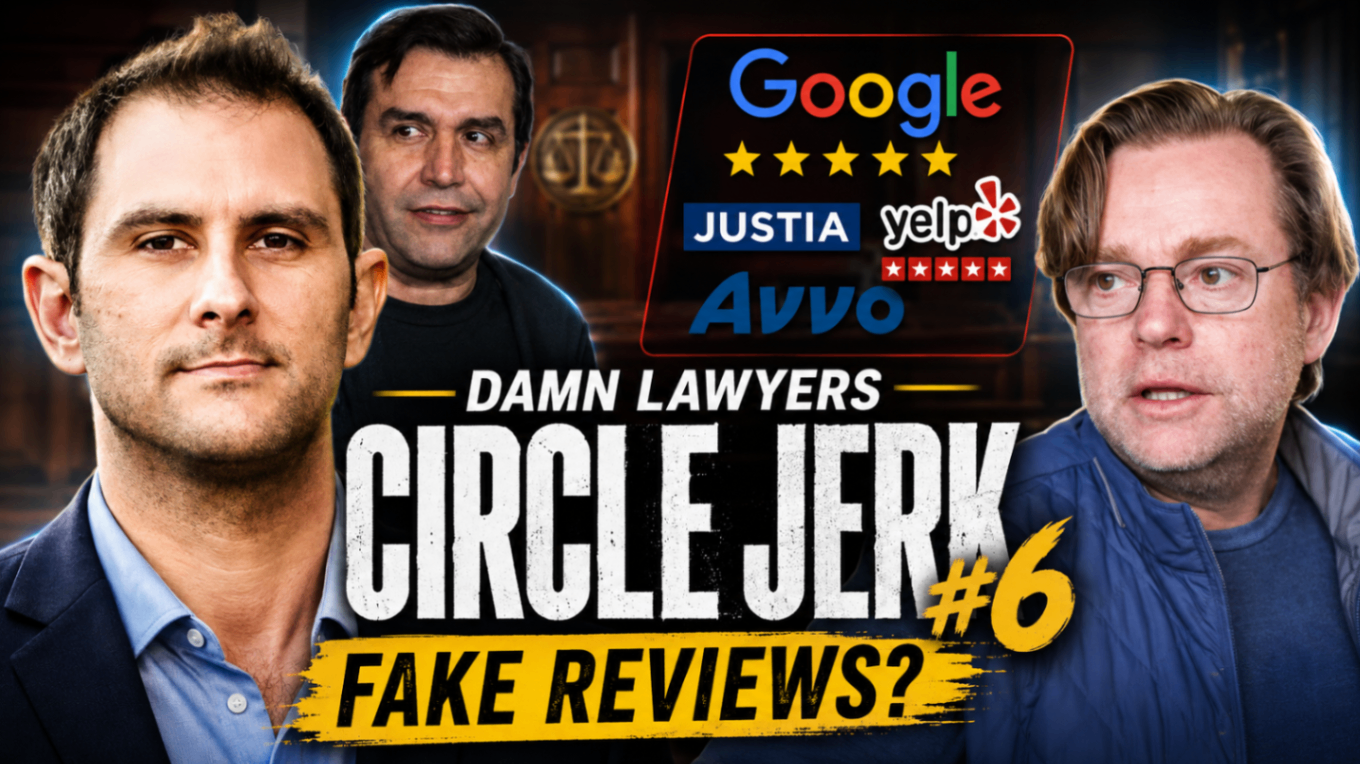
The latest release in Wayne Dolcefino’s Damn Lawyers investigation centers on the new Circle Jerk #6 video and its accompanying August 14, 2026 Consumer Alert, examining a question that reaches far beyond online reputation management: What happens when the public image of a law practice is built through allegedly manufactured, undisclosed, or selectively presented reviews?
Watch Circle Jerk #6, the new video at the center of the August 14, 2026 Consumer Alert. The accompanying press release focuses on allegations that online legal profiles were influenced by fake or undisclosed insider reviews, cross-reviews among connected attorneys, self-review activity, pressure directed at critics, and the alleged removal or suppression of unfavorable reviews.
Readers who want to review the reporting alongside the underlying presentation can watch the video here:
For broader context, the series backstory connects Circle Jerk #6 to the wider Damn Lawyers investigation and the record it says supports continued scrutiny.
Stop Legal Bullying reviewed three complaint files associated with the review-fraud investigation, which includes links to complaints submitted to the FTC and the Texas Attorney General. Those files contain allegations and reported exhibits: not adjudicated findings. Their significance is that they present a documented pattern for regulators, review platforms, legal advertisers, and consumers to examine under the Federal Trade Commission’s Consumer Review Rule, 16 C.F.R. Part 465.
What the complaint files allege
The complaint packages describe a pattern that the complainant says made certain legal profiles appear more independent, more credible, and more consumer-trusted than the underlying relationships may have justified. According to the complaint packages, that pattern includes alleged insider reviews, cross-reviews, self-review activity, misleading profile presentation, and disputes over the removal or suppression of criticism.
One complaint package alleges a concentrated one-day Google review cluster on March 8, 2026. The exhibit purports to show 11 reviews appearing within that single day. The complainant says those accounts included alleged business, professional, family, and low-history connections that were not apparent to ordinary consumers viewing the profile. At this stage, those assertions remain allegations in a complaint package, not adjudicated findings.
That distinction matters. A truthful review from a person connected to a law firm is not automatically unlawful. But if a reviewer has a material connection to the business, that relationship can affect how consumers interpret the endorsement. Presenting an insider as though the person were an unrelated client may create a misleading impression.
Another complaint package alleges review manipulation through cross-reviews and shared-network endorsements. One exhibit purports to show a co-attorney review posted six days after the investigation became public, while another exhibit is described by the complainant as linking an account to a shared office connection. The complaint package characterizes those reviews as potentially independent-looking endorsements that may have concealed professional alignment from consumers. Reported examples involving employee reviews in another state show why regulators and consumers examine those patterns closely, though that Pennsylvania matter does not prove anything about the Texas complaints discussed here.
The files also describe alleged self-review activity or self-review proxy activity. That outside example involves a reported disciplinary accusation, not proof of the allegations discussed here. The complainant says some profile activity appeared to function less like organic client feedback and more like reputation management generated by the same professional circle. The complaint packages further raise issues involving alleged AI or misleading profile-image practices and platform-dispute conduct, though those allegations likewise remain unproven and require careful factual review.
Those are serious allegations, but the complaint packages do not themselves establish who authored every review, who directed any activity, whether any platform was misled, or whether any particular act violated federal or state law. Those questions require investigation and an opportunity for the accused parties to respond.
The alleged suppression of negative reviews
Positive reviews are only one side of the story. The complaint packages also allege that unfavorable reviews were removed, disputed, buried, or otherwise made less visible across multiple platforms.
Reported exhibits describe repeated attempts to challenge or remove critical reviews, including allegations that genuine negative reviews disappeared during the same general period that favorable reviews appeared. One complaint package also reports a timestamped late-night Yelp message that the complainant interpreted as challenging or intimidating a reviewer after criticism was posted. That description is the complainant’s characterization of the exchange, not a formal finding about intent or legality.
A review platform may remove content that is fraudulent, defamatory, abusive, obscene, or otherwise violates its rules. A business may also report content it reasonably believes is fake. The concern arises when legitimate criticism is selectively suppressed, or when legal threats, intimidation, or false accusations are used to force a reviewer into silence.
The complaint packages allege that reviewers were challenged, identified, pressured, or intimidated after posting criticism. Whether a particular communication qualifies as intimidation or an unfounded legal threat is fact-specific. It depends on the language used, the factual basis for the communication, the surrounding circumstances, and the purpose behind it.
The central issue is not whether every negative review must remain online. It is whether a business is creating a deceptive overall picture by displaying favorable feedback while removing or suppressing materially unfavorable feedback.
What 16 C.F.R. Part 465 changes
The FTC Consumer Review Rule became effective in October 2024. It applies to businesses that use reviews and testimonials to market products or services, including law firms, legal advertising agencies, and other legal-service providers.
In this article, the rule is best understood as the legal framework that gives context to the evidence described in the complaint packages and highlighted by Circle Jerk #6, not as proof that any violation has been established.
Fake or false reviews
The rule addresses reviews that materially misrepresent whether a reviewer exists, whether the reviewer used or experienced the service, or what the reviewer’s experience actually was.
For legal advertisers, that means a person who never hired or consulted a firm should not be presented as a client. A review should not describe a legal result, professional relationship, or client experience that did not occur.
That framework is relevant where a complaint package alleges self-review activity, coordinated posting, or accounts that the complainant says did not look like ordinary independent client reviewers.
Undisclosed material connections
The rule also addresses insider reviews and testimonials. A material connection can include an employment relationship, ownership interest, agency relationship, close family relationship, compensation, or another connection that could affect the credibility of the endorsement.
The disclosure must be clear and conspicuous. A consumer should not have to investigate the reviewer’s identity, search business records, or infer a relationship from scattered clues.
That issue is relevant where the complaint packages allege reviews by people with business, professional, family, or other connected relationships that were not plainly disclosed on the profile itself.
Review suppression and intimidation
The rule prohibits certain efforts to suppress reviews through unfounded or groundless legal threats, physical threats, intimidation, or public false accusations. It also addresses selective review practices that create a misleading impression about the business’s overall customer feedback.
This does not prevent platforms from enforcing neutral content standards. It does not eliminate legitimate defamation claims. It does not require publication of content that is plainly false or abusive. It does require businesses to avoid using coercion or deceptive curation to manufacture a cleaner reputation than the underlying review history supports.
That framework is relevant to the complaint packages’ descriptions of disputed takedowns, reviewer challenges, and the late-night Yelp communication that the complainant interpreted as pressure. None of that, standing alone, establishes an FTC violation, an enforcement action, or a penalty.
Complaint, investigation, enforcement, and finding are not the same
The legal status of the complaint files must be described precisely.
A private complaint is a report submitted by an individual or organization describing alleged misconduct and providing supporting material. It is a request for review: not a final determination.
An FTC investigation would be a fact-gathering process conducted by the Commission. The existence of a complaint does not, by itself, establish that the FTC has opened an investigation.
An enforcement action is a formal proceeding brought by a government agency or through a court process. It may result in negotiated relief, litigation, penalties, or dismissal.
An adjudicated finding is a conclusion reached through a formal process after the relevant parties have had an opportunity to respond. The complaint files discussed here are not adjudicated findings.
That distinction protects both accountability and fairness. Regulators should investigate credible evidence, while readers should not treat allegations as proven facts.
Texas ethics rules provide additional context
The federal rule is not the only relevant framework. Texas Ethics Opinion 685 provides useful context by recognizing that lawyers may encourage current or former clients to post truthful reviews and ratings. It does not authorize false, misleading, or manipulated testimonials.
Texas Rule 7.01 addresses communications concerning a lawyer’s services, while Texas Rule 8.04(a)(3) addresses conduct involving dishonesty, fraud, deceit, or misrepresentation. These authorities provide a professional-ethics context for evaluating online legal advertising.
They are not findings that any attorney violated those rules. Whether a specific review or marketing practice violates Texas ethics standards would require analysis of the evidence, applicable law, and procedural record.
Why legal advertising is a high-stakes category
A manufactured online reputation can do more than influence a routine purchase. It can determine who receives a phone call from a grieving family, who is trusted with an estate, and who is hired during a dispute involving a home, inheritance, trust, or business.
Probate consumers are particularly vulnerable to reputation manipulation. They may be dealing with a death, family conflict, urgent court deadlines, restricted access to records, and unfamiliar legal procedures. Most cannot easily evaluate whether an attorney’s strategy is sound before signing an engagement agreement.
A profile filled with apparently independent fake five-star reviews can become a substitute for meaningful due diligence. Stop Legal Bullying has also detailed that concern in its reporting on manufactured ratings. If those reviews are allegedly connected to insiders, cross-promotional partners, or accounts that do not reflect genuine client experiences, the consumer may be making a high-stakes decision based on a false signal.
That is why lawyer accountability, attorney misconduct, and truthful legal advertising are consumer-protection issues: not merely questions of marketing style.
A compliance and accountability checklist
For law firms and legal advertisers
- Request reviews based on genuine experience, not guaranteed positive sentiment.
- Do not create, purchase, script, or distribute fake or misleading testimonials.
- Clearly disclose family, employment, ownership, referral, compensation, and other material connections.
- Apply neutral criteria when responding to or reporting negative reviews.
- Do not threaten, intimidate, publicly shame, or falsely accuse reviewers to obtain removal.
- Preserve review policies, vendor instructions, approval records, and corrective actions.
- Audit reputation-management agencies and marketing contractors for compliance.
For review platforms
- Investigate coordinated review floods, connected accounts, and suspicious cross-review patterns.
- Give reviewers a meaningful process to contest removals.
- Distinguish fraud detection from reputation-protection requests.
- Preserve audit records when reviews are removed, disputed, or reinstated.
- Publish aggregate information about removals and appeals without exposing private data.
For regulators
- Treat repeated complaint patterns as potential evidence requiring enhanced review.
- Track complaints, outcomes, repeat allegations, and conflicts of interest publicly in anonymized form.
- Distinguish confidential individual complaints from aggregate transparency.
- Coordinate review-fraud enforcement with attorney-discipline authorities.
- Examine whether procedural protections for respondent lawyers are balanced by meaningful rights for complainants.
For consumers
- Check whether reviewers appear to have real experience with the firm.
- Look for clusters of reviews posted close together.
- Examine whether reviewers disclose professional or family connections.
- Compare multiple platforms rather than relying on one star rating.
- Save screenshots and records before reporting a disputed review.
- Ask a prospective lawyer about fees, risks, conflicts, arbitration provisions, and likely outcomes.
- Treat online reputation as one source of information: not proof of competence or integrity.
This article reports allegations from complaint files and the August 14, 2026 Consumer Alert. It is not a legal finding and is not legal advice. Accountability requires evidence, transparency, and a fair process: but it also requires that regulators and platforms take credible patterns of review fraud seriously.
One Response