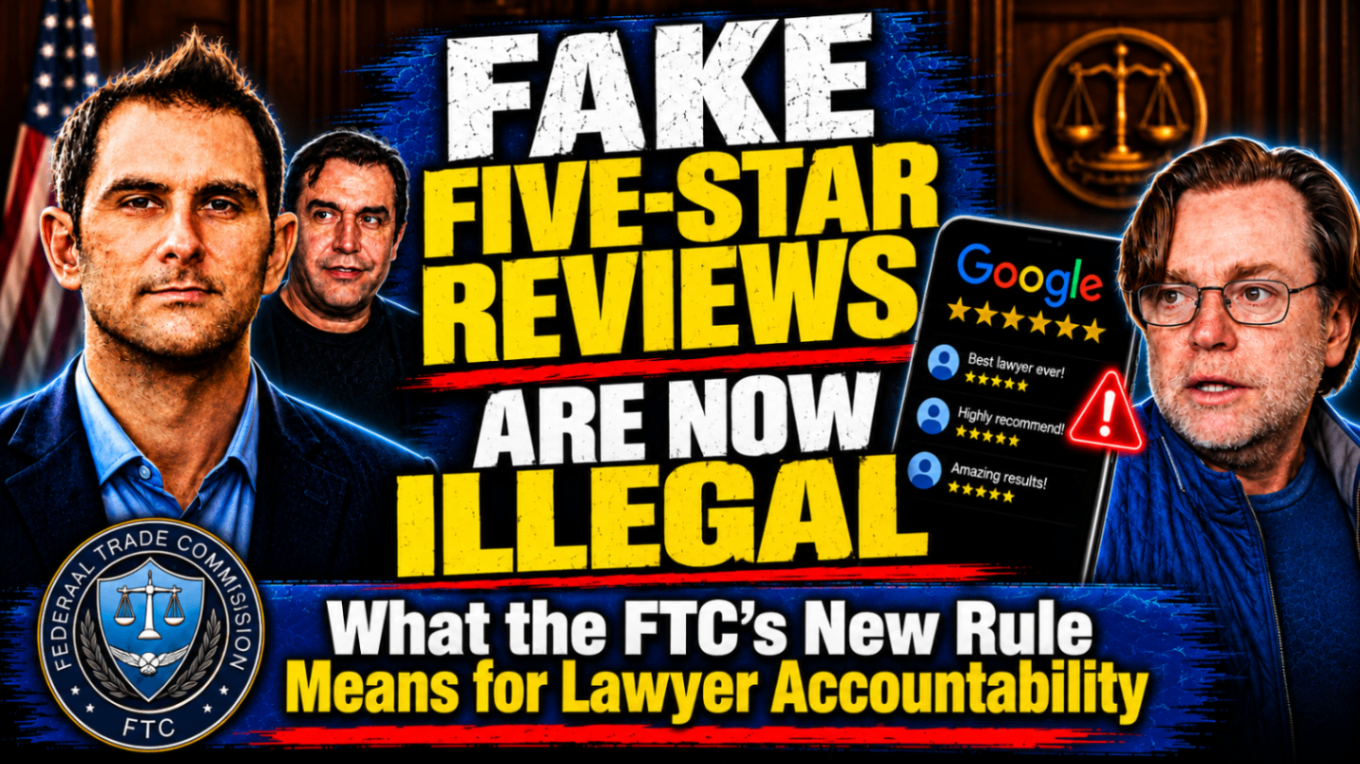
A five-star rating can influence whether a person hires a lawyer, signs a fee agreement, or trusts a firm with a home, an inheritance, or years of savings. But a perfect rating is not automatically proof of excellent legal work. It may reflect genuine client experiences: or a carefully managed reputation campaign.
That is why the FTC Consumer Reviews and Testimonials Rule matters to consumers searching for legal help. Effective October 21, 2024, the rule gives the FTC a direct enforcement tool against specific forms of fake reviews, undisclosed insider testimonials, review suppression, and fabricated social-media influence.
The rule does not make every positive review illegal. It does, however, make clear that businesses: including law firms: cannot mislead consumers through manufactured social proof.
What the FTC rule actually prohibits
The Consumer Reviews and Testimonials Rule, found in 16 C.F.R. Part 465, addresses deceptive conduct involving reviews and testimonials. It applies to businesses that market services to consumers. There is no general exemption for lawyers or law firms, and the agency’s FTC rule guidance gives additional context on how the rule applies in practice.
The rule prohibits businesses from creating, selling, buying, or distributing fake or false reviews when they knew or should have known the reviews were deceptive. That includes reviews written by people who never used the service, reviews posted under fabricated identities, and testimonials that misrepresent the reviewer’s actual experience.
Artificial intelligence makes this problem more difficult to detect. A review may appear to come from a real person while actually being generated from a fictional account, copied language, or a profile created solely to promote a business. The FTC specifically identified AI-generated fake reviews as part of the problem the rule is intended to address.
The rule also prohibits compensation or incentives conditioned on a particular sentiment. A business may ask for honest feedback and, in some circumstances, offer an incentive for a review. It cannot require or imply that the review must be positive: or negative: to qualify for that incentive.
Insider reviews cannot quietly look like client reviewsf
A review written by an employee, manager, officer, agent, or immediate family member is not automatically prohibited. The problem arises when the relationship is hidden or when the review is presented as though it came from an ordinary customer.
For a law firm, that distinction is significant. A spouse, relative, employee, office associate, business partner, or fellow professional may have a genuine opinion about a lawyer. But if that person posts a five-star review without clearly disclosing the relationship, prospective clients may reasonably assume the reviewer was an unrelated client, a concern that also intersects with Texas Ethics Opinion 685.
The FTC says required disclosures must be clear and conspicuous. A disclosure buried behind a link, hidden in a profile, or placed where consumers are unlikely to see it may not be sufficient.
Even a disclosed insider review can create a separate concern if it materially inflates the overall star rating. Consumers often see the rating before they read individual reviews. A technically disclosed relationship may not cure a misleading overall impression.
Review suppression is part of review manipulation
Fake reviews are only one side of the problem. A reputation can also be distorted by making legitimate criticism disappear.
The rule addresses certain forms of review suppression, including the use of unfounded legal threats, physical threats, intimidation, or false public accusations to prevent or remove negative reviews. It also prohibits a business from claiming that its published reviews represent all or most reviews when negative reviews were selectively excluded because of their rating or sentiment.
Not every removed review establishes wrongdoing. A platform may lawfully remove a review about the wrong business, a review containing prohibited personal information, or content that violates a neutral policy applied consistently. The key questions are whether the removal process was deceptive, whether negative feedback was treated differently from positive feedback, and whether intimidation or unsupported claims were used to silence criticism.
For people documenting possible Google review fraud, the distinction is important. A disappearing one-star review is a lead: not conclusive proof. The surrounding evidence matters: what the review said, when it was posted, who reported it, what reason the platform gave, and whether similar positive reviews remained online.
Fake social-media indicators create another layer of false credibility
The FTC rule also targets fake indicators of social-media influence. These may include bot-generated followers, views, likes, comments, or shares; accounts that do not represent real individuals; hijacked accounts; or other indicators that do not reflect genuine activity or experience.
For lawyers and law firms, inflated social-media metrics can create the appearance of authority. A large following, unusually high engagement, or a sudden burst of online support may influence consumers even when those numbers do not reflect a real community of clients or readers.
The rule focuses on commercial misrepresentation. It does not prohibit legitimate marketing, real clients choosing to follow a lawyer, or genuine public interest in a legal issue. It does prohibit buying or distributing fake influence indicators when the buyer knew or should have known they were fake and used them to misrepresent commercial importance.
What the documented investigation does: and does not: show
Wayne Dolcefino, through the Dolcefino Investigates series, has examined how legal reputations can be built through online reviews, professional relationships, and the removal of critical consumer accounts. That reporting includes a consumer alert, a page on alleged review manipulation, an investigative video, and an independent review-fraud analysis.
Stop Legal Bullying’s documented fake-review investigation presents screenshots, review histories, account information, and other materials for public scrutiny. The investigation raises questions about whether certain reviews reflected genuine client experiences, whether relationships were disclosed, and whether negative feedback was challenged or removed.
Those materials should be evaluated carefully. They are not the same as a court judgment or an FTC finding. A complaint submitted to a regulator is not proof of misconduct, and a suspicious pattern is not automatically an established violation.
The broader issue is nevertheless clear: consumers need a way to distinguish authentic client feedback from manufactured credibility. The fake lawyer reviews investigation explains the patterns that consumers should examine without treating every allegation as proven.
How to document suspected review fraud
Consumers who believe a law firm’s online reputation may have been manipulated should preserve evidence before it disappears.
Start with the complete review page. Take screenshots that show the business name, star rating, reviewer name, review text, date, and platform address. Save the page as a PDF when possible. Record the date and time of each capture.
Next, preserve information about the reviewer. Note the profile URL, profile photo, number of reviews, locations, review history, and any public connection to the lawyer or firm. A reviewer using the same photograph across multiple accounts, posting identical language, or reviewing a cluster of connected businesses may provide useful context: but those signs alone do not prove who controlled the account.
Keep copies of communications with the firm and the platform. Save emails, direct messages, notices that a review was reported, explanations for removal, and any request that you change or delete your review. If someone threatened legal action, preserve the exact language. A legitimate legal claim is different from an unsupported threat intended to frighten someone into silence.
Build a timeline. Separate what you personally observed from what you infer. For example:
- Fact: a review appeared on a specific date.
- Fact: the review later became unavailable.
- Fact: the platform stated that it was removed for a stated reason.
- Inference: the firm may have influenced the removal.
That discipline makes a record more credible and reduces the risk of overstating an allegation.
Consumers can report suspected deceptive practices to the FTC, notify the relevant review platform, and consider whether a professional-discipline complaint or other report is appropriate. In matters involving documented allegations, preserving copies of FTC complaints, reported review fraud, and related records can help establish chronology and context. The FTC does not investigate every complaint, and the Consumer Reviews Rule does not create a private right of action. A complaint helps regulators identify patterns; it does not decide the facts in an individual dispute.
What lawyer accountability should look like
The federal rule is an important development, but enforcement should not depend only on consumers discovering digital evidence after harm occurs.
Texas should pursue attorney-discipline reforms that provide procedural fairness to complainants and respondent lawyers alike. That includes publishing complaints with clear disclaimers, tracking outcomes publicly, identifying repeat patterns of alleged misconduct, and resolving conflicts of interest in the complaint process. Readers following questions about attorney misconduct, bar complaint filings, legal ethics, and broader attorney accountability can see why procedural transparency matters to both complainants and respondent lawyers.
A complaint should not be treated as a finding. But secrecy can prevent the public from recognizing repeated allegations involving the same conduct, the same professionals, or the same institutional relationships. Transparency: with due-process protections and accurate labeling: would give consumers better information without prejudging any lawyer.
The legal profession has a legitimate interest in protecting lawyers from frivolous accusations. Consumers have an equally legitimate interest in knowing whether complaints were dismissed, resolved, disciplined, or repeated over time. Accountability requires both protections.
Legal disclaimer: This content is not legal advice. It does not validate any individual complaint, establish that any person or business violated the law, or constitute a declaration that disputed allegations are true. Readers should independently verify information and consult a qualified attorney about their circumstances.
A five-star rating should reflect real experience, not intimidation, undisclosed relationships, fabricated accounts, or selective erasure. Consumers can help expose review fraud by preserving evidence, reporting suspected manipulation, and demanding transparent systems that distinguish allegations from findings.
Law firms, regulators, platforms, and professional authorities should meet the same standard: tell the truth, disclose relevant relationships, preserve legitimate criticism, and accept accountability when the public record raises serious questions.
Tags: review fraud, fake five-star reviews, FTC complaints, attorney misconduct, review manipulation, Google review fraud, lawyer accountability, Dolcefino Investigates, legal advertising, consumer protection