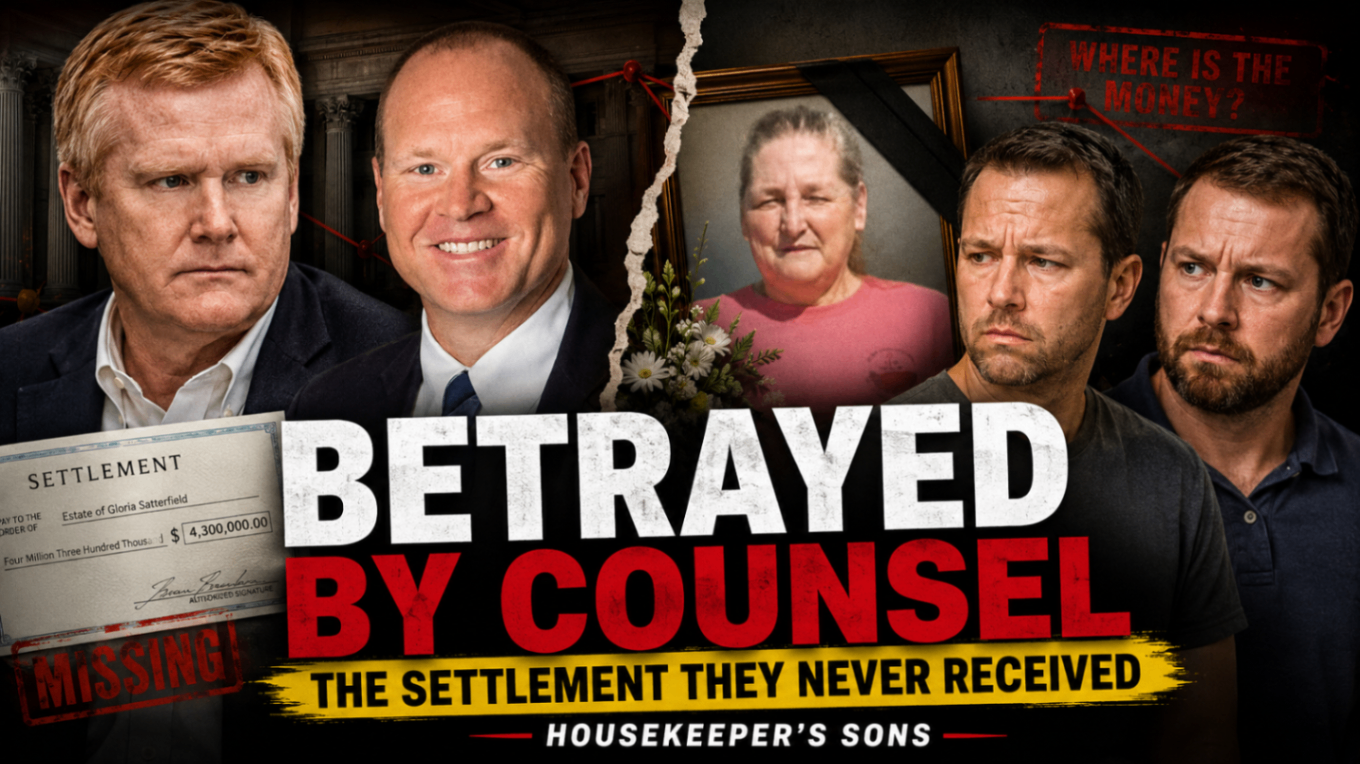
The air in the South Carolina Lowcountry is thick with more than just humidity; it is thick with the scent of a generational entitlement that finally rotted through. For twenty years, Gloria Satterfield cleaned the floors and raised the children of the Murdaugh family. She was more than an employee; she was a fixture in their lives until the day she fell down the stairs of their Moselle estate and never woke up. In the wake of her death, her sons were grieving, vulnerable, and looking for a way to honor their mother’s memory.
Enter Alex Murdaugh, the man their mother had served for two decades. He didn’t just offer condolences; he offered a solution. He told the Satterfield boys he would “take care of them.” He suggested they hire a lawyer he knew well: his college roommate and close friend, Cory Fleming. It was a recommendation presented as a gesture of goodwill, a shortcut to justice in a complex legal system.
What the Satterfield sons didn’t know was that they weren’t being ushered toward justice. They were being walked directly into a predatory attorney’s mouth. This is the story of how a “trusted” referral became the ultimate betrayal of the attorney-client relationship.
The referral that was a trap
In the legal world, a referral is often seen as a seal of approval. When one lawyer sends you to another, there is an implicit promise of competency and independence. But in the hands of Alex Murdaugh and Cory Fleming, the referral was a weapon. By installing Fleming as the attorney for the Satterfield estate, Murdaugh ensured that the person “fighting” him for settlement money was actually his coconspirator.
The conflict of interest was blinding, yet hidden behind a veil of professional courtesy. Fleming filed a wrongful death claim against his friend Murdaugh. The insurance companies settled quickly for over $4.3 million. On paper, it looked like a victory for the grieving sons. In reality, not a single cent of that money reached the Satterfield family for years.
While the sons waited for news that never came, their settlement money was being siphoned off through a maze of fraudulent accounts. This type of attorney self-dealing isn’t just a breach of ethics; it is a calculated theft of a family’s future. It mirrors the tactics seen in cases of estate disputes across the country, where those entrusted with protecting assets are the ones most eager to strip them away.
Private jets and stolen grief
The audacity of the theft was matched only by the vanity of the spending. While the Satterfield sons were struggling to make ends meet, Cory Fleming was using his share of the stolen loot to fund a lifestyle of luxury. In one of the most galling details revealed during federal and state investigations, it was discovered that settlement funds were used to charter a private plane to the College World Series.
The image is haunting: a lawyer sitting in the leather seat of a private jet, flying toward a baseball stadium on the back of a dead housekeeper’s insurance policy. This is the stench of cronyism that Wayne Dolcefino has spent his career exposing. It’s the same pattern of behavior we see when new victims come forward and describe lawyers treating their clients’ tragedies as personal ATM machines.
The corruption does not end with the theft itself. It is followed by a censorship offensive designed to bury the evidence before more victims compare notes. The pattern is now unmistakable. First they went after former client reviews, pressuring review platforms and attacking truthful accounts on Avvo, Yelp, Justia, and Google. Then they tried to remove the how did my lawyers make more money testimony, branding a firsthand account as “false” simply because it was damaging. After that came Wayne Dolcefino’s Damn Lawyers investigation, where the lawyers featured answered public reporting with vague accusations of falsehood while refusing to identify what was supposedly false.
Now the same playbook has expanded again, with bully tactics aimed at a major newswire source carrying reports about predatory lawyers. They do not like the truth. They will not stop attacking and trying to censor anything said about them that is true.
Fleming eventually pleaded guilty to federal conspiracy charges. He admitted he knew Murdaugh intended to steal from the family, though he claimed he didn’t realize the theft would encompass the entire multi-million dollar award. He was sentenced to nearly four years in prison, a stark reminder that even the most well-connected “good ol’ boys” can’t outrun the law forever when an investigator like Dolcefino or a dedicated prosecutor starts pulling the thread.
The systemic stench of the Damn Lawyers
The Murdaugh-Fleming scandal is a extreme example, but the underlying rot is systemic. We see the same echoes in the investigations featured by Dolcefino. Attorneys often referred to as “the Damn Lawyers” operate within systems that prioritize the protection of the profession over the protection of the public.
That systemic rot now comes with its own censorship escalation playbook. The sequence matters because it shows intent. Step one is review-platform suppression: truthful criticism disappears or gets challenged across Avvo, Yelp, Justia, and Google. Step two is the attack on individual testimony, where firsthand accounts from people such as the Gail Echols testimonial are targeted as supposedly false without any honest engagement with the facts.
Step three is the attack on journalistic investigation, including Dolcefino’s reporting on the stench of cronyism and legal deception. Step four is the attack on press distribution itself, where pressure is directed at outlets carrying stories on mandatory arbitration and growing reform calls. The escalation is the point. They keep moving outward because they cannot stand the truth being preserved anywhere.
When lawyers and judges become too cozy, the client is the one who pays. Whether it’s through fee harvesting or the strategic use of the arbitration trap, the goal is the same: to keep the truth hidden and the money flowing into the hands of the practitioners. The Satterfield case shows that without transparency, a “referral” is just another word for a kickback scheme.
The legal profession often relies on a “black box” of confidentiality to hide its misconduct. In many jurisdictions, including Texas, the lack of transparency means that a lawyer can be under investigation for years while still taking on new, unsuspecting clients. The Satterfield sons thought they were hiring an advocate; they were actually hiring an accomplice, a pattern laid bare by the probate plot and the stories told by victims of Anne Ashby.
A call for legislative accountability
We cannot wait for another Murdaugh-style explosion to demand change. The judicial system and the arbitration industry have become playgrounds for profiteers who exploit wrongful death settlements for personal gain. What is happening now goes beyond a single abuse case. It is a campaign to erase criticism in stages, from reviews, to testimony, to investigation, to press distribution. That is not reputation management. That is a censorship escalation playbook.
To stop the legal bullying that devastated the Satterfield family and continues to harm others, we must demand:
- Judicial Review of Arbitration: No more secret “justice” behind closed doors. Every arbitration decision must be subject to the same oversight as a public court.
- Mandatory Disclosure of Conflicts: If a lawyer refers you to a friend, roommate, or business associate, that relationship must be disclosed in writing.
- Transparency in Fees: We need to end contingency fee abuse where lawyers take the lion’s share of a settlement meant to sustain a family.
The Satterfield sons eventually received restitution through civil litigation, but only after years of fighting and the complete public collapse of the Murdaugh dynasty. Most probate abuse victims never get that kind of closure. They are left with empty bank accounts and a profound sense of betrayal by the very system that promised to protect them. That is why the demand for legislative reforms is no longer optional.
It is time to pull back the curtain on the “Damn Lawyers” and the rigged systems they inhabit. Accountability isn’t just a buzzword; it is a necessity for a functioning society. We must exercise our First Amendment rights to expose the predatory lawyers, the arbitrator, and the systems that protect them. The truth must stay public, the censorship campaign must fail, and the pressure for accountability must increase.