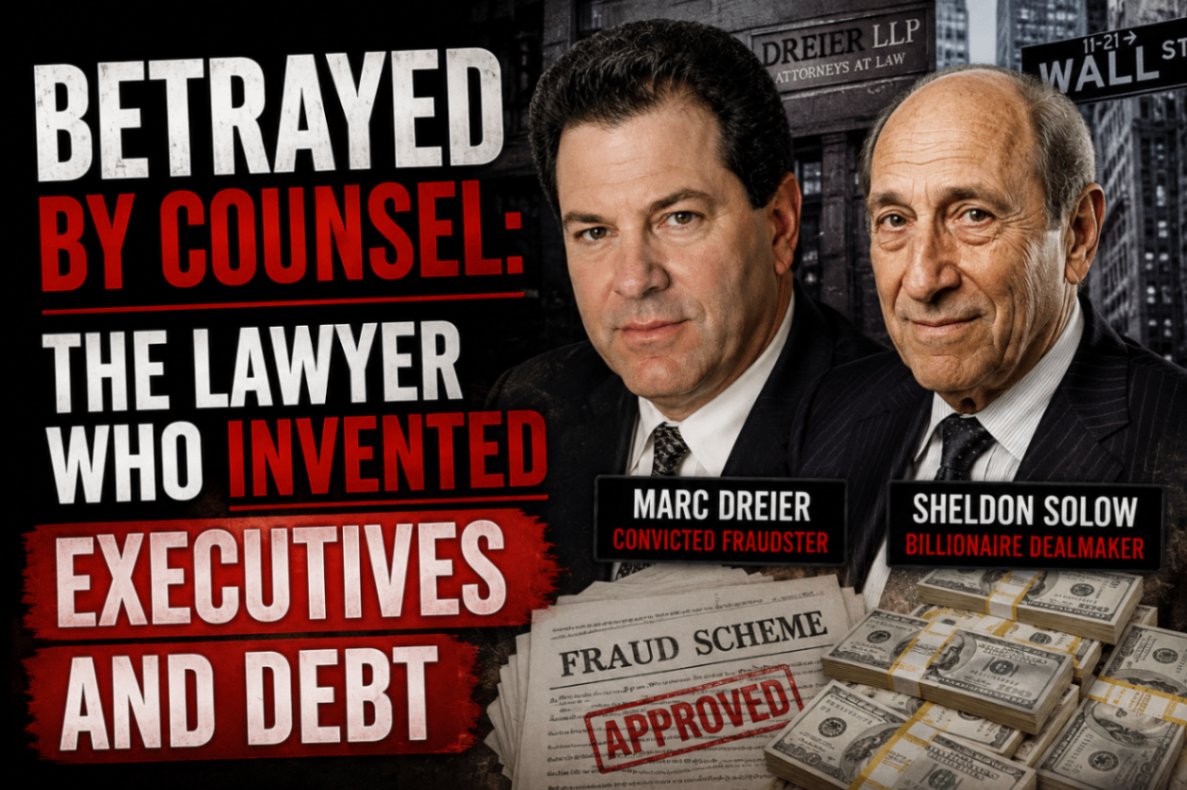
The hedge fund managers sat in the high-end conference room of a Manhattan skyscraper, convinced they were closing a multi-million dollar deal with one of the most powerful real estate empires in New York.
Across the table, a man who claimed to be the president of the company spoke with the quiet confidence of a billionaire’s right-hand man. The paperwork was immaculate. The signatures were verified. The law firm representing the deal, Dreier LLP, was a 270-lawyer powerhouse with offices across the country.
What the investors didn’t know was that the “president” was a paid actor. The conference room had been commandeered for an hour under false pretenses. And the lawyer orchestrating the entire charade, Marc Dreier, was selling them hundreds of millions of dollars in debt that simply did not exist.
Marc Dreier’s fall in 2009 remains one of the most audacious examples of how a law license can be used as a mask for a predator. He didn’t just steal money; he manufactured a reality. In a world where we are taught to trust the prestige of a firm and the ethics of a bar card, Dreier proved that without systemic transparency, a lawyer’s office can become a theater for massive legal bullying and financial ruin.
The problem of credential substitution
The core of Dreier’s fraud relied on a psychological trap called “credential substitution.” Investors assumed that because Dreier was a graduate of Yale and Harvard, and because he ran a massive law firm, his word was as good as gold. They substituted the hard work of verifying a transaction with the perceived prestige of the man handling it.
This same trap is what allows predatory lawyers to operate in the shadows today. Whether it is a New York Ponzi scheme or a Texas courtroom, the legal system relies on the honor of its officers. But when that honor is replaced by greed, the system doesn’t just fail, it facilitates the theft.

At Stop Legal Bullying, we see this pattern repeated by the “Damn Lawyers” featured in the Dolcefino investigation. The playbook involves using the perceived authority of the court to drain assets while shielding their actions from public view. In Dreier’s case, the “authority” was a fake corporate executive; in today’s probate courts, the authority is often a biased ruling or an undisclosed conflict of interest.
Exposing the theater of Marc Dreier
Dreier’s scheme was breathtaking in its simplicity. He sold fake promissory notes, essentially IOUs, purportedly issued by billionaire developer Sheldon Solow. To keep the lie alive, Dreier created dummy email addresses, phony financial statements, and forged audit letters. When hedge funds started asking questions, he took the deception to a new level.
He once waited for a real executive at a real company to leave for lunch, then sneaked into their office building and hijacked a conference room to host a fake meeting with victims. He even hired a former client to impersonate the president of Solow’s real estate company. This wasn’t just a white-collar crime; it was a high-stakes performance designed to prevent victims from discovering they were being bled dry.
This is the extreme version of what we call fee harvesting. While Dreier was selling fake notes, many attorneys today use fake “legal needs” to churn billable hours. In probate and guardianship cases, we see families hit with inheritance theft masked as “necessary litigation.” The “Damn Lawyers” have mastered the art of making a manufactured dispute look like a legitimate legal battle, just as Dreier made a forged note look like a secure investment.
The stench of cronyism and lack of oversight
Dreier operated his $700 million fraud for years because nobody was looking behind the curtain. The Bar associations and judicial oversight committees are often the last to know when a lawyer has crossed the line. Dreier was eventually caught only after he was arrested in Canada for trying to impersonate another lawyer during a meeting, a clumsy mistake in an otherwise sophisticated criminal career.
The reality is that the legal profession is “self-regulated,” which is often a polite way of saying the fox is guarding the henhouse. This lack of transparency is exactly why we see rampant arbitration corruption. When disputes are moved behind closed doors, lawyers can engage in attorney self-dealing without fear of public record or appellate review.

Investigator Wayne Dolcefino has spent years shining a light on this “stench of cronyism.” From the Damn Lawyers to the judges who enable them, the system is designed to protect its own. Just as Dreier’s victims were left with $400 million in losses, today’s victims of probate abuse find their life savings evaporated by attorneys who prioritize their own bottom line over the clients they swore to protect.
The lesson: credentials are not a substitute for verification
Marc Dreier was sentenced to 20 years in prison, but his story serves as a warning. A law license is not a guarantee of ethics. A prestigious firm address is not a guarantee of safety. The legal industry has become a marketplace where the tools of the trade, motions, hearings, and settlements, are often weaponized against the very people they are meant to serve.
We see this weaponization in contingency fee abuse, where lawyers take the lion’s share of a settlement while the victim is left with pennies. We see it in the explosion of bar complaint filings that go nowhere because the disciplinary system is broken.

Fixing a rigged system
The “Dreiers” of the world are not an anomaly; they are a symptom. The legal system allows for a level of secrecy that is incompatible with justice. To stop the next Marc Dreier, or to hold the current Damn Lawyers accountable, we must demand systemic reform.
First, we must eliminate the “arbitration trap.” Mandatory arbitration allows unethical attorneys to hide their misconduct in private forums where they often have cozy relationships with the arbitrators themselves. All arbitration decisions involving attorney-client disputes must be subject to full judicial review.
Second, we need real-time transparency. The public should have easy access to the track records of attorneys, including all pending investigations and past settlements related to misconduct. If the hedge funds had known about Dreier’s past red flags, his theater would have closed on opening night.
Stop Legal Bullying is committed to being the voice for those who have been exploited. We don’t just want to tell the stories of betrayal; we want to change the laws that allow it. It is time for a legislative debate that puts the rights of citizens above the protection of predatory lawyers. The era of the “lawyer-as-thespian” must end, and the era of accountability must begin.