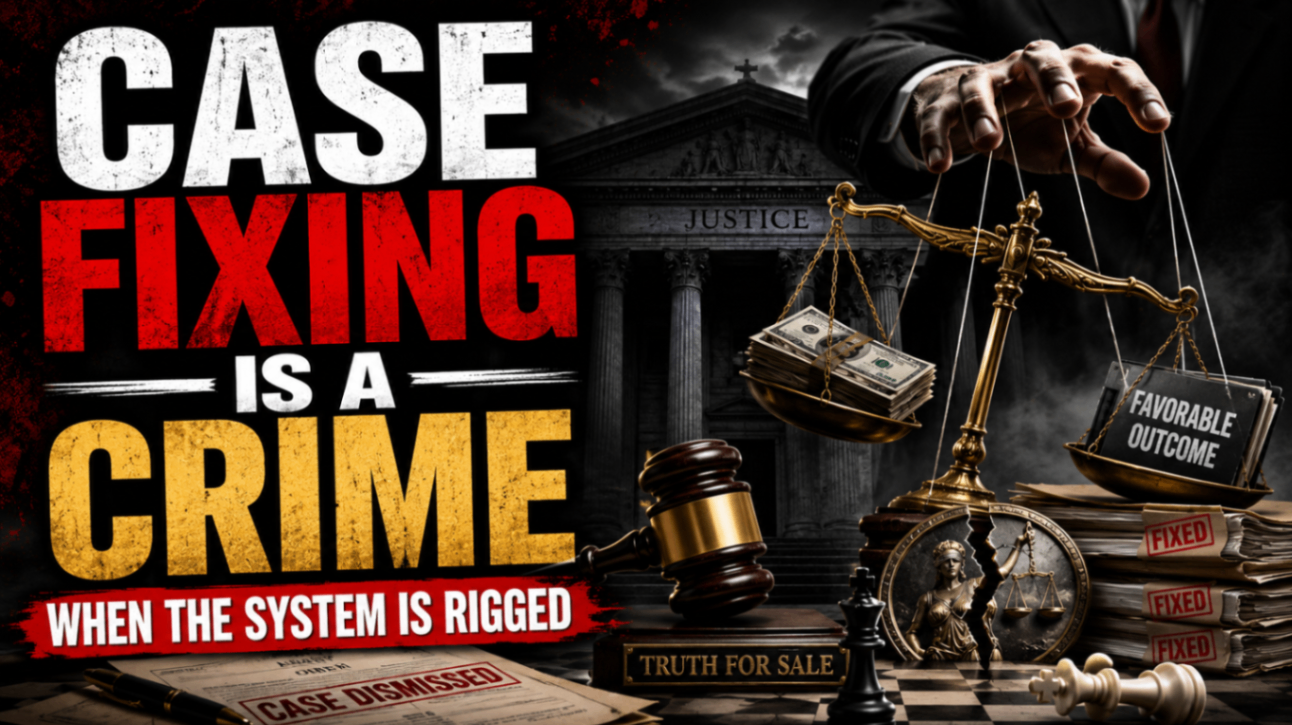
The courtroom is supposed to be the one place where the playing field is level: a sanctuary where the facts dictate the outcome and the law is applied without favor. But for many families in Texas and across the country, that sanctuary has become a hunting ground. Behind the heavy oak doors and the polished mahogany benches, a darker reality often lurks: the “fix.”
Case fixing isn’t just a plot point in a legal thriller; it is a federal crime that strikes at the very heart of the American justice system. When a judge or an arbitrator decides a case based on a backroom deal rather than the evidence, they aren’t just breaking the law: they are committing a betrayal of the public trust that can destroy lives, drain estates, and leave victims in a state of perpetual trauma.
The legal hammer: how the feds crush corruption
When the local systems of accountability fail: when the State Bar looks the other way or local commissions protect their own: the federal government has a specific set of tools to dismantle corrupt networks. The core of almost every case-fixing prosecution is a powerful statute known as honest services wire fraud.
Under 18 U.S.C. §§ 1341 and 1343, federal prosecutors don’t necessarily need to find a suitcase full of cash to prove a crime. They only need to show that a public official (or someone performing a similar role) deprived the public of their right to “honest services” through a scheme involving bribes or kickbacks. This is often paired with:
- 18 U.S.C. § 201: The classic bribery statute for public officials.
- The Hobbs Act (18 U.S.C. § 1951): Prosecuting extortion “under color of official right.”
- RICO (18 U.S.C. §§ 1961–68): Used when the corruption isn’t just one bad apple, but an entire “corrupt organization” of lawyers and judges working in tandem.
For those trapped in the “arbitration trap,” the standard is found in FAA § 10(a)(2), which allows for the vacatur of an award for “evident partiality or corruption.” While arbitrators often escape the orange jumpsuits that judges face, the legal principle remains the same: a rigged decision is no decision at all.
The kids for cash scandal: a warning from Pennsylvania
Perhaps the most chilling example of judicial corruption in U.S. history is the Pennsylvania judicial corruption scandal. Judges Mark Ciavarella and Michael Conahan didn’t just take bribes; they sold the lives of over 2,500 children.
In exchange for $2.8 million in kickbacks from the builders of private, for-profit juvenile detention centers, the judges enforced a “zero-tolerance” policy. Children as young as eight were shackled and hauled away for minor infractions like jaywalking or school-yard arguments: often without a lawyer present.
What makes this scandal so important is how it unraveled. It did not begin with a raid. It began when Laurene Transue made a phone call after her 14-year-old daughter, Hillary Transue, was jailed over a mock judicial abuse. That one parent’s complaint reached the Juvenile Law Center, where advocates began spotting a pattern. Reporting by journalist Terrie Morgan-Besecker pushed the facts into public view. A petition was then taken to the Pennsylvania Supreme Court and denied. Only later, as a separate corruption probe touched organized crime figures and courthouse money trails, did the FBI begin pulling on the thread hard enough to expose the full machine. On January 26, 2009, the U.S. Attorney announced charges that detonated one of the ugliest courthouse scandals in modern history.
The victims were not abstractions. Charlie Balasavage was 14 when he was sent away over a stolen scooter. Ed Kenzakoski was 17 when a fender-bender helped push him into the system; he later died by suicide, and his mother Sandy Fonzo famously confronted Ciavarella on the courthouse steps. Justin Bodnar was 12 when he was punished after cursing at another student’s mother. Amanda Lorah later described the trauma plainly: “I was scared every day… I still wake up from nightmares.” The damage was multiplied by institutional cowardice. Two district attorneys and the chief public defender stayed silent while children were processed like inventory. Court employee Sandra Brulo later entered a guilty plea for obstruction, another sign that the rot did not stop at the bench.
The human toll was catastrophic. Families were shattered, and one young man, haunted by the trauma of his wrongful imprisonment, eventually took his own life. The federal response was decisive. Ciavarella was sentenced to 28 years in federal prison, and Conahan received 17.5 years. A federal judge eventually ordered the duo to pay over $200 million in damages to their victims, a stark reminder that while justice may be slow, it can be devastatingly heavy when it finally arrives.
Texas-sized betrayal: the fall of Judge Angus McGinty
Judicial corruption isn’t confined to the Northeast. Right here in Texas, the stench of cronyism reached the 144th District Court in Bexar County. Judge Angus McGinty was a man who traded his integrity for Mercedes repairs.
Through a series of judicial corruption wiretaps, investigators caught McGinty soliciting bribes from attorney Alberto Acevedo Jr. in exchange for favorable rulings and lenient sentences for Acevedo’s clients. It started with a single civilian tip to the San Antonio FBI division from Acevedo’s own client, a detail that matters because it shows how small the first crack can be before the whole courthouse wall starts to split. Acevedo then flipped, cooperated fully, and received 1 year and a day, while McGinty drew 2 years in federal prison. The investigation also swept wider than the final charges, with other Bexar County actors reportedly under scrutiny as agents mapped the full network around the courthouse.
McGinty thought he was untouchable. Instead, he was sentenced to 24 months in federal prison. His case proves a vital point for victims of the Damn Lawyers featured in the Dolcefino investigation: the FBI does not need a mountain of evidence to start looking; they only need a thread to pull. For families tracking the Anne Ashby story, the McGinty prosecution is the most directly useful Texas precedent because the FBI’s San Antonio Division ran courthouse wiretaps from a single civilian tip and built the case under honest services wire fraud.
The Philadelphia sting: catching a fixer in a ghost trial
In Philadelphia, the FBI took it a step further to catch Judge Joseph Waters. They didn’t just wait for a crime to happen: they manufactured an entire “ghost” case to see if Waters would take the bait.
The investigation reportedly grew out of campaign finance anomalies and a pay-to-play pattern that suggested favors were moving through the courthouse for connected people. To test the system, federal agents invented “David Khoury,” a fake defendant with a fake arrest for carrying an unloaded Glock, a fake Social Security number, and Virginia plates. Even prosecutors and defense lawyers involved in the matter did not know it was a sting. Businessman Samuel G. Kuttab, later convicted of tax evasion, was part of the orbit around the case. Judge Dawn Segal was caught on wiretap helping reduce charges for the fake defendant. Judge Joseph O’Neill was recorded saying “No problem” and later lied to the FBI. Judge Angeles Roca was subpoenaed as investigators widened the net.
Federal agents created a fake defendant and a fake small-claims lawsuit. When a political donor asked Waters to “take a hard look” at the case, Waters didn’t hesitate. He called the presiding judge and urged a favorable ruling for his “friend.” The FBI caught every word on a wiretap. Waters was sentenced to two years in prison, proving that federal investigators are willing to build entire fictitious worlds to expose the reality of case fixing.
The arbitration trap: where the fix is hidden in plain sight
While judges face the threat of FBI stings, the world of private arbitration remains a “Wild West” of undisclosed conflicts. This is where we see the most modern version of the “fix.” In the Dolcefino investigations, we have exposed how mandatory arbitration clauses are used to strip citizens of their 7th Amendment rights.
Take the case of Anne Ashby, a former judge turned arbitrator. In a shocking display of “evident partiality“ it was revealed that Ashby had a 9-year “Of Counsel” relationship with the very firm representing the opposing side: a conflict that remained hidden while she presided over a case involving the attorney misconduct.
This mirrors the landmark arbitration corruption case, where the Ninth Circuit vacated an award because the arbitrator failed to disclose an ownership interest in the arbitration firm (JAMS) that had a massive repeat-business relationship with Monster Energy. The court ruled that an “impression of bias” is enough to tank a ruling. When the predatory lawyers and their preferred arbitrators keep the details of their relationships in the dark, they are participating in a system designed to harvest fees, not deliver justice.
How they get caught: the power of the whistleblower
The criminals in robes and expensive suits rely on one thing: your silence. They want you to believe the system is too big to fight. But history shows that the “fix” is usually exposed through:
- Informants and Tipsters: Most FBI investigations start with one person who has had enough.
- Outcome Pattern Analysis: When the same lawyers (like Nick Abaza, Jorge Borunda, or Michael Trevino) consistently land in front of the same “friendly” arbitrators, it creates a statistical anomaly that investigators love to explore.
- Post-Award Discovery: Digging into the probate corruption records and financial filings often reveals the “handshakes” that were never disclosed.
- Investigative Journalism: The work of Wayne Dolcefino has done more to expose the stench of cronyism than almost any state regulatory body.
The master pattern: one civilian starts the chain
The common thread across Pennsylvania, Philadelphia, and Texas is not just corruption. It is the moment an ordinary person noticed something was wrong and refused to be quiet. One parent’s phone call about judicial corruption helped trigger the chain that exposed the largest judicial corruption scandal in modern history. In Texas, an attorney’s own client tipping the FBI helped bring down a Bexar County judge. In Philadelphia, investigators followed campaign-finance irregularities and pay-to-play patterns until they built a fake case that flushed out the fixers.
That is the master pattern victims need to understand. You do not have to prove the whole enterprise on day one. You only have to report the thing that makes no sense, preserve the timeline, save the messages, and refuse to be intimidated. You are the whistleblower in the chain. And when your evidence is combined with reporting, records, and the kind of digging seen in the attorney misconduct investigation and the wider legal abuse series, the stench of cronyism becomes a map investigators can follow.
The fix for the fix: legislative reform
We cannot wait for the FBI to catch every corrupt lawyer. We need systemic reform to ensure that no family is ever forced into a probate plot or a rigged arbitration room again.
This is why we are calling for the passage of probate reform legislation. This legislation would require that all mandatory arbitration be subject to judicial review, ensuring that if an arbitrator like arbitration misconduct fails to disclose a conflict, there is a clear, legal path to hold them accountable.
The legal system should not be a “pay-to-play” scheme for predatory attorneys. If you have been a victim of the predatory lawyers or have witnessed the “fix” in action, your voice is the most powerful weapon we have. It’s time to stop the legal bullying and demand a system that follows the law, not the money.