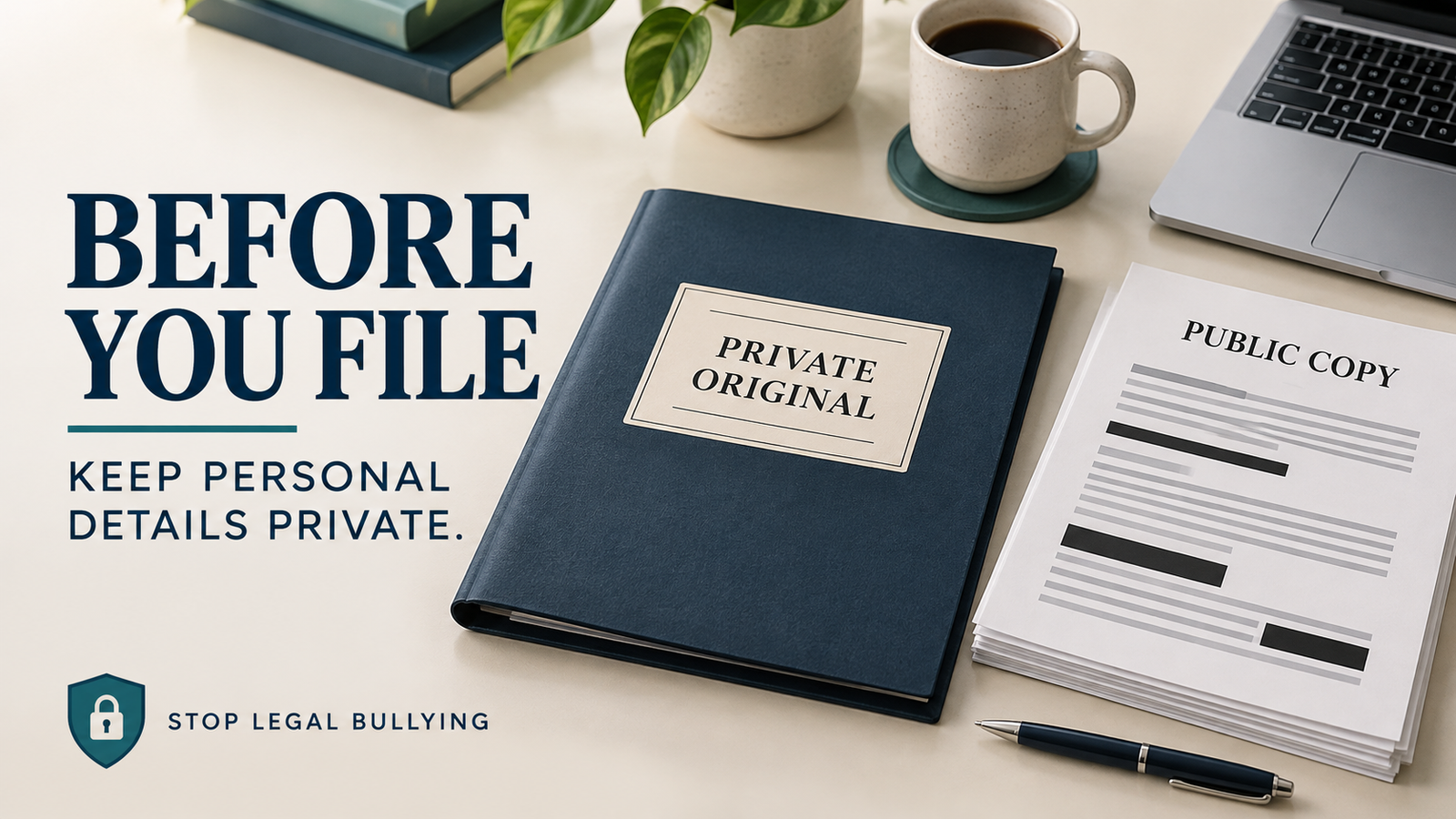
A court filing can become part of a public record. Before submitting a federal-court document, check the public copy for personal information, not only in the main text, but also in exhibits, attachments and hidden file data. The rules cover specific identifiers; they do not automatically make every personal detail confidential. The filer is responsible for checking what is submitted.
The Damn Lawyers campaign publishes legal-accountability reporting, but making an issue public does not require exposing every personal identifier. This guide concerns federal filing rules. It does not report a privacy breach in any separate campaign matter discussed below.
Know which identifiers the federal rules cover
Federal Rule of Civil Procedure 5.2 sets limits for specified information in civil filings. Unless an exception or court order applies, a filing may include only the last four digits of a Social Security or taxpayer-identification number, the year of a person’s birth, a minor’s initials, and the last four digits of a financial-account number.
Federal Rule of Criminal Procedure 49.1 covers those categories in criminal filings and also limits an individual’s home address to the city and state. That additional address provision is part of the criminal rule. Do not assume it creates a universal federal civil-case requirement, and do not apply these federal rules to state-court filings.
The rules include exceptions, and a court may issue orders that affect what must be redacted. If a complete identifier seems necessary, do not assume the answer is to file it publicly or to seal the whole document. Check the current rules and procedures for the court handling the case, any relevant court order, or ask a lawyer about the proper process.
Make a separate public copy
Keep the original document unchanged in a secure private location. Prepare a separate copy for public filing, and review that copy from beginning to end. Check every page, exhibit and attachment. Personal identifiers may appear in places that are easy to miss, such as account statements, medical records, correspondence, forms or screenshots.
Redaction is the filer’s responsibility. Do not assume court staff will find and correct a problem before a document becomes accessible. Also remember that removing an identifier from the main document does not remove it from a separate attachment or from a second copy included in the filing.
If a document needs to include information that the public copy should not show, follow the court’s current procedure. Depending on the circumstances and applicable rules, a process may involve requesting permission to file material under seal or using another court-approved method. Sealing is not automatic or guaranteed. Check the local rules and orders before filing.
The campaign’s accounts from probate families and arbitration-related accounts concern different disputes. Readers collecting their own records can preserve complete evidence privately while checking which information belongs in a public filing. These links do not establish that any campaign subject exposed private information.
Remove the text, not just its appearance
A black rectangle placed over words may hide them on screen while leaving the text underneath selectable, searchable or recoverable. Changing text to white can have the same problem. A visual cover is not a reliable redaction.
Use a method that actually removes the sensitive text from the public copy, then check the result. The District of New Jersey’s guidance on personal identity and metadata redaction techniques warns that a PDF may contain information beyond what is visible in a reader, including prior revisions, author details and other metadata. It also cautions that covering or recoloring text does not protect it.
Before filing, reopen the final PDF, not just the editable source file. Review the visible pages; search the PDF for the information you meant to remove; inspect document properties; and check for attachments or other included material. Sanitize hidden metadata as appropriate. Do not assume that printing to PDF or flattening a file alone makes it safe; verify the actual final document.
Keep sensitive information out of screenshots and filenames as well. A filename can be displayed in a docket or copied into other systems. Use a neutral name for the public copy, without personal identifiers.
If the document is already filed
If you discover personal information in a document that has already been filed, do not send it again publicly while asking for help. Contact the court clerk or your counsel to ask what procedure applies. The right next step depends on the court’s rules and the circumstances; do not assume that a public filing can simply be replaced or removed without following the court’s process.
Read separate campaign records on their own terms
Campaign-published filings raise questions about representation terms and advice during a legal matter. Read each alongside its underlying documents and any response. A filing records allegations; it does not establish that an authority accepted them.
A record concerning disputed legal charges requires its own agreement and billing context. The judicial-conduct submission concerns a separate oversight process. Neither is a report about filing privacy or data exposure.
The collection also contains a filing addressing professional duties, a separate legal-service dispute and concerns about an older client’s understanding. Their subjects are not connected here to filing privacy or data exposure. A shared place in an archive does not combine distinct allegations into one case.
Check the full account, not a short summary
Related campaign reporting examines online review removal and professional relationships. Read the full report to distinguish an interviewee’s statement from a documented event or an official finding.
The same care applies to reporting on alleged deception, arbitration disputes and probate disputes. These are separate campaign materials, not evidence about a privacy breach. Their inclusion implies no endorsement by the people discussed.
Before submitting your own document, check the final public copy against the applicable rule and any court order. Keep the private original secure. If the technical or procedural question remains unresolved, get help before putting sensitive material into the public record.
Sources: Federal Rules of Civil Procedure 5.2 and Criminal Procedure 49.1, reproduced by the Eastern District of Kentucky; District of Maine advisory on personally identifiable information; District of New Jersey guidance on personal identity and metadata redaction. General information, not individual legal advice; verify current local rules and orders.
AI-generated conceptual illustration; no actual filing or personal information is depicted.