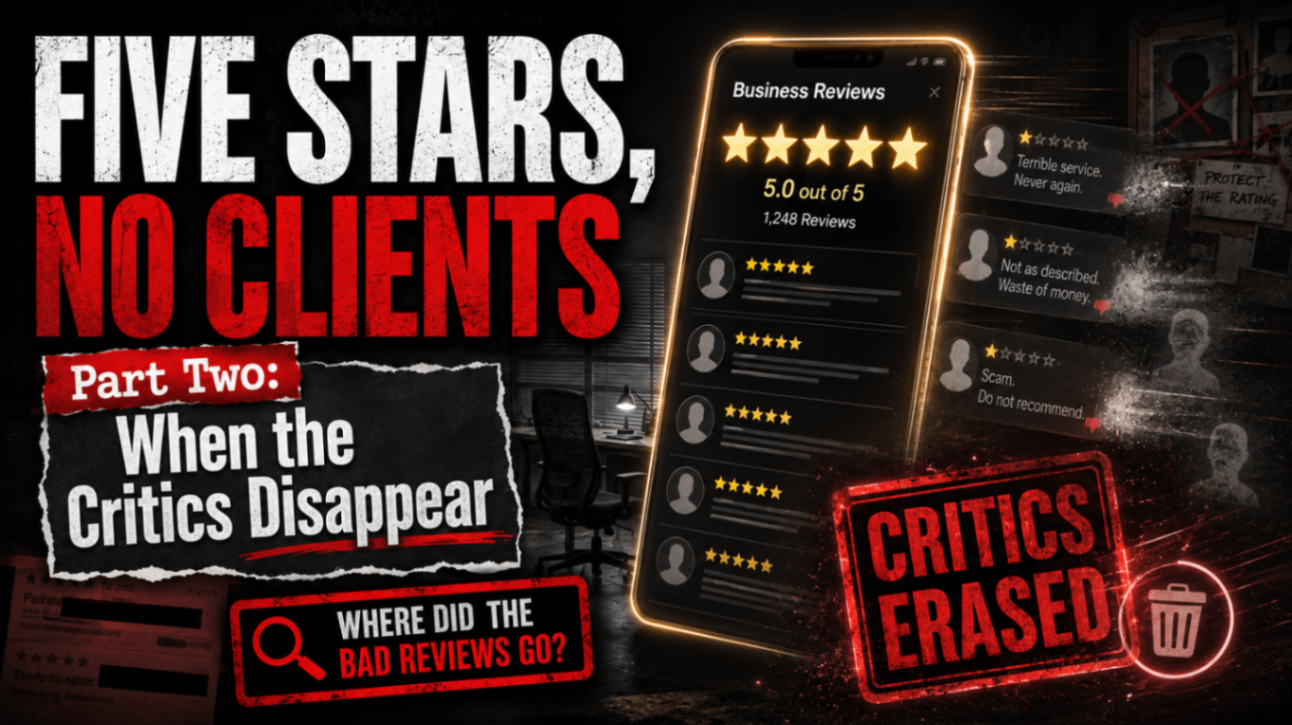
The courtroom is a theater of evidence, but the digital storefront of a law firm is often a theater of mirrors. For families caught in the crosshairs of a probate battle, a Google or Avvo rating isn’t just a number: it is a lifeline. They are looking for a protector, a guide through the labyrinth of grief and litigation. What they often find instead is a curated illusion, a digital fortress where dissent is silenced and the truth is “ghosted” into oblivion.
In this second installment of our investigative series, we peel back the curtain on how predatory lawyers manufacture trust by ensuring their failures never see the light of day. When the critics disappear, the public is left vulnerable to the very system meant to protect them.
The FTC once accused a fashion company of hiding hundreds of thousands of negative reviews. Former legal clients now describe a quieter version of the same problem.
Fashion Nova did not need to invent every positive review on its website. According to the Federal Trade Commission, the company created a misleading picture by holding back the negative ones.
In 2022, the retailer agreed to pay $4.2 million to settle allegations that its review system automatically published four- and five-star ratings while hundreds of thousands of lower-star reviews waited in a queue and never appeared. It was the FTC’s first case accusing a company of suppressing negative customer reviews. Fashion Nova disputed the agency’s characterization but agreed to restrictions on how it handled future reviews.
The lesson was simple: A rating can be deceptive even when the glowing reviews are genuine. Remove enough criticism and the remaining praise tells a false story.
That principle takes on unusual force in the legal profession, where dissatisfied clients may be unable to prove their experience without revealing confidential information. This dynamic is particularly dangerous in cases of inheritance theft, where the emotional and financial stakes are at their peak.
The complaints involving the trio describe negative reviews that their author says were challenged, rejected, filtered or made difficult to see while favorable reviews from professional insiders remained visible. Those allegations fit a broader pattern of attorney misconduct that Dolcefino investigation has started to expose.
The complaint against one of the predatory lawyers includes five review-related rejection notices and alleges that no critical Avvo review survived on his profile. It also reproduces a private Yelp message sent at 1:18 a.m. from an account identified as “Alexi D.”
“I am afraid your review didn’t make sense,” the sender wrote before questioning whether the reviewer was truly a client and disputing details of the probate matter.
The recipient answered: “Who is Alexi D.? I’m not discussing my case with someone I don’t know.”
Caroline Allison alleges the account was connected to that lawyer’s family or business presence. The full review manipulation evidence lays out the exchange. The screenshots establish the exchange, but not who typed the message or whether that lawyer authorized it. This type of digital maneuvering often masks deeper issues like fee harvesting and undisclosed conflicts.
The complaint involving another of the predatory lawyers contains screenshots of a long one-star account written by someone identifying herself as a real client. The review warned readers to examine the engagement agreement and discussed fees, arbitration and the handling of the case. The complaint labels it “ghosted,” meaning Allison says it appeared to the poster but was not functioning as an ordinary public review.
Platforms have legitimate reasons to remove material. Reviews can be fabricated, duplicative, defamatory or filled with private information. The arbitration trap enables this secrecy, shielding attorneys from accountability. Lawyers are entitled to contest false claims. For a closer look, watch this arbitration trap overview.
But legal clients enter the dispute at a disadvantage.
The lawyer has the contract, billing records, emails and complete file. The lawyer understands defamation, confidentiality and the language that triggers platform moderation. The client may be asked to upload documents from a painful probate or family fight simply to prove that the relationship existed. This imbalance is the cornerstone of probate abuse victims, where the victim is forced to relive their trauma just to warn others. The deception evidence makes that cost impossible to ignore.
That imbalance can turn review moderation into a second legal proceeding: one the lawyer is far better equipped to win. Arbitrators with hidden conflicts make these rulings.
Federal law already recognizes the danger of silencing honest reviewers. The Consumer Review Fairness Act protects consumers against contract provisions that prohibit or penalize truthful criticism. The FTC’s newer rule also prohibits certain unfounded threats or intimidation used to suppress negative reviews.
Yet the platforms’ decisions remain largely invisible.
A review disappears. The star rating rises. The prospective client sees no notice that criticism was submitted, challenged or removed. In the shadows of these digital deletions, arbitration corruption flourishes, as mandatory clauses prevent these disputes from ever reaching a public courtroom.
There may be valid explanations for each deletion alleged in the Houston complaints. That is why platform records matter: who challenged the review, what the lawyer claimed, what evidence the client supplied and why the platform ruled as it did. The same pattern described in the probate plot raises deeper questions about who gets believed.
Without that information, the public is left with a polished score and no way to know what was edited out.
A five-star reputation can be built with false praise. It can also be built by making certain that dissatisfaction never counts. This systemic suppression is a form of legal bullying that leaves families defenseless against those who would exploit their inheritance.
The stench of cronyism isn’t just found in the backrooms of courthouses; it’s baked into the very algorithms that govern our trust. When lawyers use their superior knowledge of the law to silence those they have harmed, they aren’t just protecting their brand: they are dismantling the 1st Amendment rights of their victims. The stories of victims of Anne Ashby show how familiar this pattern has become.
The solution requires more than just better platform moderation. We must demand systemic reform that brings these hidden disputes into the light. We need legislative solutions that require arbitration to be subject to judicial review and transparency in how legal professionals manage their digital reputations.
The “Damn Lawyers” may have succeeded in quieting individual voices for a time, but the collective outcry for accountability is growing. It is time for the Texas Legislature to step in and ensure that the digital storefront of the legal profession is held to the same standard of truth as the testimony given under oath. Families confronting inheritance theft deserve public scrutiny, not secret systems.
True justice cannot exist in a system where the evidence of misconduct is deleted at 1:18 a.m. by an anonymous account. We must continue to push for transparency, support accountability into unethical practices, and ensure that no family is ever again led into the “arbitration trap” by a review manipulation. The fight against legal bullying belongs in open legislative debate.
Accountability is not an option; it is a necessity. The critics haven’t disappeared; they’ve just been silenced. It’s time to give them back their voices.