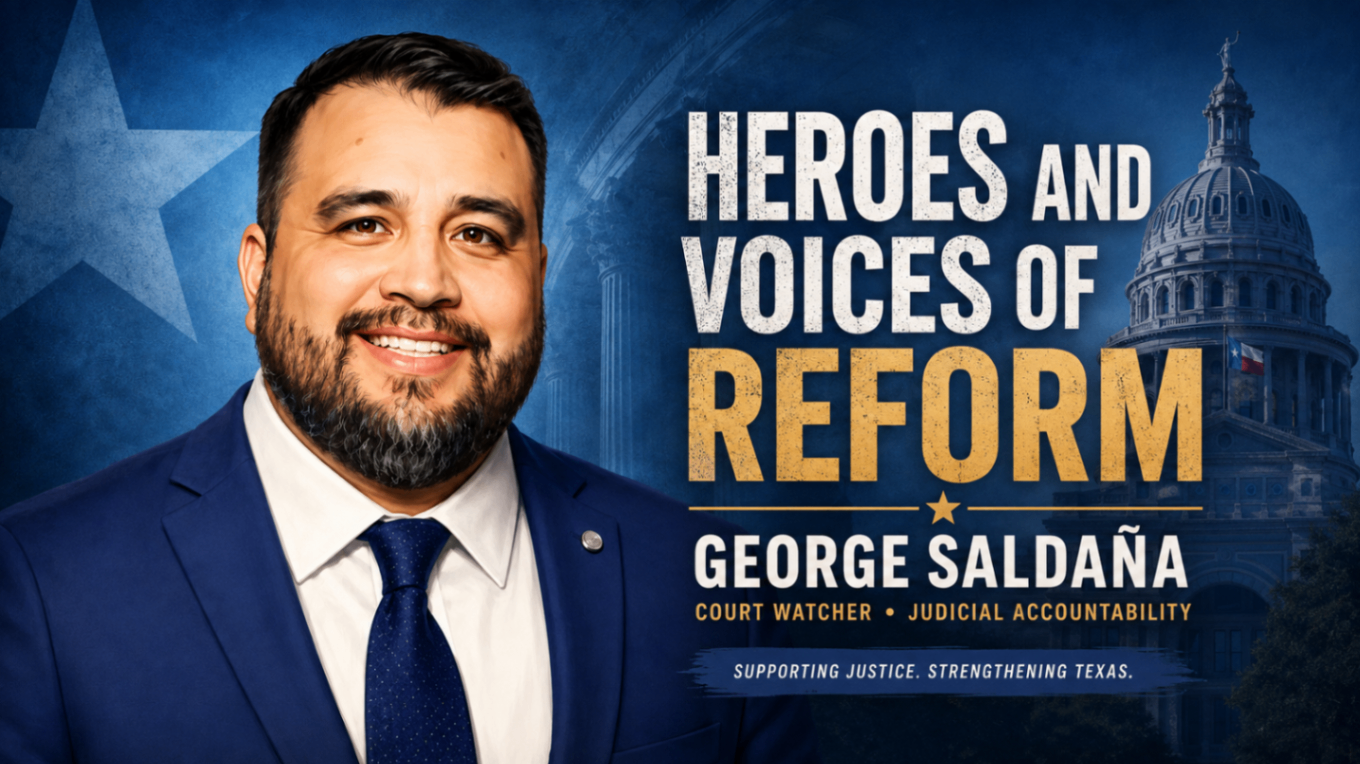
Some advocates arrive at court reform through policy. George Saldaña arrived through pain.
He says he has gone years without seeing his son. That personal loss did not make him withdraw. It made him start reading. He began studying statutes, court procedure, judges, judicial races, legislative proposals, committee hearings, and the day-to-day machinery of the Texas court system. What started as a father’s attempt to understand what had happened became something larger: a habit of showing up, paying attention, and helping other people ask better questions.
That is what makes George Saldaña a strong fit for Friday’s Heroes and Voices of Reform series. He is not presented here as a judge, a lawyer, or a final authority on every issue he discusses. He is a citizen advocate whose public voice has grown out of lived experience. Readers do not have to agree with every opinion he shares to recognize the value of accumulated experience, persistence, and civic participation. In a system that can feel sealed off from ordinary families, that kind of public engagement matters.
When reform becomes personal
Court reform can sound abstract until it lands in someone’s home. For George, the issue is not theoretical. He speaks from the position of a parent who believes the system failed to protect an important relationship in his life. He has described the experience in human terms, not policy language: years passing, a son growing up, and the unbearable weight of missed time.
That grief appears to have become his engine. Instead of staying at the level of outrage, George turned toward process. He wanted to know what happens when a custody order is not followed. Who enforces it? What recourse does a parent have when enforcement seems slow, inconsistent, or out of reach? What happens when court actors are accused of failing to follow the law? Where does a citizen go when each doorway seems to lead to another office, another form, another hearing, or another dead end?
Those questions are why many parents and reform-minded Texans pay attention to people like George Saldaña. He is trying to translate a system that often feels unreadable to the people most affected by it.
Learning the language of the system
George’s public advocacy reflects a simple but powerful lesson: the system speaks its own language, and parents who do not learn it are often at a disadvantage.
According to his public commentary, that learning process led him deep into legal research and civic process. He began studying court procedure, judicial conduct, election cycles, committee hearings, and the rhythms of the Texas Legislature. He paid attention not only to what laws say on paper, but also to how institutions respond when families try to invoke those laws in real life.
That focus puts him in conversation with broader concerns about procedural fairness and accountability. Stop Legal Bullying has repeatedly argued that legal bullying is ultimately a transparency, accountability, and legal-system reform issue, requiring public visibility, better tracking of complaints, and clearer pathways for ordinary people who believe something has gone wrong. Related concerns about probate abuse and hidden decision-making in other parts of the legal system are different from family-court conflicts, but they raise a similar question: how is a regular person supposed to challenge a process that feels insulated from scrutiny?
George’s answer, in practice, has been to keep learning and keep teaching.
A court watcher with a phone and a memory
Some advocates work mainly behind the scenes. George is more visible than that. He has built a public presence as a court watcher, legislative participant, testifier, and educator. He watches hearings. He tracks public issues. He follows judicial races. He listens when candidates, officeholders, and institutions explain themselves. Then he brings that information back to the public in a form that feels direct and usable.
His Facebook videos are part of that effort. They appear to function as frequent, informal public education: discussions of statutes, hearings, court issues, judicial races, and developments that he believes ordinary Texans should understand. Readers who want to follow those updates can do so on George’s public Facebook profile. They are not courtroom transcripts or neutral encyclopedias, and they should be evaluated as advocacy commentary and public education, not official legal advice or verified findings. But they do serve a public function that many people find valuable. They model engagement. They show that a citizen can pay attention, take notes, ask questions, and invite others to do the same.
That may be one reason his voice resonates with parents and reform advocates. He is not speaking in polished institutional language. He sounds like someone who had to learn the hard way and decided not to keep the lessons to himself.
The questions that keep families up at night
The most powerful part of George Saldaña’s advocacy may be the questions underneath it.
What happens when a custody order is not followed?
Who enforces it?
What recourse does a parent actually have?
What happens when the lawyers and judges entrusted with enforcing rules are themselves the subject of criticism or advocacy concerns?
These are not academic questions for families. They shape whether a parent sees a child, whether a child maintains a relationship, and whether a person leaves the courthouse believing the law means what it says.
George’s public work keeps those questions alive. He appears determined not to let them be brushed aside as private heartbreak or isolated frustration. He pushes them into civic space, where they become questions about parental rights, public participation, judicial accountability, and the obligations of people who hold power.
That matters even when answers remain incomplete. Many Texans have learned that there is a large difference between reading a rule and getting meaningful enforcement of that rule. George’s advocacy keeps attention on that gap.
Watching judges, watching elections, watching the process
One of the distinctive parts of George’s profile is that his advocacy is not limited to a single grievance. He does not appear to see reform as something that happens only in one courtroom on one bad day. He pays attention to judicial races, public office, hearings, and the legislative process because those are the places where culture gets reinforced or challenged.
That broader lens is important. Families often encounter the justice system at the worst moment of their lives, but the system they meet was shaped long before their hearing date. Judges run for office. Legislators write and amend statutes. Committees hear testimony. Oversight bodies decide what they will pursue and what they will leave unresolved. Voters, when they are paying attention, can influence some of that. When they are not, the process can feel like a closed loop.
George’s contribution is to remind people that participation does not end with personal disappointment. It can begin there.
That public participation includes testimony and public comment. The supplied video records George Saldaña speaking during the Texas State Commission on Judicial Conduct’s October 2, 2024 public hearing on the Commission’s mission and operations. In those remarks, he identified himself as a family-court accountability advocate and raised concerns about judicial oversight, enforcement of family-court orders, First Amendment and due-process issues, and the Commission’s handling of complaints. Those were the subjects of his public comments and advocacy concerns, not established findings, and his message urged greater accountability and transparency.
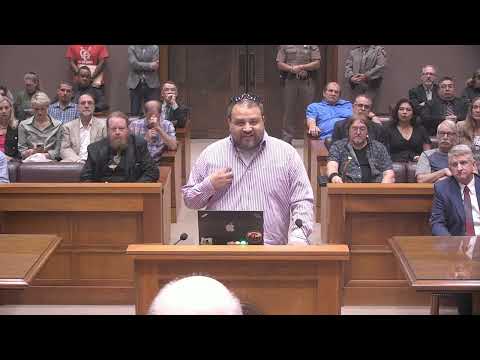
▶ Watch George Saldaña’s October 2, 2024 public comments before the SCJC on YouTube.
George also supports legislative efforts to strengthen judicial accountability and works with or supports Texans for Judicial Accountability. His advocacy in that lane includes advancing public awareness, public comment, and legislative change. It does not mean he personally passed any law, and it does not imply that any specific proposal has already been enacted.
He keeps showing up as a witness to process. He keeps showing up as a participant in public debate. He keeps showing up as someone trying to make complex civic systems less mysterious for the next parent standing in confusion outside a courtroom.
Why his voice matters even when people disagree
Advocates who work in public will always draw disagreement. That is normal, especially in emotionally charged areas like family court, parental rights, and judicial accountability. It is also why nuance matters.
This profile does not ask readers to treat every claim, interpretation, or conclusion as established fact. It does not resolve the merits of George Saldaña’s family case. It does not declare misconduct by any judge, lawyer, or court actor. Where George speaks from personal experience or advocacy concern, those points should be understood in that context.
What this profile does recognize is the public value of someone who keeps doing the civic work anyway.
There is a difference between perfection and usefulness. George’s public record as an advocate suggests usefulness: to parents trying to understand the vocabulary of the system, to citizens trying to follow judicial races, to observers trying to make sense of hearings and procedure, and to reform-minded Texans who want to know how to participate rather than simply complain.
That is part of the larger spirit behind the Damn Lawyers series backstory. Stop Legal Bullying exists because too many people describe legal systems as intimidating, confusing, or inaccessible. Wayne Dolcefino’s investigations have focused public attention on places where the powerful allegedly benefit from opacity. George’s lane is different in style, but connected in spirit: show people how the machinery works, or fails to work, so they can engage it with clearer eyes.
He keeps showing up
The simplest way to understand George Saldaña may also be the most accurate.
He keeps showing up.
He keeps showing up to watch.
He keeps showing up to learn.
He keeps showing up to ask what the law requires and what happens when lived reality seems far from that promise.
He keeps showing up in discussions about parental rights, custody interference, judicial accountability, judicial races, and legislative reform.
He keeps showing up for people who are still trying to understand how a court system can feel so formal on paper and so bewildering in practice.
That repetition matters. Reform is not only made by polished experts or elected officials. Sometimes it is sustained by ordinary people who refuse to disappear after the worst thing in their life happens. Sometimes it is advanced by someone who studies late, records a video, watches a hearing, testifies when allowed, explains a process to another parent, and returns the next day ready to do it again.
George Saldaña’s story belongs in Heroes and Voices of Reform because it illustrates a kind of civic endurance that institutions cannot manufacture. He did not wait for permission to become informed. He did not wait for a title to begin educating others. He did not stop at private grief.
He turned that grief into vigilance.
For readers who feel overwhelmed by family court, judicial procedure, or the sheer distance between official language and real-world experience, that example has weight. The lesson is not that one advocate has all the answers. The lesson is that public participation still matters, accumulated knowledge still matters, and persistent witnesses still matter.
George keeps showing up, keeps watching, keeps learning, and keeps trying to make the system easier for the next parent to navigate. Texas needs more of that kind of accountability-minded citizenship, and the people with power should expect the public to keep watching.
This profile is provided for general information only and is not legal advice. It describes George Saldaña’s public advocacy and reported experiences, and it does not determine the truth of any individual allegation or resolve any family-court dispute.