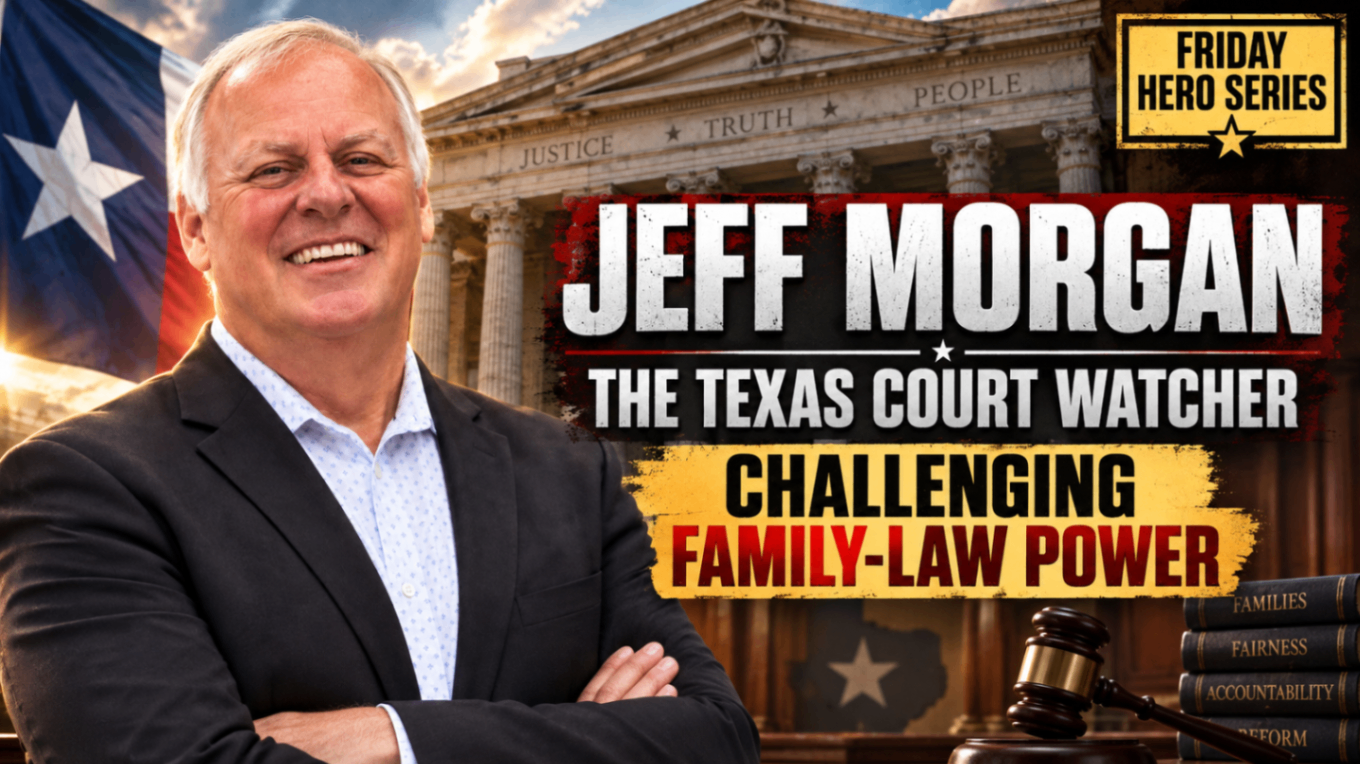
Friday’s Voices of Reform / Heroes Day feature
The Reformer Behind the Record
Jeffrey S. “Jeff” Morgan of Dallas is not a lawyer, judge, or institutional-policy executive. He is a citizen activist, researcher, court watcher, commentator, legislative advocate, and pro se litigant who has spent years questioning how family courts operate and who benefits from their structure.
Public records and advocacy materials identify Morgan in different ways as a federal Financial Institution Examiner or an FDIC professional. That background helps explain the way he approaches reform. He tends to examine systems through the lens of incentives, conflicts, institutional relationships, controls, and accountability.
His central question is not limited to whether a particular divorce statute is wise. It is broader: What happens when professionals with specialized power operate inside a system that ordinary families cannot effectively audit?
That question overlaps with Stop Legal Bullying’s work on judicial accountability, transparency, complaint systems, and institutional reform. Related campaign reporting on the Allison family probate case concerns a separate dispute, but the recurring concern is similar: who watches the people who control the process?
He Was Reforming Before He Was Litigating
Morgan’s reform work predates his current divorce case by years.
In 2019, he became active around HB 922 and HB 926, proposals associated with then-Representative Matt Krause. Morgan’s position was more specific than a blanket call to prohibit divorce. He distinguished between:
- Mutual-consent divorce, where both spouses agree; and
- Unilateral no-fault divorce, where one spouse seeks to end the marriage over the other spouse’s objection without proving traditional fault.
His argument was that mutual consent should permit a no-fault divorce, while a nonconsenting spouse should be entitled to require proof of a legally recognized ground. HB 926, as described in contemporary reform accounts, would have extended the waiting period in certain cases involving children from 60 days to six months.
In 2021, Morgan was also identified with efforts surrounding HB 3187, HB 3188, and HB 3190. Advocacy accounts describe him as a connector who brought written testimony from outside reform advocates to Matt Krause. The network reportedly included Bai Macfarlane of Mary’s Advocates, Jennifer Roback Morse of the Ruth Institute, and Katy Faust of Them Before Us.
The record should be described carefully. The available legislative search results do not independently confirm every role attributed to Morgan in those bill campaigns. His involvement is documented in advocacy materials and public accounts, but advocacy documentation is not the same as an official legislative finding.
The same caution applies to Morgan’s account that he helped add the word “unilateral” to Republican Party of Texas platform language concerning no-fault divorce. That may be politically significant, but it remains his account unless platform records independently establish authorship.
The Ruth Institute recognized Morgan as its 2019 Activist of the Year. That is meaningful recognition from an organization in the marriage and divorce-reform movement, documented through the Ruth Institute recognition, but it should not be described as an objective ranking of all Texas activists.
The Court Watcher
One of Morgan’s strongest claims to reform credibility comes from his court-watching work. In written comments described in the research record, he said he had attended more than 300 family-court and CPS proceedings.
That level of observation shaped his criticism of broad standards such as the “best interest of the child.” Morgan argues that when statutory language is open-ended, judges, attorneys, evaluators, and other court-connected professionals may exercise enormous discretion with limited public visibility.
His proposed solutions have included:
- Defining “best interest of the child” more precisely;
- Favoring preservation of intact families;
- Presumptive 50/50 custody in some circumstances;
- Strengthening parental and grandparent relationships; and
- Limiting highly subjective decision-making by judges and professionals.
Those proposals are controversial, and Stop Legal Bullying does not endorse every one of them. But they reveal a consistent philosophy: discretion should be matched by standards, records, and review.
Morgan has also raised concerns about protective orders, CPS investigations, alleged false accusations, perjury, attorney conduct, and the use of legal procedures as tactical weapons. His descriptions of “criminal coaching,” favoritism, ex parte communications, campaign-finance relationships, or judicial misconduct remain allegations or opinions unless supported by official findings.
There is a similar distinction between a public complaint and a proven violation. A bar complaints resource can help explain the process, but a complaint itself does not establish attorney misconduct, liability, or discipline.
The official legislative record also requires precision. Advocacy materials have associated Morgan with support for procedural protections in HB 1086. However, the official 2023 public-comments record located during research identifies Jeffrey Morgan commenting in support of HB 1686, not HB 1086. Those are different bills. The discrepancy should be resolved before HB 1086 is presented as a verified part of his legislative record.
The Lobbying and Accountability Question
The most revealing part of Morgan’s reform record may not concern divorce at all. It may be his March 2023 criticism of the Texas Family Law Foundation.
Morgan questioned why an organization representing family-law professionals should receive privileged access in legislative discussions about a system in which its members work and earn money. He argued that lawmakers should distinguish between:
- A neutral expert;
- A professional organization;
- A lobbying organization; and
- A stakeholder with direct economic interests in the outcome.
That is a classic regulatory-capture question. It does not prove corruption. It does not establish that the Texas Family Law Foundation acted improperly. It does, however, raise a legitimate institutional issue: when lawmakers seek advice about reform, whose experience is treated as authoritative, and whose experience is treated as anecdotal?
Morgan also questioned communications involving Joel Rogers, the Texas Attorney General’s Child Support Division, and the Texas Family Law Foundation. His language was often forceful, including characterizations of corruption. Those characterizations remain Morgan’s allegations, not established findings by the Attorney General or another adjudicating body.
Still, the underlying concern has broad relevance. The same question arises in debates over lawyer accountability, attorney self-dealing, professional lobbying, and complaint systems: can institutions fairly police an industry when insiders dominate the information flow?
That is why Morgan’s work belongs in a larger reform conversation that includes legal abuse, transparency, consumer protection, and public access to records.
The Network
Morgan operates across several reform communities rather than through one large staffed organization.
In December 2023, he moderated a Dallas screening and discussion of We The Parents. The advertised panel included Jennifer Lundy of Texans for Judicial Accountability, Anthony Brassil of National Parents Organization of Texas, Jeff Younger, and Britton Brooks. The event identified Morgan as a “Family Rights Advocate and Court Watcher.”
The participants’ appearance on one panel does not establish that they agreed on every issue or endorsed one another’s positions. It does show that Morgan has served as a bridge among parental-rights advocates, court watchers, legislative reformers, and critics of judicial discretion.
Jennifer Lundy’s organization has emphasized court transparency and reform. Stop Legal Bullying has also documented broader reform work in a feature on judicial transparency. These resources are advocacy materials, not substitutes for court records or legal advice.
The same network logic extends beyond family law. Families dealing with probate disputes may recognize similar concerns in resources for probate victims. Consumers questioning forced arbitration may encounter the same institutional imbalance in campaigns addressing arbitration reform. Stop Legal Bullying’s Damn Lawyers investigation likewise approaches legal power through documentation and public accountability, not through a claim that every lawyer or judge is unethical.
The Case That Made the Issue Personal
On July 8, 2025, Morgan’s wife filed for divorce in Dallas County. Morgan, representing himself, later filed a constitutional challenge to Texas Family Code §6.001, the statute allowing a court to grant a divorce without regard to fault when one spouse alleges that the marriage has become insupportable.
The statutory language is available in the Texas Family Code. A published profile described Morgan’s filing as a lengthy motion raising due-process, equal-protection, religious-liberty, contract, separation-of-powers, and First Amendment theories. The constitutional challenge record contains additional updates from an advocacy organization following the case.
The litigation remains active and contested. Reports say several judges recused themselves or were replaced during the proceeding. The reasons for those recusals should not be inferred without reviewing the actual orders. A recusal is a procedural event; it does not establish bias, misconduct, or the merits of either party’s position.
The case transformed Morgan’s longstanding policy argument into a live constitutional dispute. He is now testing in court the same proposition he had advanced in public for years: that a nonconsenting spouse should have a meaningful legal defense against unilateral dissolution.
Why Jeff Morgan Matters
Morgan is not an institutional-policy lawyer or a neutral academic. He is an intensely committed grassroots reformer whose rhetoric can be religious, ideological, and at times inflammatory. That style may narrow his appeal among moderates, judges, or organizations seeking a nonideological coalition.
But his strengths are substantial:
- Persistence: His public reform record stretches across roughly a decade.
- Firsthand observation: He says he has watched hundreds of family-court and CPS proceedings.
- Network intelligence: He has connected advocates, legislators, researchers, and court watchers.
- Audit-style thinking: He focuses on incentives, controls, relationships, and failure points.
- Transparency: He records and analyzes public hearings and presentations rather than relying only on private allegations.
On August 18, 2026, Morgan addressed the Texas Commission on Marriage and Family. His remarks appear in the official HHSC meeting video at approximately 3:40:55. The commission was created by HB 3284, whose official text describes a temporary state advisory body. The official commission video shows that Morgan remains active in Texas family-policy debates.
The Question Nobody Has Answered
The enduring question behind Jeff Morgan’s work is not simply whether Texas should repeal no-fault divorce. It is whether a legal system can claim legitimacy when the people most affected by its decisions have the least ability to challenge its assumptions.
Who audits the lobbyists? Who tracks repeat patterns? Who explains discretionary decisions? Who protects complainants when professional systems investigate themselves? Who separates a genuine policy disagreement from proven attorney misconduct?
Those questions deserve fair answers even when observers disagree with Morgan’s remedies.
On Friday, Stop Legal Bullying recognizes Jeff Morgan as a voice of reform because he has continued to watch, document, testify, organize, and litigate. The next step is not blind agreement. It is public accountability grounded in records, procedural fairness, and transparent institutions.
Disclaimer: This is an informational feature, not legal advice. Statements attributed to Morgan or other advocates remain their statements unless verified by official records. Ongoing litigation, grievances, public comments, and advocacy claims do not establish liability or misconduct.
More from Stop Legal Bullying
Readers exploring the wider campaign can also visit the campaign’s Anne Ashby resource page. These campaign resources collect reporting and accounts of alleged legal abuse. They are separate from the events described above and do not establish findings against anyone discussed in this article.