The gavel drops with a heavy, final thud. The judge leans over the bench, his voice echoing in a silent courtroom as he sentences another high-profile attorney to years in federal prison. To the casual observer, justice has been served. The headlines will scream about the “fall from grace” and the “record-breaking sentence.” But for the victims: the widows, the orphans, and the families who watched their life savings vanish into a lawyer’s offshore account: the sound of the gavel is just a hollow noise.
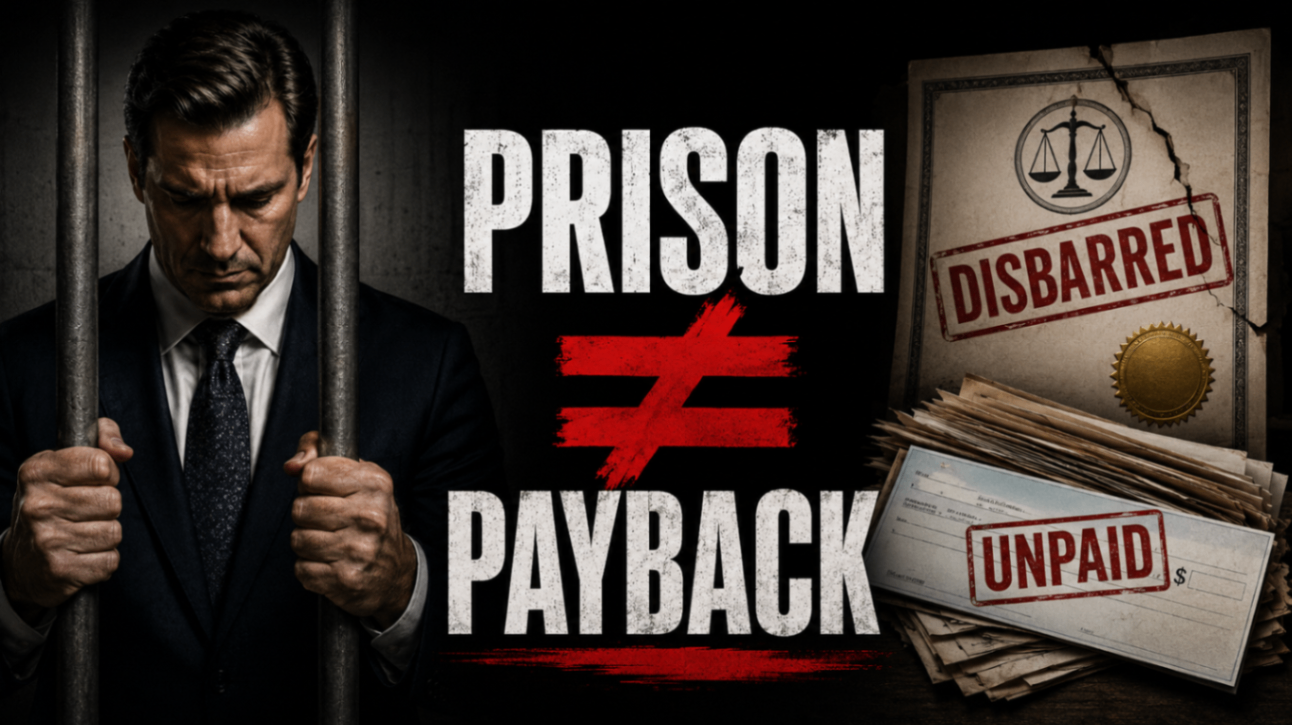
There is a dangerous myth in the American justice system: the idea that a prison sentence equals restitution. We see the words “ordered to pay” and assume the bank accounts are being refilled. We assume that because a lawyer is behind bars, the system has worked.
In reality, restitution is a debt, not a bank account. It is a paper promise that is rarely kept. While attorneys like Tom Girardi or Alex Murdaugh sit in cells, their victims are often left fighting a second war: one against a system designed to protect the “stench of cronyism” and the hidden assets of the legal elite.
The illusion of accountability
The problem is systemic. When a lawyer is caught in a fee harvesting scheme, the first thing to disappear isn’t their law license: it’s the money. By the time the State Bar or the Department of Justice catches up, the millions of dollars have often been funneled through shell companies, hidden in trusts, or spent on a lifestyle of private jets and luxury estates.
We are told that disbarment is the ultimate professional death penalty. Yet, disbarment does nothing to recover a stolen inheritance. It does nothing to reverse the probate abuse that leaves families destitute. In many cases, the most predatory lawyers are the ones who know exactly how to navigate the system to keep their ill-gotten gains even while they serve time.
The legal heist: A status report on high-profile lawyers
Of the lawyers who betrayed their clients, some are rotting in prison, others are already walking free, and some never saw the inside of a cell at all. The following table highlights the gap between the crimes committed and the actual price paid.
| Lawyer Name | Status | Sentence/Details |
|---|---|---|
| Tom Girardi | Still in Prison | 87 months (June 2025) for embezzling millions. |
| Alex Murdaugh | Still in Prison | 27 years state + 40 years federal for financial crimes. |
| Michael Avenatti | Federal Custody | 14 years; currently in halfway house/reentry. |
| Jason Kurland | Still in Prison | 13 years (2023) for defrauding lottery winners. |
| Scott Rothstein | Still in Prison | 50 years (2010) for a $1.2B Ponzi scheme. |
| Christopher Kamon | Still in Prison | 121 months (2025); Girardi’s accounting chief. |
| William Gallion | Released | 25 years; commuted by President Biden (Dec 2024). |
| Shirley Cunningham Jr. | Released | 20 years; released March 2024 (Fen-Phen scandal). |
| Marc Dreier | Released | 20 years; released/commuted Dec 2024. |
| David Lira | Likely Released | 4 months + 4 months home confinement. |
| Stanley Chesley | No Prison | Disbarred; $42M civil judgment; avoided criminal time. |
Getting off light: When the punishment doesn’t fit the theft
When you look at the numbers, the “justice” looks more like a slap on the wrist for some. David Lira, a former Girardi Keese lawyer, received only four months in federal prison despite his role in concealing millions in stolen settlement funds. Sara King faced only 21 months for an $8.7 million fraud. Matthew Dickason was sentenced to just 27 months for stealing over $3 million from his clients.
Then there is Stanley Chesley. Often cited as one of the most successful mass-tort lawyers in history, Chesley was a central figure in the Fen-Phen settlement scandal. While his partners went to prison, Chesley avoided criminal charges entirely. Despite a $42 million civil judgment and courts describing an “ongoing campaign” to shelter assets from his victims, he never spent a day in a cell. This is the clearest example of how predatory lawyers can use their knowledge of the law to evade the very consequences they impose on others.
This lack of parity creates a system where the Damn Lawyers can continue to operate in the shadows, relying on arbitration corruption to hide their tracks.
The asset shell game
Why is restitution so hard to collect? Because the legal system allows it to be. In the case of Scott Rothstein, his empire collapsed because the scale of his $1.2 billion Ponzi scheme was too massive to hide. But for others, like the Damn Lawyers, the game is played through attorney self-dealing and the strategic use of bankruptcy.
When a lawyer is “ordered to pay,” they often point to empty pockets while their family members live in mansions purchased with “consulting fees.” We see this pattern repeatedly in inheritance theft cases, where the money is moved long before the first attorney misconduct filings are ever reviewed.
The public needs to understand that a court order is not cash. For the evidence vault, the struggle isn’t just about winning a case: it’s about finding where the money went while the system looked the other way.
Discussing the stench of cronyism
The failure to collect restitution is often rooted in the “stench of cronyism” that pervades our judicial system. In many jurisdictions, judges and lawyers share the same social circles, contribute to the same campaigns, and protect one another through closed-door arbitration traps.
Wayne Dolcefino has spent years exposing how new alleged victims, probate misconduct investigation, and cronyism investigation reveal how these heists happen in plain sight. When a system is rigged, even a “win” in court results in a loss for the victim. We see it in inheritance theft, legal deception, and the wider probate plot facing families who are billed into oblivion by the very people sworn to protect them.
The fix: Legislative reform and judicial review
We cannot rely on the goodwill of the legal profession to police itself. The review fraud scandals have shown that even professional reputations can be manufactured. We need real, systemic change.
- Mandatory Judicial Review of Arbitration: Arbitration has become a black hole where arbitration reform thrives. Every arbitration award must be subject to judicial review to ensure it follows the law. See the arbitration trap video.
- Asset Transparency Laws: We need legislative reforms that make it harder for attorneys to shield assets in the face of client claims.
- Restitution Funds with Teeth: State bars should be required to maintain robust victim compensation funds that are funded by aggressive asset forfeiture from unethical attorneys, especially where victim testimony, probate victim story, and judicial favoritism show the human cost.
Demand accountability
The stories of Girardi, Murdaugh, and the Damn Lawyers investigations are not isolated incidents. They are symptoms of a justice system that prioritizes the protection of its own over the restitution of the victim.
Prison is a start, but it is not the end. We must stop assuming that because a lawyer is in a cell, the victim has been made whole. True justice requires the return of what was stolen and a systemic overhaul that prevents these predators from ever using a law license as a license to steal again.
It is time for our legislators to step up. We need a transparent debate on how to fix the arbitration traps and ensure that “justice for all” actually includes the victims of the legal profession.