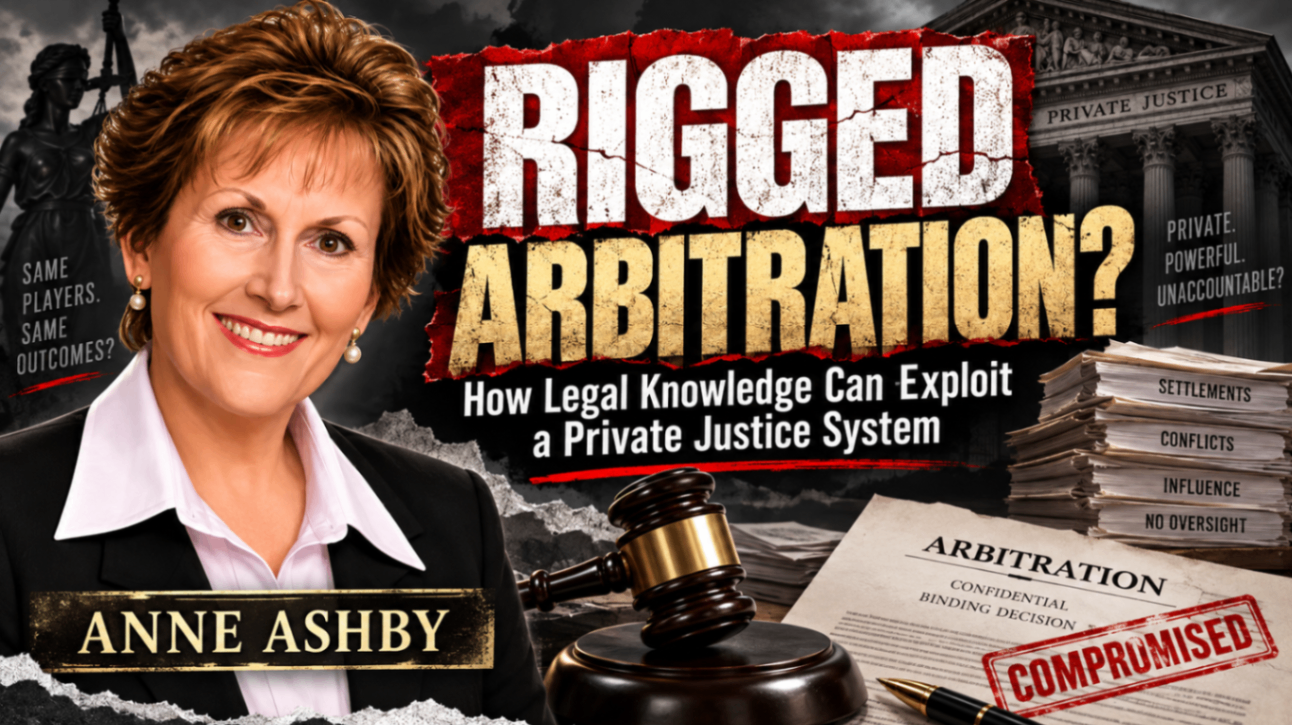
Arbitration is not a legal free zone. Arbitrators and lawyers remain subject to the governing agreement, applicable law, procedural fairness requirements, disclosure obligations, and statutory limits.
But arbitration can be difficult for an ordinary client to challenge because judicial review is often narrow. That creates a serious accountability question: Can lawyers use specialized knowledge of arbitration procedure to gain an advantage, knowing that courts may refuse to revisit even significant legal errors after an award is issued?
The answer requires precision. A disappointing result is not automatically a rigged process. A legally erroneous award is not necessarily proof of fraud. And an allegation of attorney misconduct is not a disciplinary finding. Yet when consent, conflicts, notice, evidence, fees, or the arbitrator’s authority are questioned, the label “arbitration” cannot end the inquiry.
The video raises the question
The current Damn Lawyers investigation presents allegations involving attorney fee incentives, online review manipulation, alleged conflicts, a malpractice dispute sent to arbitration, and claimed arbitrator conflicts and nondisclosures.
The video is an investigative and advocacy report, not an adjudicated finding. The lawyers featured in the investigation deny wrongdoing, and the allegations should be tested against contracts, court filings, arbitration records, testimony, and other reliable evidence. Readers can also compare the embedded report with the separate review fraud investigation, which likewise presents allegations and advocacy rather than adjudicated findings, and with the embedded rigged arbitration investigation itself.
The central issue is not whether every arbitration is unfair. It is whether legal sophistication can turn a private process into a shield: allowing a lawyer to draft the clause, influence the forum, exploit procedural complexity, and then argue that a court has almost no power to correct what happened.
Arbitration is not permission to ignore the law
The Federal Arbitration Act identifies narrow grounds for vacating an award, including corruption, fraud, evident partiality, misconduct that prejudices a party, and an arbitrator exceeding their powers. Those are the Federal Arbitration Act vacatur grounds, not optional standards.
The Supreme Court has also emphasized limited judicial review. Courts generally do not reweigh evidence or reconsider the merits simply because an arbitrator may have interpreted the law incorrectly. A party who believes an award is wrong must usually show something more specific: a statutory ground, a serious procedural failure, a lack of authority, or another defect recognized by the governing law.
Consent matters at the front end. In consent to arbitration, the Supreme Court explained that arbitration is fundamentally a matter of agreement. A person should not lose access to a jury or public court merely because a clause exists somewhere in a lengthy contract if the legal requirements for assent and enforcement are not satisfied.
Texas courts apply similarly demanding standards. The Fifth Circuit’s discussion of Texas arbitration review and the Texas Supreme Court’s treatment of Texas statutory vacatur illustrate the importance of identifying a recognized legal basis for relief rather than relying only on the claim that an award was unfair.
How procedural knowledge can become leverage
Lawyers who regularly handle arbitration understand details that most clients do not. They may know which clauses are likely to be enforced, how objections must be preserved, what discovery will be allowed, how arbitrators are selected, and which deadlines can eliminate a later challenge.
That knowledge is not misconduct by itself. Skilled advocacy is legitimate. The problem arises when complexity prevents meaningful consent or conceals conduct that should have been disclosed.
The first question is who drafted or proposed the arbitration clause and whose interests it protected. Did the client understand that accepting the clause could mean giving up a jury trial, public filings, broad discovery, and ordinary appellate review? Were the costs, location, provider, confidentiality terms, and class-action waiver explained in a way the client could reasonably understand?
The next question is selection. Was the arbitrator chosen through a neutral process? Did the arbitrator disclose professional, financial, personal, or repeat-player relationships? Guidance on arbitrator disclosure standards recognizes that timely disclosure is essential to confidence in neutrality.
An undisclosed relationship does not automatically prove bias. But the absence of disclosure can make it harder for a party to exercise a meaningful challenge before the hearing begins. In a private system with limited public records, repeat relationships may remain invisible unless a party has the resources to investigate them.
Data matters as well. The public cannot evaluate patterns it cannot see. Research concerning arbitration data demonstrates why reporting about providers, outcomes, repeat appointments, fees, and party status is important to any serious discussion of fairness.
The difference between a bad result and a rigged process
A bad result may involve an arbitrator accepting one side’s evidence, making a questionable legal interpretation, or reaching a conclusion that seems deeply wrong. Those circumstances can be painful and may support a motion for relief under some laws, but they do not alone establish fraud.
A legally erroneous award presents a related but distinct problem. Scholarship on arbitration-law research explores the tension between finality and correction. Arbitration’s limited review structure means that a legal mistake may survive unless it falls within a recognized vacatur ground.
A rigged process is different. Evidence might include a hidden conflict, a fabricated or altered agreement, a hearing conducted without proper notice, unequal treatment of evidence, intentional concealment, or an arbitrator acting outside the authority granted by the contract and statute.
Arbitration fraud may involve deception in obtaining an award or manufacturing the appearance of a legitimate proceeding. Researchers examining pirate arbitration research have described extreme situations in which purported awards were pursued despite questions about consent, notice, or the existence of a genuine arbitration process.
The distinction protects both sides. It prevents every adverse award from being branded fraudulent while preserving a path to challenge a process that was never legitimate.
What courts can: and cannot: review
A court may examine whether the parties agreed to arbitrate, whether the arbitrator had authority, whether statutory vacatur grounds are present, and whether fundamental procedural protections were denied. A court may not simply substitute its judgment for the arbitrator’s because it would have evaluated the evidence differently.
This is where public frustration grows. Critics argue that highly deferential review can shield errors or misconduct from meaningful examination, especially when arbitration records are confidential and the losing party lacks the money to pursue a challenge. That criticism should be supported by evidence, not assumptions that judges knowingly ignored the law.
The public debate over forced arbitration and the growing demand for arbitration reform reflects this concern. The issue is procedural fairness: not an anti-lawyer position. Lawyers are entitled to advocate. Clients are entitled to understand the system and receive loyal, competent representation.
The records that matter
Anyone investigating a potentially defective arbitration should preserve:
- The arbitration agreement, amendments, and documents showing assent
- The fee agreement and records of payments or extraordinary charges
- Arbitrator disclosures and all selection communications
- Conflict checks and communications concerning challenges
- Hearing notices, procedural orders, transcripts, and exhibits
- Discovery requests, objections, rulings, and evidence exclusions
- Billing records, sanctions requests, and fee calculations
- The final award, confirmation order, and post-award filings
- Deadlines for a motion to vacate, appeal, mandamus proceeding, malpractice claim, or disciplinary complaint
A bar complaint process does not automatically reverse an arbitration award. A motion to vacate, appeal, mandamus request, malpractice claim, disciplinary complaint, SCJC complaint, or FTC complaints filing each involve different standards, forums, and deadlines. A qualified attorney should evaluate those options promptly.
The public should also understand that service of process is a procedural event; it does not establish liability. Likewise, a State Bar investigation is not a disciplinary finding, and a complaint is not proof of misconduct.
Why “arbitration” cannot end the inquiry
The phrase “it was arbitration” should not become a substitute for analysis. The real questions are whether the person consented, whether the process followed the agreement, whether the arbitrator disclosed required information, whether both sides received a fair opportunity to present evidence, and whether the award stayed within lawful authority.
Those questions are especially urgent when a lawyer’s compensation may depend on the size or duration of a dispute, when a client claims advice favored the lawyer’s financial interest, or when a private process is used to resolve a malpractice claim involving the same professional network. In that setting, readers often move from arbitration questions into accountability records involving fake lawyer reviews, Ashby victims, or broader reports involving probate abuse, but each category should still be evaluated according to its own evidence and procedural posture.
Analysis of arbitration bias and proposals for arbitration reform should therefore focus on records and repeatable patterns, not merely rhetoric. The same standard should apply to claims concerning arbitrator accountability and lawyer accountability.
Reforms that would restore confidence
Texas should adopt reforms that protect complainants without abandoning fair procedures for respondent lawyers. Those reforms should include:
- Publishing bar complaints with clear disclaimers that allegations are not findings
- Tracking outcomes publicly, including dismissals, sanctions, and disciplinary orders
- Identifying repeat patterns of alleged misconduct while protecting due process
- Requiring meaningful conflict disclosures before an arbitrator is accepted
- Requiring informed-consent language explaining the loss of a jury and narrow review
- Requiring clearer written findings when extraordinary fees or sanctions are imposed
- Providing independent review when fraud or undisclosed conflicts are credibly alleged
- Reporting serious vacatur findings and recurring provider or arbitrator concerns
- Resolving conflicts of interest before they contaminate a private proceeding
Recent calls for legislative reform should be evaluated through that procedural-fairness lens.
Arbitration can be efficient, private, and lawful. But it cannot become a system where specialized knowledge defeats informed consent, undisclosed relationships go unexplored, and narrow review turns every challenge into “too late.” Accountability begins by demanding the record: and by refusing to treat the word “arbitration” as the end of the investigation.
This article is informational and investigative, not legal advice. The investigation video presents allegations and advocacy, not adjudicated findings. An adverse arbitration award does not itself prove fraud, attorney misconduct, or arbitrator bias. Readers should consult qualified counsel promptly regarding applicable deadlines and available remedies.