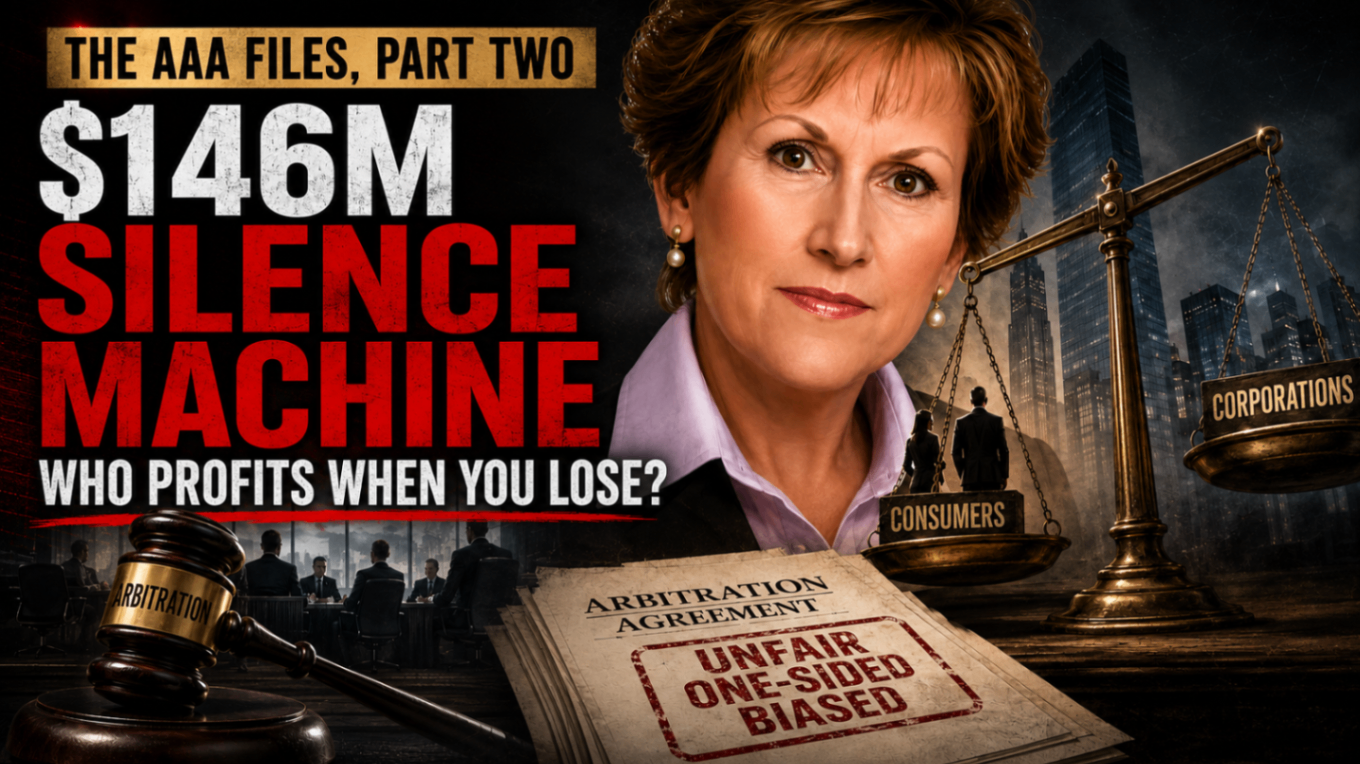
The American Arbitration Association (AAA) markets neutrality, but the money trail tells the real story.
As Wayne Dolcefino’s investigation peels back the layers of this private justice system, what emerges is a shameless scam dressed up as dispute resolution: a business sitting on roughly $450 million in assets while pulling in massive annual revenue and leaving ordinary people with ruined finances, ruined trust, and ruined lives. This is not a court. It is a business that screws over the public and stays rich because most people do not realize it is a scam until they are already trapped inside it. In this business, the “repeat players” get the VIP treatment while the average person gets billed for the privilege of losing.
The Repeat Player Effect: Why Giants Always Win
The math of the arbitration trap is simple: AAA’s existence depends on the very corporations that mandate its use. Giants like AT&T, Verizon, Equifax, and PayPal aren’t just occasional users; they are the lifeblood of the institution. These “repeat players” provide a steady, predictable flow of cases that ensure AAA’s coffers remain full.
When a company like PayPal or Verizon forces every customer and employee to waive their right to a jury trial, they are effectively choosing their own judge. This creates an environment where a predatory lawyer can thrive, knowing that the “neutral” arbitrator has a massive financial incentive to keep the big-paying corporate clients happy. If an arbitrator rules too often against a corporate giant, do you think they’ll be chosen for the next thousand cases? The “stench of cronyism” isn’t just a byproduct; it’s the foundation of the model.
CEO wealth built on consumer ruin
While AAA’s revenue climbs toward the $150 million mark, its leadership sits atop an organization reportedly holding about $450 million in assets. Its CEO reportedly commands a salary in the neighborhood of $1.2 million. That is not the profile of a public-facing safeguard protecting vulnerable people from abuse. It is the profile of a wealthy institution getting paid extremely well while delivering what too many consumers experience as shitty service with life-altering consequences.
Contrast that executive wealth with the reality faced by people pulled into forced arbitration. Consumers who dare to seek justice often enter a financial black hole. Victims of legal deception discover that even a nominal win can be gutted by filing fees, administrative costs, delays, and the hourly rates of a rented decision-maker. It is a system of fee harvesting that keeps the institution rich while the public pays for the damage.
The double standard: Arbitral immunity vs. business transparency
The AAA plays a sophisticated game of legal hide-and-seek. When it comes to accountability, it claims “arbitral immunity,” wrapping itself in protections that resemble a government court. It argues that because it performs a judicial function, it should not be sued for mistakes, conflicts, or bias.
But when the public asks for transparency, the organization flips back into private-business mode. It is not subject to open records laws. It does not have to show internal communications where a rogue arbitrator scheme could be exposed. It does not have to fully reveal financial ties, institutional incentives, or how often outcomes favor the entities that keep the pipeline full. This “immunity for me, but no rules for you” model is how rigged arbitration awards keep surfacing in a system that looks less like justice and more like revenue protection.

Teaching a lesson: The high cost of dissent
Corporations use the high cost of AAA fees as a strategic weapon. By making the entry price for justice so high, they teach a lesson to any employee or customer who thinks about fighting back. If it costs thousands in administrative expense just to challenge a much smaller loss, the corporation has already won. That is the genius of the arbitration trap: the public funds its own defeat while the institution keeps collecting.
This tactic is prevalent in estate disputes and probate abuse, where the goal is to exhaust the victim’s resources until surrender looks cheaper than resistance. We see the same money-first pattern in the Damn Lawyers investigation, where the lawyers featured in the Damn Lawyer investigation and the arbitrator benefit when victims are isolated, outspent, and silenced. It is a probate plot scaled to the national level, where the gatekeepers stay rich by making sure the public never gets a fair fight.
The FTC Warning: 16 CFR Part 465 and the End of Digital Shields
There is a glimmer of hope on the horizon. The Federal Trade Commission (FTC) recently enacted 16 CFR Part 465, a rule targeting deceptive practices, including the suppression of negative reviews through threats and legal intimidation. This is a direct shot across the bow of companies that use their “Digital PR Shields” to hide the truth about their attorney self-dealing and arbitration records.
For too long, corporations and their high-priced legal teams have used the threat of arbitration costs to keep victims quiet. Under the new FTC guidelines, using groundless legal threats to silence a critical consumer can lead to fines exceeding $53,000 per violation. This is a vital tool for judicial accountability. The “silence machine” is finally being audited by a higher power.
Exposing the local connection
The systemic rot at the AAA level is the same rot we see in Texas probate courts. Whether it is the trio of predatory lawyers exploiting vulnerable families or the arbitrator tied to a long record of evident partiality, the goal is the same: keep the money moving, keep the victims quiet, and keep the business model intact. This is where the national scam and the local scam shake hands.
We are seeing a growing State Bar investigation into these practices, but true change requires arbitration reform and relentless judicial accountability. Wayne Dolcefino’s reporting keeps exposing how this business screws over the public, how victims get herded toward silence, and how the insiders stay rich because the scam is largely invisible until the damage is done. Stop Legal Bullying will keep following the money, documenting the abuse, and demanding accountability from every institution and repeat player involved.
A private justice system with enormous assets, executive wealth, and a record of consumer devastation deserves scrutiny, not deference. Demand transparency. Demand judicial accountability. Expose the scam.