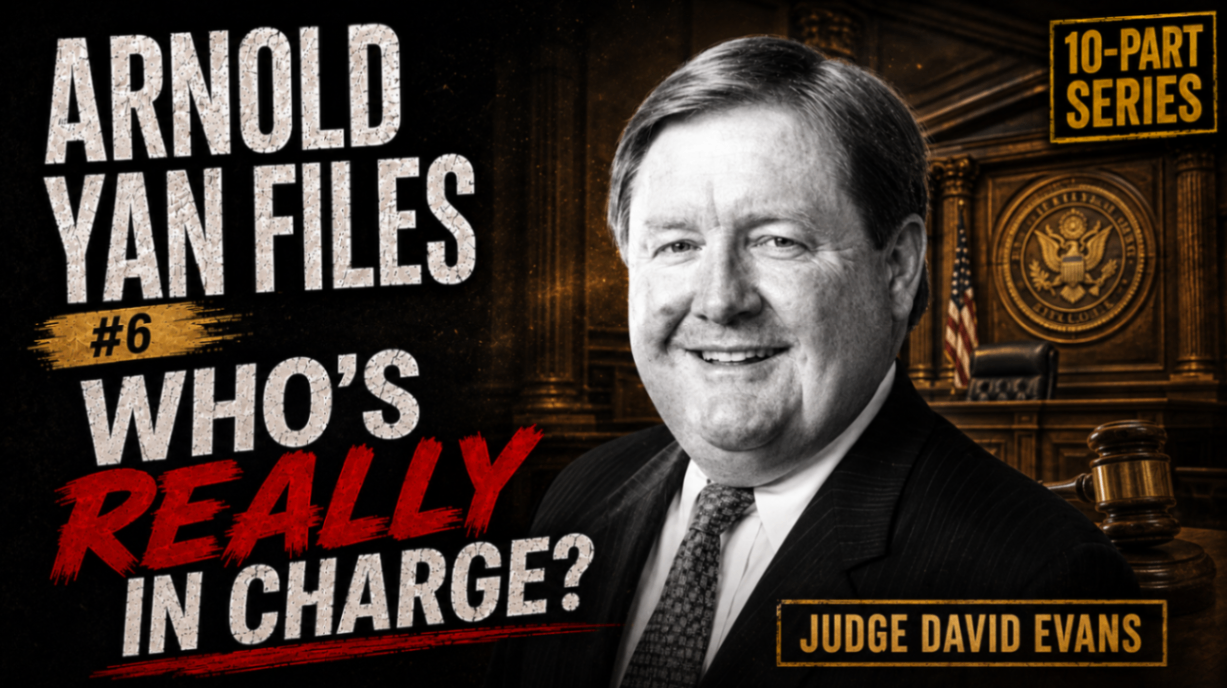
Who is really in charge? In the public record discussed here, the administrative assignment figure is David Evans. That does not mean David Evans automatically decided the merits of Arnold Yan’s case. It means the assignment function and the merits function are different, and the public needs to keep them separate before drawing conclusions.
The central point of Part 6 is straightforward. David Evans is identified in the materials as the administrative or assignment-side figure tied to judge assignment and recusal or substitution procedure under the Texas judicial-administration structure reflected in the record. The elected district judge assigned to the case is the official who exercises judicial authority over the merits of that case. An associate judge may hear delegated matters and issue recommendations. A visiting judge may act only after a lawful assignment and only within the scope of that assignment. The district clerk records filings and orders. Private lawyers request relief. A receiver, if one is appointed, acts only under a court order. A prosecutor makes separate criminal charging decisions. Different actors control different decisions.
That distinction matters because Arnold Yan has raised serious questions about who did what, when, and under what authority. Those questions deserve a precise answer, not a vague one. If the record shows that David Evans handled or helped handle assignment authority, the public should say exactly that. If the record shows that Judge William Knight, Judge Cynthia Favila Terry, Judge Patricia Baca Bennett, Associate Judge Lori L. DeAngelis, Judge Judith G. Wells, or John Weeks acted in a different role at a different stage, the article should say that too. A shared appearance in the same dispute does not establish that those people acted together unlawfully.
This is also not a story about one official secretly running everything. It is a story about divided authority inside a legal system that can be hard for outsiders to read. According to the investigation and public advocacy around Damn Lawyers, that confusion is part of the problem. When the assignment record, recusal history, referral papers, hearing notices, docket entries, signed orders, and appellate trail are not laid out clearly, people start treating every name in the file as if it carried the same power. It does not.
Reference roster of individuals named in this episode’s record
This reference roster identifies individuals named in the record discussed in this episode. It is not an allegation against any person.
Red tier — judges and attorneys
- Judge William Knight
- Judge Cynthia Favila Terry
- Judge Patricia Baca Bennett
- Associate Judge Lori L. DeAngelis
- Judge Judith G. Wells
- John Weeks
- William “Bill” Harris
- Lee Gabriel
- Thomas A. “Tom” Wilder
- Thomas “Tom” Wilder
- Cody W. Martin
Orange tier — court and investigative personnel
- David Evans
- Leslie Barrows
- William “Bert” Pigg
- Melissa Fain
- Erika Patino
- Daryl Coffey
- Phil Sorrells
THE RECORD SHOWS
The record discussed in this series points to an assignment-and-substitution question tied to David Evans. In plain language, the assignment role is an administrative lever. It concerns who is sent to hear a matter after a recusal, substitution, vacancy, conflict, or other procedural event. Administrative assignment authority is not the same thing as merits authority. If David Evans had assignment authority or participated in that process in the documented materials, that means he could affect which judge was placed into a matter. It does not mean he personally decided every disputed issue in Arnold Yan’s case.
The elected district judge remains the key merits authority in the case unless the record shows a lawful transfer, recusal, or assignment changing who heard a particular proceeding. That is the distinction readers need to hold onto. A case can include actions by Judge William Knight, Judge Cynthia Favila Terry, Judge Patricia Baca Bennett, Associate Judge Lori L. DeAngelis, Judge Judith G. Wells, or John Weeks at different times and for different procedural reasons without proving that any one of them controlled the whole matter from start to finish.
The same caution applies to the other names appearing in the materials. William “Bill” Harris and Lee Gabriel should be identified only by the roles supported in the record and public source materials. Daryl Coffey, Thomas A. “Tom” Wilder, Thomas “Tom” Wilder, Cody W. Martin, Leslie Barrows, William “Bert” Pigg, Melissa Fain, Erika Patino, and Phil Sorrells may appear in reporting, pleadings, assignment history, advocacy materials, or connected legal proceedings, but the public should not assume that appearing in the same chronology proves coordinated conduct. Where the materials establish a role, the article should name it. Where the materials do not establish a role in a specific action, the honest answer is that it has not yet been verified. That is why readers looking for broader attorney accountability should distinguish between documented roles, public allegations, and published separate Anne Ashby complaint, including this published Nicholas Abaza bar complaint alleging misconduct; it is a public allegation, not a disciplinary finding.
The procedural audit the public needs is not mysterious. It should compare the assignment order, any recusal order, any substitution paperwork, any referral to an associate judge, any notice setting a hearing, any order signed after that hearing, the district-clerk docket trail, the reporter’s record if one exists, and any appellate filing challenging what happened. That is also why broader concerns raised in forced arbitration and probate abuse resonate with readers. The broader concern is often less about one document than about how hard it is for ordinary people to follow power as it moves through procedure. The guide’s separate Nicholas Abaza review-practices complaint package concerns review-related allegations; it is not evidence about judge assignments in Arnold Yan’s case.
Private lawyers are a separate category. They do not assign judges, but they can request emergency relief, sanctions, fees, enforcement, or appointment-related action. The clerk is another separate category. The clerk records filings, timestamps, dockets, and signed orders, but does not decide the merits. A visiting judge is separate again. That judge can preside over a matter after assignment, but only within the assignment’s scope. A receiver, if one is appointed, derives power from a signed order and nothing more. A criminal prosecutor stands in yet another lane. Charging power is not a family-court assignment power.
BIGGER TEXAS STORY
The reason this assignment question matters beyond Arnold Yan is that Texans keep colliding with systems they cannot easily decode. That larger accountability fight appears in Consumer Alerts such as arbitration reform, probate lawyer complaints, and arbitration trap. Those releases are advocacy materials, not independent findings, but they reflect a recurring demand for clearer records, more transparent procedure, and a public trail that lets people distinguish a lawful assignment from an unexplained shift in power.
That same concern is one reason readers move from family-court disputes into broader accountability resources for probate victims and attorney accountability. Those pages do not prove anything about Arnold Yan’s case. They show why so many Texans now demand clearer lines between authority, paperwork, and accountability.
THEY ALLEGE
Arnold Yan and identified advocates allege that assignment and substitution decisions can become outcome-shaping events because who hears a matter affects timing, tone, and the path of later rulings. That allegation is narrower and more defensible than saying one person secretly controlled everything. The claim is that the assignment lever matters, and that the public cannot evaluate fairness without seeing exactly how that lever was used.
Some advocacy and investigative reporting, including work associated with Wayne Dolcefino, asks whether assignment-related decisions, recusal sequences, and later rulings were transparent enough for the public to test. Those are investigative questions. They are not findings of corruption, conspiracy, racketeering, or coordinated misconduct. If Arnold Yan or others advance broader theories, those theories remain allegations unless and until supported by verified records and official findings.
The same care applies to specific participants. If John Weeks served as a visiting judge in a documented proceeding, the relevant question is what assignment authorized that service, what hearing or matter it covered, and what order or recommendation followed. If Associate Judge Lori L. DeAngelis handled a delegated hearing, the relevant question is what referral authority applied and what review process was available. If Phil Sorrells or another prosecutor appears in the larger chronology, that does not establish that the prosecutor controlled family-court assignments or acted as part of a unified plan. The public has to separate allegation from proof and sequence from causation.
THIS DIDN’T START WITH ARNOLD
What gives this story force is not just one litigant’s frustration. It is the larger pattern of people saying they could not tell who made the real decision, which document authorized it, and what review path existed after the fact. That is why campaign assets on legal bullying, the arbitration trap, judicial accountability, and attorney accountability keep getting cited by readers, including victim testimony, rigged arbitration investigation, arbitration trap, planned deception allegations, and probate plot. Those videos are campaign materials, not adjudicated findings in Arnold Yan’s matter, but they frame the same complaint: legal power becomes difficult to challenge when the paper trail is confusing and each office can point to another office.
That is also why procedural fairness matters. A complaint about assignments is not an anti-lawyer or anti-judge position. It is a demand that records be plain enough for both complainants and respondent officials or lawyers to be evaluated fairly. If a substitution was proper, the file should show it. If a recusal changed who heard the next matter, the file should show it. If a recommendation was reviewable, the record should show how and when.
THE OTHER SIDE SAYS
The other side would fairly say that assignment systems exist for legitimate reasons. Judges recuse. Dockets overflow. Conflicts arise. Courts need a lawful way to keep cases moving. Administrative assignment is therefore not suspicious by itself. Neither is the appearance of a visiting judge, an associate judge, a clerk entry, an adverse ruling, a fee request, or even a later criminal charge. None of those events, standing alone, proves favoritism, coordination, or misconduct.
That defense deserves to be stated clearly because it is often true as a matter of structure. David Evans may hold or exercise an assignment-related role without deciding the merits. An elected district judge may retain case authority without personally handling every hearing. John Weeks may appear in a file because of a lawful assignment, not because he was “in charge” of the county. Judge William Knight, Judge Cynthia Favila Terry, Judge Patricia Baca Bennett, and Judge Judith G. Wells may each appear in the broader record for ordinary procedural reasons. The clerk may simply be recording what the court signed. Private lawyers may be doing what advocates do in hard litigation. The prosecutor’s office may be making a separate charging call based on its own assessment.
That is why the fair question is not “Who can we blame from the caption?” The fair question is: what exact power did each person hold at the relevant moment, and what paper proves it?
THE MONEY
Money is often where abstract authority becomes concrete pressure. Private lawyers can seek fees and sanctions. Judges can sign orders that convert requests into enforceable obligations. A receiver, if appointed, can act under the terms of that order. The clerk preserves the record that determines whether a challenge can be made cleanly. A prosecutor’s separate criminal action, if one exists, can increase pressure even though it comes from a different legal lane.
That does not prove the money trail was improper. It means the public should read the money trail alongside the assignment trail. Who requested relief? Who signed it? Who recorded it? Who enforced it? Which hearing produced it? Was there an objection, de novo review, mandamus petition, appeal, or later challenge? In any case where families say the legal system became an extraction system, those are the questions that move the discussion from outrage to proof.
THE QUESTION NOBODY HAS ANSWERED
The unanswered question is not whether one person ran the whole system. The unanswered question is whether the public can see a clean document trail showing exactly how assignment authority, merits authority, delegated hearings, recordkeeping, and enforcement fit together in Arnold Yan’s case.
If David Evans controlled or helped control the assignment lever, what document shows that authority? If an elected district judge retained merits authority, which orders show that? If John Weeks appeared as a visiting judge, what assignment put him there, for what dates, and for what matter? If Associate Judge Lori L. DeAngelis made a recommendation, what review process followed? If Cody W. Martin, Leslie Barrows, William “Bert” Pigg, Melissa Fain, Erika Patino, Daryl Coffey, William “Bill” Harris, Lee Gabriel, Thomas A. “Tom” Wilder, Thomas “Tom” Wilder, or Phil Sorrells played a role in a particular action, where is the document that defines that role instead of leaving readers to guess?
That is the direct answer to the title question. No single label tells the whole story. Different actors were in charge of different decisions. If the record supports an assignment role for David Evans, then he may have controlled a critical assignment lever. That still would not mean he controlled every ruling or outcome. The elected district judge controlled merits decisions within the court’s authority. Associate judges handled delegated matters. Visiting judges acted only if assigned. The clerk kept the record. Lawyers made requests. Receivers acted under orders. Prosecutors made separate charging calls. Accountability begins when those roles are separated and matched to documents.
THE ARNOLD YAN QUESTION: You do not have to accept every claim made by Arnold Yan. You do not have to assume that every official, lawyer, or court actor named in the same chronology acted together. But if the public cannot easily identify who held assignment authority, who held merits authority, what document authorized each step, and what review path existed, then the system is asking for trust without supplying a readable record. Texans should demand accountability grounded in documents, procedural fairness, and a public trail that can be tested.
This article is provided for public education and advocacy, not legal advice. It does not validate individual complaints. Court filings, grievances, and allegations do not prove accusations. Allegations, complaints, investigations, and adjudicated findings are different things.
More from Stop Legal Bullying
Readers exploring the wider campaign can also visit the campaign’s Anne Ashby resource page. These campaign resources collect reporting and accounts of alleged legal abuse. They are separate from the events described above and do not establish findings against anyone discussed in this article.
One Response