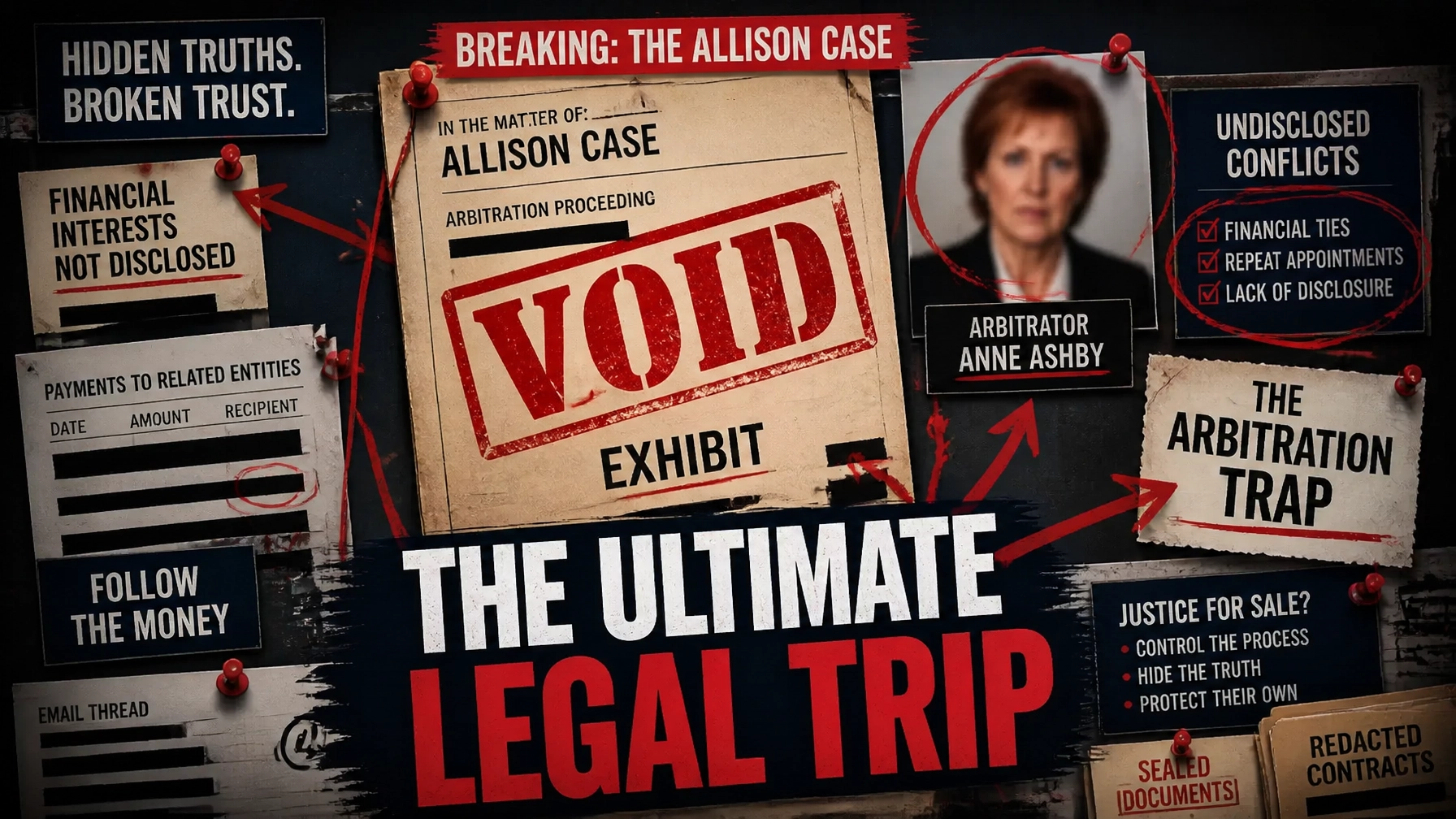
The Seventh Amendment to the United States Constitution is supposed to be the bedrock of the American justice system. It guarantees the right to a jury trial in civil cases, ensuring that twelve ordinary citizens, not a single, potentially biased individual, decide the fate of a legal dispute. But in the corridors of Texas law firms, that right is being systematically dismantled. It is called the arbitration trap, and for many families, it is the ultimate legal trip.
Imagine hiring a lawyer to protect your family’s inheritance, only to find out later that the very contract you signed contained a hidden trapdoor. By signing a standard engagement agreement, you unwittingly signed away your constitutional rights. You didn’t just hire a lawyer; you entered a closed-loop system where the rules of evidence are optional, the proceedings are secret, and the judge is someone handpicked by the very system you are trying to challenge.
This isn’t just a procedural quirk. It is a systemic failure that has allowed predatory lawyers to thrive in the shadows. When the “stench of cronyism” fills the room, the arbitration process becomes a weapon used to silence victims and protect the profits of the legal elite.
For victims trying to understand the landscape, start with the arbitration trap and the victims of Anne Ashby resource page. Families harmed in estate fights should also review probate victims, where probate abuse patterns and victim stories are collected in one place.
The problem: How mandatory arbitration strips your rights
In Texas, mandatory arbitration clauses in attorney-client agreements are treated as an enforceable waiver of the Seventh Amendment. Most clients don’t realize this until it’s too late. They believe that if their lawyer commits malpractice or overcharges them by hundreds of thousands of dollars, they can have their day in court. They are wrong.
Once you are forced into arbitration, you lose more than just a jury. You lose the right to a public record. You lose the right to full discovery. Most importantly, you lose the right to a meaningful appeal. Arbitrators in Texas enjoy a level of immunity and finality that would make a King envious. Even if an arbitrator fails to follow the law, or fails to disclose a blatant conflict of interest, vacating an award is almost impossible under current statutes.
The system is designed for “efficiency,” but in practice, it is efficient at only one thing: protecting the legal profession from the people it serves. This is the heart of the “arbitration trap” exposed by investigators like Wayne Dolcefino. He has spent years documenting how these rigged systems operate, often focusing on the arbitration trap that catches families during their most vulnerable moments.
Expose: The Anne Ashby case study
To understand how deep the rot goes, one must look at the Allison family probate case. This is a story of undisclosed conflicts, a 35-year professional network, and a total collapse of transparency.

The arbitrator at the center of the storm was Anne Ashby, a former judge who was tasked with resolving a multi-million dollar fee dispute. Ashby signed an Arbitrator Oath certifying she had no conflicts of interest. However, investigative findings and a formal bar complaint filed in April 2026 tell a different story.
The investigation revealed that Ashby had a decades-long relationship with Michael Collins, a central figure in the dispute. This relationship was not disclosed at the outset. Instead, fragments of information were leaked months into the case, far too late for the victims to seek a truly neutral forum.
Even more disturbing were the connections to the trio of attorneys representing the opposing side, Nicholas Abaza, Jorge Borunda, and Michael Trevino. Reporting tied to the fee dispute and probate litigation includes Law360’s fee agreement lawsuit and Law.com’s 127 percent fee claim. The Damn Lawyers series has painstakingly documented the “stench of cronyism” that permeated the proceedings. The record shows a pattern of asymmetrical rulings: Ashby blocked live expert testimony from the Allison family while allowing the attorneys’ witnesses to testify freely. The final award, which handed approximately $4 million to the attorneys, mirrored the lawyers’ post-hearing briefs almost word-for-word.
A post-hearing update made the picture worse. The Allison family has reported continued service evasion by key players while they pursued post-award relief, and public reports state that a formal State Bar complaint regarding Anne Ashby’s conduct was filed and remains part of the accountability fight. Coverage of those developments appears in this consumer alert and related republication covering the State Bar investigation.
When the process is this one-sided, it isn’t arbitration; it’s a scripted execution of a family’s financial future. You can read more about the specific victims of this case on our probate victims page, and families caught in arbitration should review the arbitration trap.
Discuss: The lack of transparency and the immunity shield
Why does this keep happening? Because the law currently allows it. Arbitrators in Texas are essentially untouchable. They are not required to follow the Texas Rules of Evidence or even the letter of the law. If they make a “legal error,” the courts will rarely step in.
This lack of oversight creates a breeding ground for unethical practices. When an arbitrator knows their decision is final and their conflicts remain hidden in a private proceeding, the incentive for neutrality vanishes. They become part of a “pay-to-play” network where repeat-player attorneys hire the same arbitrators, creating a financial dependency that is rarely disclosed to the client.
In the Ashby case, it was alleged that she was hired by a connected attorney shortly after filing for bankruptcy: a financial relationship that was never shared with the parties involved. This is the definition of a rigged game. The 7th Amendment was designed precisely to prevent this kind of shadow justice, yet the legal system has found a way to bypass the Constitution through the fine print of an engagement letter.
That is why victims need more than outrage. They need a record. Gail Echols’ story is one of the clearest warnings in the file. Law.com reported her claim that lawyers took 127 percent of the cash portion of a settlement in an estate fight, a gut-punch allegation that fits the fee-harvesting pattern exposed in probate abuse cases. Her experience stands as a testimonial in substance, if not marketing gloss: vulnerable clients can be cornered, pressured to settle, and then billed into oblivion.
The wider reform push has also been documented in public alerts. Yahoo Finance published this consumer alert and this probate consumer alert. GlobeNewswire also published an arbitration reform alert and a consumer alert. Together, those reports frame the same ugly truth: mandatory arbitration and hidden conflicts can leave consumers trapped in a private system built for repeat players, not ordinary Texans.
Fix: The reform agenda
We cannot simply complain about the “stench of cronyism”; we must legislate it out of existence. Stop Legal Bullying is advocating for a four-part legislative package to restore fairness to the Texas legal system. These are not radical ideas; they are common-sense protections for legal consumers.
The Texas Attorney-Client Arbitration Fairness Act
This law would mandate informed consent. A lawyer would be prohibited from including a mandatory arbitration clause unless they provide a clear, standalone disclosure of what the client is giving up: the right to a jury, the right to appeal, and the right to a public trial. Clients must be given the opportunity to seek independent counsel before signing away their 7th Amendment rights.
The Texas Legal Consumer Protection and Attorney Accountability Act
Transparency is the enemy of the legal bully. This act would require mandatory malpractice insurance for all practicing attorneys in Texas. Furthermore, it would require that this insurance information be public. If a lawyer is “judgment proof” or “go naked” on insurance, the client deserves to know before they hand over their life savings.
Robin’s Law – The Texas Family Integrity and Probate Fairness Act
Probate is where some of the worst abuses occur. Robin’s Law would ban contingency fees in probate and inheritance disputes. Currently, predatory lawyers manufacture disputes to justify taking 40% or more of an estate. By requiring hourly billing or court-approved fees in probate, we can stop the “fee harvesting” that leaves families with nothing.
The Texas Attorney Complaint Transparency and Record Preservation Act
The State Bar of Texas currently operates like a private club. Complaints are often dismissed in secret, and even “private reprimands” remain hidden from the public. This act would require permanent bar complaint records to be accessible to the public. If a lawyer has a history of unethical behavior, the “permanent record” should follow them, just like it does for any other professional.
Those four fixes should be read as a working reform blueprint:
- clear informed consent before any attorney-client arbitration clause can be enforced
- mandatory malpractice insurance and public disclosure of coverage
- a ban on contingency fee harvesting in probate and inheritance disputes
- permanent, public preservation of bar complaint records and discipline history
Accountability and the need for judicial review
The most critical reform, however, is the requirement for full judicial review. If an arbitrator fails to disclose a conflict of interest, or if they flagrantly disregard the law, the resulting award must be subject to a de novo review by a real judge in a real courtroom. The current standard of “evident partiality” is too high and too easily dodged by sophisticated actors.
For victims and reform advocates, the investigative record matters. The master hub is the Damn Lawyers series, and the Dolcefino investigation also runs through these core installments:
- Damn Lawyers video 1 — the opening investigation into how an inheritance fight turned into a fee-driven legal war, introducing the Allison case and the arbitration trap. Watch on YouTube, Facebook, and the Dolcefino site.
- Damn Lawyers video 2: The stench of cronyism — focuses on alleged undisclosed relationships, repeat-player arbitration, and the closed network that keeps victims in the dark. Watch on YouTube and the Dolcefino site.
- Damn Lawyers video 3 — centers on deception allegations, post-hearing evidence, and the growing push for judicial review after arbitration. Watch through YouTube.
- Damn Lawyers video 4 — follows the widening fallout, additional victim accounts, and the case for legislative intervention. Watch through YouTube.
Social platforms have also become part of the evidence trail. Caroline Allison has publicly discussed what she describes as being effectively “in bed” with the arbitrator system through undisclosed relationships and stacked incentives, and those short-form discussions should be embedded here using the available Instagram and Facebook reel links provided by the team.
We are calling for a legislative debate. It is time for the Texas Legislature to stand up for the people, not the powerful law firms that fund their campaigns. The “arbitration trap” is a stain on our justice system.
If you or someone you know has been a victim of these rigged proceedings, now is the time to speak up. Whether it is through the arbitration trap outreach, the victims of Anne Ashby page, or by sharing your story on our probate victims platform, your voice is the only thing that will break the silence.
Watch the full investigation into these predatory practices on the Damn Lawyers channel. Then push this fight where it belongs: into public view, into the Legislature, and into a serious debate over judicial review, disclosure, and accountability.