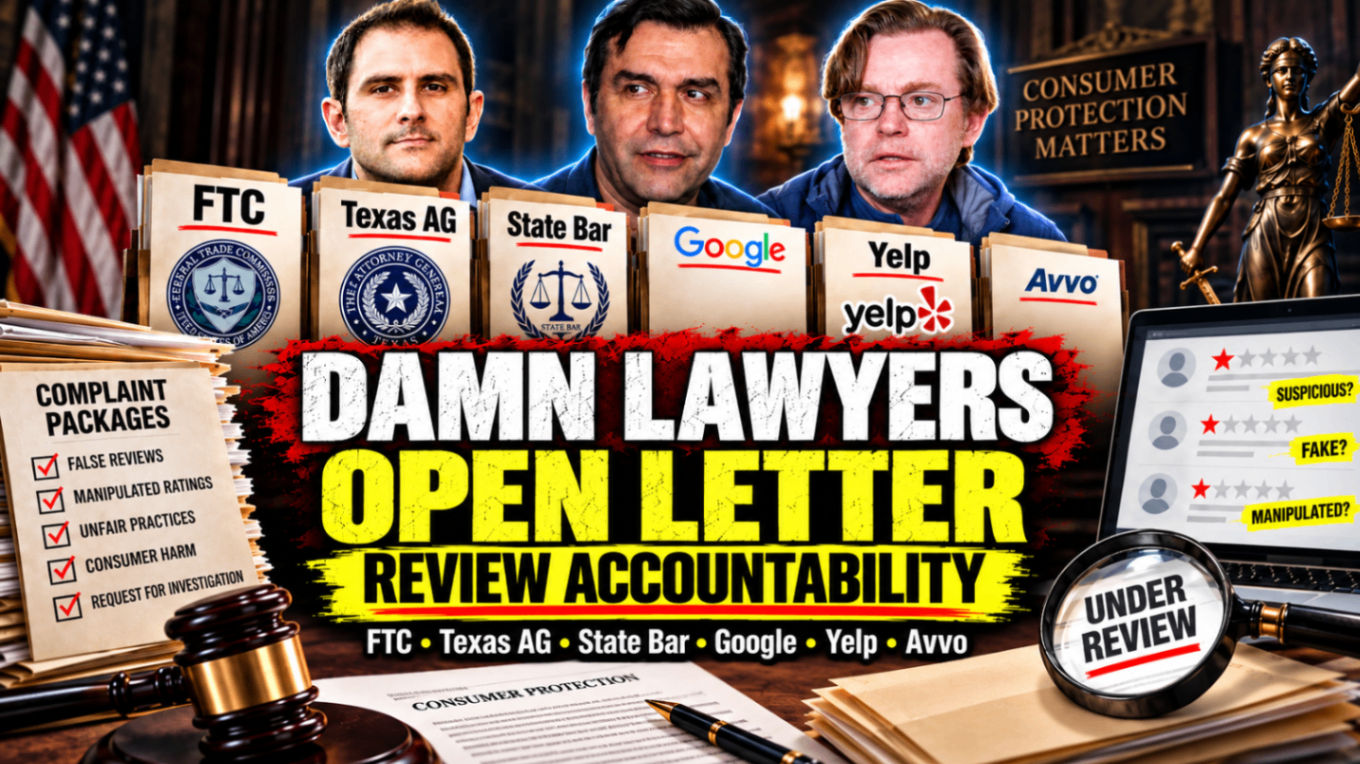
To the Federal Trade Commission, the Texas Attorney General’s consumer-protection officials, the Texas State Bar, Google, Yelp, Avvo, and the public:
Please look closely at how legal reputations are built, protected, and presented online.
The request is not for a predetermined finding against anyone. It is a request for a careful, evidence-based review of three complaint packages concerning Jorge Borunda, Nicholas Abaza and Michael Trevino, and the August 14 Consumer Alert, both of which ask authorities and platforms to examine alleged review practices across multiple platforms. The complaint packages and the August 14 Consumer Alert press release, ask regulators and companies to preserve records, authenticate exhibits, compare patterns across platforms, assess whether material relationships were disclosed, provide fair notice and rebuttal, protect complainants from intimidation, and publish status or outcomes with clear disclaimers.
The allegations are serious because online reviews can influence whether a grieving family hires a lawyer, signs a fee agreement, accepts a contingency arrangement, or turns over control of an inheritance dispute. The public deserves to know whether those ratings reflect independent client experiences or a reputation system allegedly shaped by undisclosed professional, family, business, or office relationships.
The investigation is led publicly by Wayne Dolcefino. To understand the central question raised by the filings, readers can review the review fraud investigation. The video and the August 14 Consumer Alert place the complaint packages within a broader investigation into lawyer accountability, legal advertising, and alleged review manipulation.
Investigative video discussing reporting and allegations related to lawyer-review accountability; it does not present adjudicated findings.
The video reports. The complaints allege. The exhibits are offered as support. No agency, platform, or court finding is established by filing a complaint.
What the complaint packages ask authorities to examine
The complaint packages describe a pattern that warrants verification rather than dismissal.
They submit concrete categories of evidence for review, including dated screenshots, review timelines, alleged one-day review clusters, alleged insider and cross-review relationships, platform dispute or removal notices, reviewer-intimidation communications, self-review allegations, and records of repeated posting attempts. The packages ask reviewers to compare those exhibits against platform-side records rather than treating any one screenshot or message as self-proving. Related background materials on fake lawyer reviews and third-party analysis of alleged Google review fraud frame why authentication matters, but those materials, like the complaint packages, should be understood as advocacy or analysis rather than adjudicated findings.
According to the filings, some exhibits are meant to show timing patterns, including concentrated review activity that allegedly appeared within narrow windows. Other exhibits are offered to show whether reviewers may have had undisclosed professional, business, family, or office relationships that could matter to how a reasonable consumer evaluates an endorsement. Still others reportedly concern disputes, removals, and reposting efforts, which may help investigators determine whether criticism was moderated neutrally or challenged in a way that distorted the overall public picture.
The packages also reportedly include communications that complainants interpreted as intimidating, along with exhibits offered to support allegations of self-reviewing or cross-reviewing. Those allegations require authentication and context. A filing may raise legitimate questions, but no filing alone establishes who controlled an account, who authored a review, what a platform knew internally, why content was removed, or whether a relationship was disclosed elsewhere.
These are not conclusions. They are issues presented for review. The complaints and exhibits are allegations, and no agency, platform, or court finding is established by filing.
Why legal advertising deserves serious review
Choosing a lawyer is not like choosing a restaurant.
Probate clients may be dealing with death, family conflict, inheritance pressure, urgent court deadlines, and uncertainty about what legal services will cost. They may have limited access to the underlying records and little ability to determine whether a lawyer’s marketing claims are accurate. A polished website and a near-perfect rating can become a substitute for independent due diligence.
That creates a heightened consumer-protection concern when the public presentation of a law practice may depend on allegedly undisclosed endorsements or missing criticism.
A prospective client may reasonably assume that a five-star review came from a former client who had firsthand experience with the attorney’s legal services. If the reviewer is instead a family member, business partner, office associate, or professional colleague, that relationship may be material. It does not automatically make the review false, but it can change how a reasonable consumer evaluates the endorsement. That concern is one reason complaint packages involving Jorge Borunda, Nicholas Abaza, Michael Trevino, and Anne Ashby should be reviewed as allegations or requests for review, not as proof, including materials concerning alleged attorney misconduct, a related Nicholas Abaza bar complaint, probate victims, attorney accountability, and arbitrator-conflict allegations.
The same principle applies to negative reviews. A platform may properly remove content that is unlawful, irrelevant, threatening, confidential, or demonstrably fabricated. But the public should be able to distinguish legitimate moderation from the alleged suppression of unfavorable client criticism. When negative reviews disappear and positive reviews remain, the resulting rating may present a misleading picture even if every individual platform decision appears routine in isolation.
This is the central accountability question: Does the public reputation accurately reflect the available evidence, or has the presentation been selectively shaped?
What the FTC should examine
The Federal Trade Commission should evaluate the complaint files under the appropriate consumer-protection framework, including 16 C.F.R. Part 465, where relevant, and the FTC fake review rule.
Part 465 is a framework authorities may consider when reviewing fake reviews, deceptive testimonials, undisclosed insider relationships, review suppression, and related conduct. Its existence does not establish that any person or firm violated the rule. The facts, intent, relationships, disclosures, and use of the reviews in advertising must be investigated, and any public-facing explanation should remain consistent with available FTC guidance.
A fair FTC review should include:
- Preserving platform records before accounts, reviews, messages, or profile information change.
- Authenticating exhibits against underlying account, IP, device, authorship, authorization, and moderation records where available.
- Determining who created, controlled, or authorized the accounts identified in the complaints.
- Examining whether material relationships were disclosed when reviews were posted or later used in advertising.
- Comparing dated screenshots, review timelines, and alleged one-day review clusters with platform-side event logs.
- Examining patterns across platforms rather than viewing each review in isolation.
- Reviewing whether positive and negative reviews were treated consistently.
- Determining whether ratings or testimonials were used to market legal services.
- Giving respondents fair notice and a meaningful opportunity to explain the reviews, relationships, and platform activity.
- Protecting complainants and witnesses from retaliation or intimidation during the process.
- Publishing status or outcomes with clear disclaimers where the agency’s rules permit.
The goal should be evidence-based enforcement where warranted, not punishment based solely on provocative video language or the filing of a complaint. Readers looking for additional context can consult accountability resources assembled around legal advertising, arbitration, complaints, and consumer awareness.
What the Texas Attorney General should examine
Texas consumer-protection officials should consider whether the alleged conduct falls within their authority over deceptive or misleading representations in the marketplace. Legal services are professional services, but professional status should not create a blind spot when public marketing claims may influence vulnerable consumers.
The Texas Attorney General’s review should examine whether advertised ratings, testimonials, or claims about client experience omitted material information or created a misleading overall impression. It should also consider whether review-management practices affected consumers’ ability to make informed decisions, whether alleged insider relationships were disclosed, and whether repeated posting, removal, or dispute activity created a materially inaccurate public picture.
Coordination may be appropriate where federal and state concerns overlap. Platform records, complaint histories, advertising materials, and communications may be held by different entities. A coordinated process could reduce duplication while preserving each authority’s independence. Preservation requests should go out early, before relevant logs, moderation notes, or internal account data are lost in the ordinary course.
The request is not for the Texas Attorney General to declare liability. It is for officials to determine whether the evidence justifies further inquiry and, if so, to proceed under established procedures with fair notice, an opportunity to rebut, and public status reporting where allowed, accompanied by clear disclaimers that allegations are not findings.
What the Texas State Bar should examine
The Texas State Bar should review the allegations under the state’s ethics authorities governing honesty, deceit, misrepresentation, and communications about legal services.
Those authorities are frameworks for inquiry, not proof that a violation occurred. A disciplinary investigation is not a disciplinary finding. Respondents must receive notice of the allegations and a meaningful opportunity to answer. Complainants, however, should not be left without basic information about whether a complaint was received, whether it remains pending, whether it was dismissed, or whether further action occurred. Where exhibits involve alleged self-reviews, insider endorsements, cross-review relationships, or reviewer-intimidation communications, the review should focus on authentication, disclosure, and context rather than assumption. The same caution applies to an SCJC complaint or materials from Ashby victims: filing a complaint requests review, but it does not establish wrongdoing.
Texas should adopt stronger transparency safeguards for attorney complaints, including:
- Publishing complaint status with clear disclaimers that allegations are not findings.
- Tracking and publishing outcomes in a searchable format.
- Identifying repeat patterns of similar complaints without prejudging individual cases.
- Reviewing potential conflicts of interest among investigators, decision-makers, and respondents.
- Providing complainants with meaningful procedural information, fair notice, and a fair opportunity to submit evidence and rebut inaccuracies.
- Explaining the reason for closure or referral where permitted by law.
The current structure contains protections for respondent lawyers that are not always matched by equivalent procedural rights for complainants. Due process must protect respondents from unjust discipline, but procedural fairness must also ensure that credible complaints are not buried in an opaque system.
What Google, Yelp, and Avvo should do
The platforms are not courts, and they should not decide professional discipline. They do, however, control records that may be essential to determining what happened.
Google, Yelp, and Avvo should preserve relevant review histories, account-creation information, dispute submissions, removal reasons, messages, edits, associated business-profile data, and internal moderation records when credible complaints identify potential manipulation. They should also help authenticate the exhibits by matching dated screenshots, timelines, alleged one-day review clusters, repeated posting attempts, and removal notices against their internal records.
Platforms should consider requiring clear disclosure when a reviewer has a material connection to the lawyer or firm being reviewed. They should examine coordinated review activity across platforms rather than treating each review as an isolated event. They should also create a reliable channel for complainants to report suspected self-reviews, undisclosed insider endorsements, cross-endorsements, and intimidation, while providing fair notice and a meaningful rebuttal process to the subjects of those complaints. Related reporting on a separate rigged arbitration investigation and broader arbitration-law research may help illustrate why transparency and record preservation matter across adjacent accountability systems, though neither source substitutes for platform-side verification here.
A platform’s decision to remove or retain a review is not itself proof of misconduct. But unexplained removals, incomplete archives, and undisclosed relationship signals can make accountability nearly impossible. Platforms should publish status information or outcomes where feasible, paired with disclaimers that complaints are allegations and that preservation or review does not establish wrongdoing.
What the public should demand
The public should demand transparency without abandoning fairness.
Consumers should be cautious about unusually concentrated five-star activity, reviewers who appear connected to a firm, identical language, sudden rating changes, and profiles with little independent history. They should preserve screenshots and correspondence, ask prospective counsel about fee structures and material relationships, and avoid treating any star rating as a substitute for informed questions.
At the same time, public criticism should remain accurate, relevant, and supported by personal experience. Accountability is strongest when it is documented, specific, and open to verification.
The purpose of this open letter is not to ask agencies or platforms to accept an allegation as fact. It is to ask them to examine whether the complaint packages reveal a broader problem in lawyer review accountability and legal advertising.
The appropriate next step is a transparent, fair investigation: preserve the records, authenticate the exhibits, investigate patterns across Google, Yelp, and Avvo, disclose material relationships where they existed, provide fair notice and rebuttal, protect complainants from intimidation, and publish status and outcomes with clear disclaimers. If the evidence supports enforcement, authorities should act under the law. If it does not, they should explain why. Either result is better than silence.
Disclaimer: This article reports allegations presented in complaint files and a video investigation. It does not establish that any person or firm engaged in unlawful or unethical conduct, does not validate any individual complaint, and is not legal advice. Complaint pages, FTC submissions, bar complaints, SCJC complaints, and investigations are requests for review or allegations, not findings.
More from Stop Legal Bullying
Readers exploring the wider campaign can also visit the Damn Lawyers investigation hub. These campaign resources collect reporting and accounts of alleged legal abuse. They are separate from the events described above and do not establish findings against anyone discussed in this article.
One Response