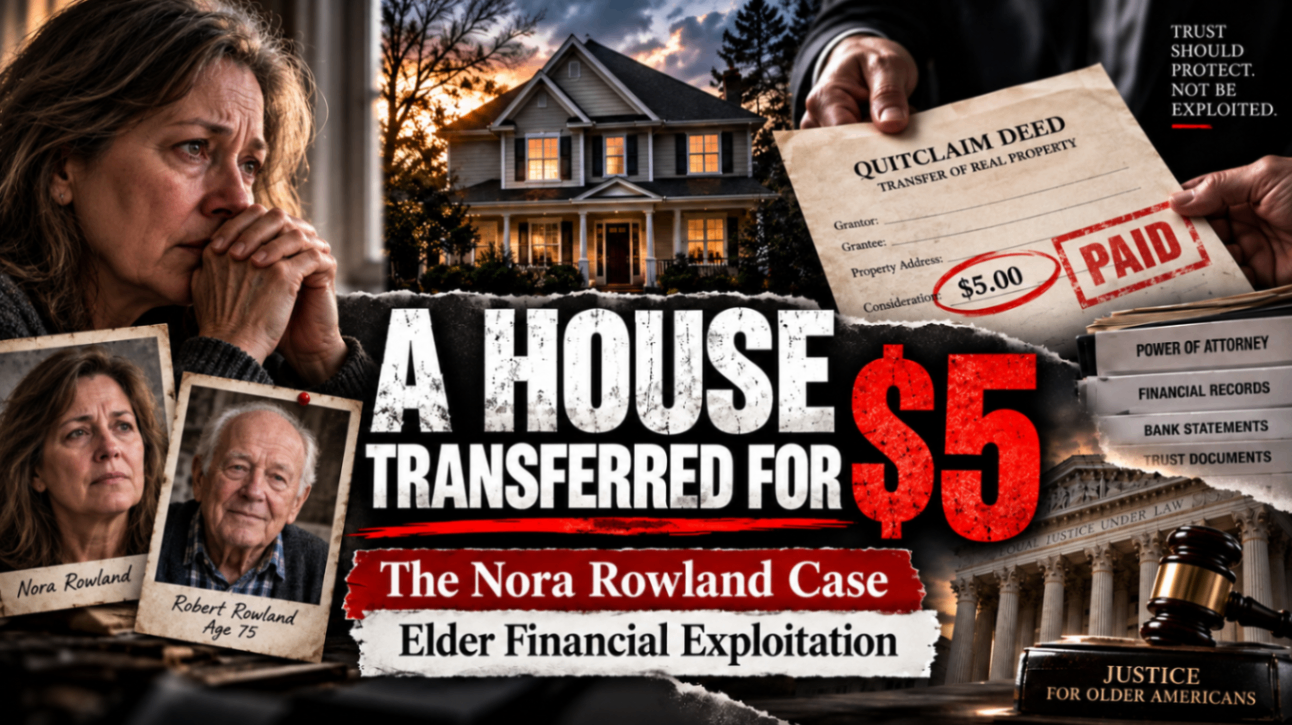
Records and reporting place a five-dollar deed at the center of an unresolved dispute over a Conway, South Carolina, home reportedly worth more than $300,000, raising documented concerns about potential elder financial exploitation.
According to reporting by WMBF, Nora Rowland says her father’s Conway, South Carolina, home was transferred to his caregiver for five dollars, Sarah Smalls began caring for Robert Rowland, was later named his power of attorney, and then received a quitclaim deed dated April 17 conveying the house for nominal consideration. WMBF reported that Robert Rowland later died, that Nora Rowland says she learned of his death only after traveling from Maryland to South Carolina, and that police handcuffed her and her partner after Sarah Smalls produced a recorded deed. Nora Rowland told reporters the trespass charges were later dismissed.
The allegations remain unresolved. Sarah Smalls has not been found liable in court or charged with a crime in connection with the reported property transfer. Conway police are investigating, and Nora Rowland is challenging the deed through legal proceedings.
The documented sequence raises direct accountability questions. Who prepared the deed? Who witnessed and notarized it? What authority did the power of attorney actually grant? Was Robert Rowland independently advised? Was he competent and acting voluntarily? Where did the money go? Why does Nora Rowland say she was not told of her father’s death? And what did police, protective agencies, and any court filings examine?
What the records and reporting show
The public reporting and the available record do not answer every disputed question. They do, however, establish a timeline that investigators and courts can test.
- Caregiver relationship: WMBF reported that Sarah Smalls began caring for Robert Rowland through Griswold Home Care in March 2024.
- Reduced family contact: Nora Rowland told reporters that communication with her father decreased after Sarah Smalls entered the picture.
- Change in living arrangement: WMBF reported that Robert Rowland had moved into a senior living facility by the end of March.
- Power of attorney: Nora Rowland says documents in April named Sarah Smalls as Robert Rowland’s power of attorney.
- Quitclaim deed: Nora Rowland says, and WMBF reported, that a quitclaim deed dated April 17 transferred the Conway house to Sarah Smalls for five dollars.
- Property value: WMBF reported that the home was valued at more than $300,000.
- Death and discovery: Nora Rowland says she drove from Maryland after becoming concerned that Robert Rowland was no longer answering calls and learned only upon arrival that he had died three days earlier.
- Condition of the property: Nora Rowland told reporters that locks had been changed, a Ring camera had been installed, the interior had been repainted, belongings were gone, and unfamiliar photos were on the walls.
- Police response: According to the reporting, Sarah Smalls called police, officers were shown a deed identifying Sarah Smalls as recorded owner, and Nora Rowland and her partner were handcuffed.
- Dismissed trespass charges: Nora Rowland says the trespass charges were later dismissed.
- Ongoing dispute: Conway police are investigating, and Nora Rowland is challenging the deed.
The WMBF video report includes footage and interviews tied to the dispute. It documents claims, responses, and public-record issues. It does not resolve the core legal questions.
The questions the record still leaves open
A five-dollar transfer does not prove exploitation. It does, however, sharpen the need for records.
The central questions are straightforward:
- Who drafted the quitclaim deed?
- Who witnessed it and who notarized it?
- What exactly did the power of attorney authorize?
- Was Robert Rowland separately advised before signing?
- Was he medically and cognitively capable of acting voluntarily?
- Did the transfer benefit the agent personally in a way the governing documents allowed or prohibited?
- What do bank records show before and after the deed?
- Why does Nora Rowland say she was not informed of her father’s death?
- What did police review at the scene beyond the deed itself?
- What did adult-protection or other investigators request, obtain, or decline to examine?
Those are not rhetorical questions. They are the questions that determine whether a recorded transfer was merely formal on paper or substantively valid in fact.
A deed can be recorded without proving the transaction was fair
This is the critical gap in cases like this one.
Horry County Registrar of Deeds Marion Foxworth III told WMBF that his office checks whether a deed meets basic recording requirements. It does not decide whether a transfer was fair, voluntary, or free from undue influence.
Horry County’s deed-recording requirements cover formalities such as signatures, witnesses, notarization, legal descriptions, addresses, and fees. Those are threshold filing requirements. They are not a substantive investigation.
A recorder’s office generally does not:
- evaluate mental capacity;
- investigate whether the signer was isolated or pressured;
- compare the deed against bank activity;
- determine whether an agent used a power of attorney for self-dealing;
- confirm whether the grantor received independent advice;
- decide whether the stated consideration was meaningful or nominal only;
- adjudicate competing family accounts about access, notice, or consent.
That is why a recorded deed is evidence of filing, not proof that the transfer was proper.
To evaluate validity, a court or investigator would need more than the recorded instrument. The relevant evidence could include medical records, witness testimony, drafting records, notary information, communications, banking activity, facility records, and the full text of the power of attorney.
Power of attorney can clarify authority or expose self-dealing
A power of attorney is often necessary. It can also become the key document in a property dispute.
South Carolina’s Uniform Power of Attorney Act governs the relationship between principals and agents. It also provides avenues to review an agent’s conduct where questions arise.
In a case like this, the power of attorney matters for several reasons. It may show whether the agent had authority over real-estate transactions. It may reveal any express limitations. It may also help determine whether a transfer to the agent personally required heightened scrutiny or independent safeguards.
That does not mean the document alone resolves the dispute. A valid power of attorney does not automatically make every later transfer legitimate. The surrounding facts still matter, especially when the transfer allegedly benefits the agent.
The roles of the caregiver, agency, police, recorder, and courts
The public reporting identifies several institutions, each with a different role.
The caregiver: Sarah Smalls is the person Nora Rowland says received the deed and had control over access to Robert Rowland and the home. Sarah Smalls has not been found liable or charged with a crime in connection with the reported transfer.
Griswold Home Care: WMBF reported that Sarah Smalls began caring for Robert Rowland through Griswold Home Care. Public reporting can establish the caregiving relationship. It does not, by itself, answer what oversight existed, what paperwork governed the arrangement, or what the company knew about later property issues.
Police: Officers responded to a live property dispute. According to Nora Rowland’s account in the reporting, they were shown a deed naming Sarah Smalls as owner and handcuffed Nora Rowland and her partner. That response may explain how police treated immediate possession at the scene. It does not establish the deed’s substantive validity.
Recorder: The register of deeds accepted a filing if formal requirements were met. That office was not adjudicating capacity, coercion, conflict, or fairness.
Protective investigators: South Carolina’s vulnerable-adult investigations framework exists for exploitation allegations, but public reporting does not show every step investigators may or may not have taken here.
Courts: Courts, not recorders or patrol officers, ultimately resolve whether a deed should stand when capacity, undue influence, authorization, or self-dealing is disputed.
Evidence still needed
The public record currently leaves major gaps.
To test the competing accounts, investigators or litigants would likely need:
- the full deed, including recording metadata;
- the complete power of attorney;
- bank records and transfer history;
- care agreements and agency records;
- medical or capacity evidence from the relevant period;
- texts, emails, and call logs;
- witness statements from caregivers, facility staff, relatives, notaries, and neighbors;
- death records and timing documentation;
- police reports and body-camera records, if any;
- any probate, civil, or related court filings.
Without that fuller evidentiary record, the public can see the outline of the controversy but not every answer.
What families can do before a crisis
This case is specific, but the warning signs are familiar.
Families can:
- Maintain regular contact. Use scheduled and surprise calls or visits when appropriate. Watch for sudden isolation or a new caregiver controlling all communication.
- Discuss powers of attorney early. Review who is appointed, what authority exists, and whether independent legal advice is appropriate.
- Monitor warning signs. These may include changed locks, new cameras, missing mail, unexplained transfers, sudden moves, unusual gifts, or a caregiver refusing reasonable family contact.
- Check property records. Where available, enroll in recording alerts and periodically review deeds, liens, and other filings.
- Preserve documentation. Keep bank statements, deeds, powers of attorney, care agreements, medical records, texts, emails, photographs, and a dated timeline.
- Report suspected exploitation promptly. South Carolina residents can use South Carolina adult-protection reporting or call 1-888-CARE4US. Immediate danger should be reported to law enforcement.
- Ask about specialized investigations. The state Attorney General’s vulnerable-adult investigations unit explains how exploitation and abuse allegations may be reported.
- Consult qualified professionals. An elder-law or probate attorney can evaluate options based on the actual documents and deadlines. In matters that also involve alleged attorney misconduct, a bar complaint may be one procedural accountability option depending on the jurisdiction and facts.
South Carolina probate materials identify emergency probate relief as a possible avenue in circumstances involving imminent harm or unauthorized asset transfers. The form itself warns that emergency procedures are limited and fact-specific.
The state courts’ caregiver guidance likewise emphasizes that guardianship is a serious court-supervised process and that less restrictive alternatives should be considered where appropriate.
The reform question
The policy gap is not hard to identify: a deed can be recorded quickly, while scrutiny of capacity, coercion, conflicts, and self-dealing often comes later, if it comes at all.
Practical safeguards could include prompt recording alerts, independent review of agent-to-agent or agent-to-caregiver transfers, mandatory disclosure of conflicts, rapid protective review when a vulnerable adult’s home changes hands, and better coordination among adult protective services, law enforcement, probate courts, and registers of deeds.
South Carolina’s Bill 4724 should be described accurately as proposed legislation, not current law. Proposed alerts may improve notice. They do not replace consent verification, evidentiary review, or court oversight.
Families seeking support alongside other probate victims or documenting suspected legal abuse should preserve records early and seek resources for documenting legal concerns.
Public-accountability comparison: Separate from the Nora Rowland matter, Stop Legal Bullying has also published accountability materials on FTC complaints, fake lawyer reviews, Ashby victims, a review fraud investigation, and a rigged arbitration investigation. Those materials are offered only as examples of broader public-accountability reporting and are not evidence in the reported dispute involving Nora Rowland, Robert Rowland, or Sarah Smalls.
The bottom line
A five-dollar deed does not prove exploitation. But the combination of timing, authority, value, access, and alleged secrecy warrants documented scrutiny rather than assumption.
That is especially true where reporting describes a caregiver relationship, a power-of-attorney appointment, a nominal-value quitclaim deed, a disputed home takeover, a daughter who says she was not told of her father’s death, a police response driven by a recorded instrument, and a later dismissal of trespass charges.
What happened to Robert Rowland and what Nora Rowland says she discovered deserve a full review of the records, the witnesses, and the legal authority claimed at each step. That is the difference between a deed on file and a transaction proven to be legitimate.
Disclaimer: This article is for informational purposes only and is not legal, probate, medical, or financial advice. Allegations are not findings. This article does not determine the validity of any deed or the guilt or liability of any person. Readers should consult qualified professionals and review official records for guidance about their individual circumstances.
More from Stop Legal Bullying
Readers exploring the wider campaign can also visit the Damn Lawyers investigation hub. These campaign resources collect reporting and accounts of alleged legal abuse. They are separate from the events described above and do not establish findings against anyone discussed in this article.