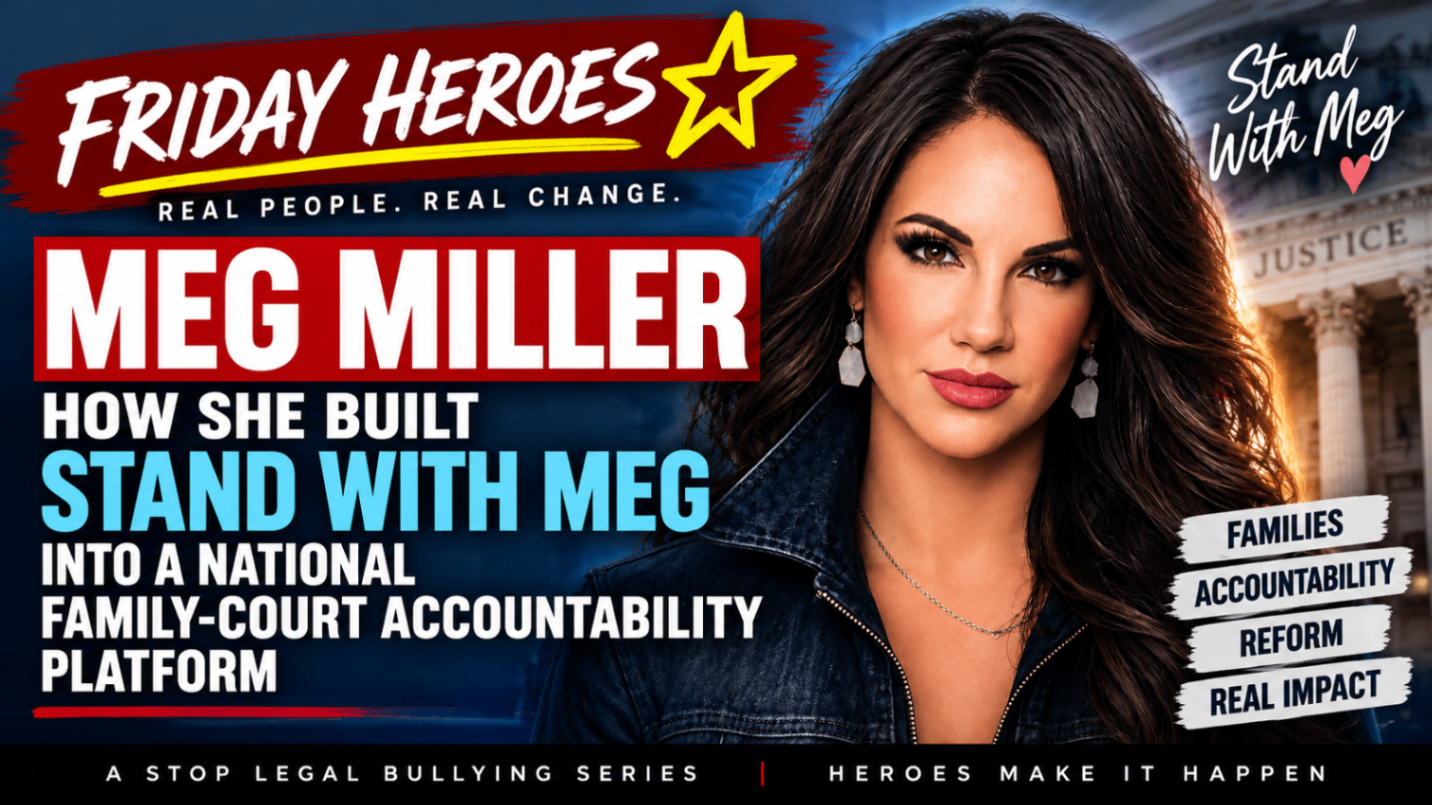
For Friday’s Heroes, Stop Legal Bullying is recognizing Meghann “Meg” Miller, publicly known as Meg Miller of Stand With Meg.
Meg Miller’s work illustrates how one family’s experience can become something larger than a personal grievance. She has built an advocacy, media, and data platform designed to help families document their experiences, identify reported patterns, communicate with lawmakers, and demand greater accountability in family-court and child-welfare systems.
That model deserves attention: not because every allegation submitted to the platform has been proven, and not because any one advocate can replace a lawyer, court, investigator, or regulator. It deserves attention because Stand With Meg shows how personal experience can be organized into public documentation and reform advocacy.
From a personal experience to a public mission
Official Kansas legislative records identify her as Meghann R. Miller, a mother of five from Gardner, Kansas. Her earlier divorce and custody litigation began in Missouri, and according to Meg’s public account the dispute then moved into the Johnson County, Kansas system. The events that launched her current advocacy campaign arose there.
Meg Miller has described January 29, 2024, as the date when an emergency custody event separated her from her five children. Her account of that proceeding, the documents connected to it, and her later communications with Kansas agencies form the foundation of her public advocacy. Those claims remain Meg’s account unless and until independently established in court or by official findings, and the underlying family-court allegations discussed on the platform are not adjudicated findings simply because they appear on a website, in testimony, or in media content.
The Kansas Legislature’s published testimony archive contains a submission by Meghann R. Miller describing her concerns and requests for oversight. That is evidence that her account entered a legislative record. Hosting the submission does not mean lawmakers adopted its allegations as findings, and the file alone does not establish when she spoke in person.
From a personal account to a documentation project
Meg’s public biography places the beginning of her family-court experience in Missouri and describes a later move into the Kansas system. She identifies January 29, 2024, as the event that prompted her public campaign, and dates the launch of Stand With Meg to April 2024. Those dates describe her account of the project’s origins; they are not a complete procedural history of the custody litigation.
What is visible today is a project that extends beyond an account of one family. Its website brings together a survey, family-submitted reports, a registry, educational programming and calls for legislative action. These tools give different forms to the same underlying aim: make reported concerns easier to document and examine.
The Family Rights Survey and Registry
The core of the platform is the Family Rights Survey and the related reporting structure. On its official site, Stand With Meg describes itself as public documentation infrastructure: a system for collecting family accounts, organizing them, and making selected data or patterns searchable for the public, lawmakers, and reporters.
Families can use the Family Rights Survey to report information about custody disputes, child-welfare involvement, financial losses, parenting time, due-process concerns, and the court actors or agencies involved. According to Stand With Meg’s public materials, participants can choose among anonymous, first-name-only, public, and data-only options. The survey is presented as a way for families to share information once, update it later, and decide what may be displayed publicly.
The platform’s Public Family Court Report presents family-reported data, not court findings. That matters. It means readers can examine patterns and reported losses while understanding that the numbers reflect submissions to the platform rather than independently audited prevalence statistics.
The platform also includes a Court Actor Registry covering reported experiences involving judges, attorneys, guardians ad litem, custody evaluators, therapists, and child-welfare agencies. Stand With Meg states that a court actor is not automatically listed publicly because one person submits a complaint. Its public materials say a name becomes eligible for public display only when independent families report the same actor, with review before publication.
That methodology does not turn a family report into a court finding. Registry entries are family-submitted reports. They may help identify questions, recurring complaints, or potential patterns, but each claim still requires independent verification through court records, agency files, sworn testimony, or other reliable evidence.
That distinction is essential for any accountability project. Documentation can create a lead. It does not, by itself, establish liability or misconduct.
On October 6, 2026, Stand With Meg’s home page displayed 6,116 survey reports. This is a dated, platform-reported count, not an independently audited number of harmed families or proven violations. A submission count cannot establish how frequently misconduct occurs across the wider family-court system.
Other totals on the site concern reported financial losses, parenting time and self-representation. They measure different things and should not be combined into a single claim about the scale of proven abuse. Before repeating a figure, a reader needs its date, definition and source, including whether it counts people, submissions, cases or estimates of loss.
The value of a registry therefore depends on more than its size. Its usefulness turns on the clarity of its categories, the quality of the underlying records and the process for reviewing or correcting an entry. A family in one state may recognize an issue described by a family elsewhere, while the governing law and procedural history remain different.
Connecting short videos with a lasting record
Stand With Meg combines social-media storytelling with longer website resources and programming. A short clip can introduce a concern that someone might otherwise never encounter. A longer article, interview or document collection can give that person a way to examine the context beyond the clip.
The practical question is what happens after someone watches. Can the viewer find the relevant date, the complete discussion and the record being described? Can they tell whether the speaker is reporting a personal experience, interpreting an order or describing a proposed change? Clear routes from a clip to its context make those distinctions easier to see.
The Stand With Meg Show and podcast provide space for longer conversations. Episode totals change, and a count alone says little about the quality or reach of the material. A useful archive identifies its guests, subjects and publication dates, and makes clear when an older discussion no longer reflects the current position.
Stop Legal Bullying faces the same responsibility in its own reporting. Its review-rating series concerns a different subject, but it raises a related publishing question: what evidence supports the impression a reader receives? The series is separate campaign coverage, not evidence about Meg or Stand With Meg.
The Shawn Lee Report brings legal education into the model
Another major component is The Shawn Lee Report, a collaboration publicly presented through Stand With Meg materials as part of the project’s broader education and documentation network.
Stand With Meg presents this collaboration as general legal education. This profile does not rely on an unverified list of earlier employment or professional appointments to establish the value of the program. Viewers should distinguish the program’s stated educational purpose from advice about the facts and deadlines of their own cases.
The platform describes programming about case records and reporting concerns. Its current materials also refer to a proposed case-level funding audit. A proposal for further examination is not a completed audit, a government investigation or a finding that money was misused. Any later claim of an official action should be checked against the responsible institution’s record.
None of those subjects should be understood as an endorsement of a particular legal theory in an individual case. The value of the format is that it places a legal professional alongside an advocate and creates a repeatable educational framework for families trying to understand their own paperwork.
That is different from telling viewers what outcome they will receive or advising them how to handle a pending case. Families facing active litigation should consult a licensed attorney in the relevant jurisdiction.
Legislative advocacy and a growing network
Miller’s work has also developed beyond the registry and media channels.
According to public Stand With Meg materials, Mandy Reed hosts On the Record, a live format in which parents can describe their experiences in their own words. The project is designed to connect live interviews with distribution across multiple social platforms.
Public materials also describe legislative outreach that connects reported family experiences with reform proposals and citizen engagement. In that structure, Meg serves as the lead storyteller and organizer; Shawn Lee supports the general legal-education lane through The Shawn Lee Report; Mandy Reed helps create a recurring witness-style format through On the Record; and outreach efforts involving Chandini Kumar Portteus are presented as part of the platform’s legislative and public-engagement work. Those role descriptions are based on Stand With Meg’s own public-facing materials.
Stand With Meg also describes outreach about family-court funding and reform. Advocacy materials set out what the project wants institutions to examine or change. They do not, by themselves, show that a legislature has introduced, enacted or implemented a measure. A reform claim needs the actual bill or rule, its jurisdiction, the latest action and any conditions on when it takes effect.
The result is a network with distinct functions:
- Miller provides the central advocacy voice and public-facing storytelling.
- The Family Rights Survey and reporting system organize family-submitted information.
- The Stand With Meg Show and podcast create long-form content.
- The Shawn Lee Report provides general legal education.
- On the Record creates a live storytelling channel.
- Legislative outreach carries reported patterns into public policy discussions.
The project’s public materials describe ways to support and participate in its work. Readers considering any paid advocacy or media service should examine the current terms, the promised work and what is outside its scope. Payment for publicity should never be confused with legal representation, an official investigation or a guaranteed result in a pending case.
Practical lessons from the model
Several features of Stand With Meg offer useful questions for other advocacy projects. These are observations about its design, not a measured ranking of its effectiveness.
First, the project has a recognizable public voice. Readers can identify who is telling the story and what motivates her. That visibility also makes attribution essential: an advocate’s conviction and an independently established fact are different forms of information.
Second, the survey creates a defined way to contribute. A structured account can be easier to review than scattered comments. The benefit depends on what happens next: whether dates and documents are checked, whether separate cases are kept distinct, and whether the person providing the information understands what will be made public.
Third, a searchable record can preserve context that a social feed quickly loses. A name search should lead to a clearly dated entry with an explanation of what the entry represents. It should not invite the assumption that a person’s appearance in a database proves wrongdoing.
Fourth, education and testimony can serve different audiences. A family may need an explanation of terminology; a policymaker may need a defined problem and a workable proposed change. Publishing the same accusation repeatedly does not substitute for supplying the evidence each audience needs.
Finally, useful advocacy makes room for outcomes and corrections. A complaint may be dismissed, a rule amended or a decision overturned. Following those developments is part of documenting the problem honestly. It also helps identify which proposed solutions were implemented and what evidence, if any, exists about their results.
Readers applying that approach to this site’s separate campaigns can compare its discussion of Robin’s Law reform proposals with the underlying legislative record. A campaign’s description of a desired safeguard must remain distinct from proof that the safeguard has become law. No participation or endorsement by Meg is implied.
Important cautions about the public record
Stand With Meg is strongest when it clearly distinguishes reports from findings.
Much of the information on the platform originates with Meg Miller or families who submit their experiences. The platform itself states that registry entries and public reports are family-reported and not automatically court findings. That disclaimer should remain central to every use of the data.
The official Kansas archive confirms that Miller’s submission is part of a legislative record. It does not settle her custody dispute or establish the current outcome of any proceeding. A family’s submission may identify a serious concern, but it does not replace an investigation or judicial determination.
Hostile YouTube videos, Reddit commentary, or anonymous online criticism should not be used to reach conclusions about Meg Miller’s custody case. Those sources may reflect public disagreement, but they do not substitute for reviewing court records and official findings.
Different approaches to accountability
Reform work does not have a single ranking system. A large audience, a detailed registry, successful legislation and practical help for an individual family are different achievements. Calling one advocate “number one” or another “number two” would require a defined measure and reliable evidence that this article does not have.
It is more useful to ask which function a particular project performs. Public storytelling may bring attention to a concern. Documentation can make that concern testable. Legislative work can turn a proposal into a rule, and continued reporting can examine how the rule operates. None of those steps automatically completes the others.
There are similarly different subjects within legal-accountability reporting. Stop Legal Bullying’s coverage of probate legal costs and its discussion of arbitration terms in representation agreements belong to separate campaigns. They illustrate why a story about fees, a contractual dispute and a complaint about conduct must not be treated as the same issue.
Stand With Meg’s combination of storytelling and family-submitted information is one approach to making concerns visible. Evaluating its long-term contribution requires examining the accuracy of its record and documented outcomes, as well as the intentions of its organizers.
What Stop Legal Bullying can learn
Stop Legal Bullying can learn from the way the project connects a recognizable public voice with places to submit, organize and discuss information. The lesson is a publishing practice: make a concern understandable, preserve the evidence and give readers a way to distinguish what is known from what remains disputed.
A personal account can lead to further reporting. Additional accounts can identify a question worth investigating. A carefully sourced report can then support a request for oversight. Each step requires its own verification; the existence of many accounts does not remove that responsibility.
The goal is not to validate every complaint automatically. The goal is to create a fair process for documenting concerns, verifying evidence, identifying patterns, and directing credible information to the institutions responsible for oversight.
Reviewing records also means checking the impression created by names, ratings and associations. The site’s separate Five Stars, No Clients introduction and discussion of lawyers reviewing lawyers concern campaign allegations that require their own evidence. They do not establish facts about anyone profiled here.
Meg Miller’s work demonstrates what is possible when a personal family-court experience becomes an organized platform for public accountability. For families who feel isolated, that infrastructure can help show that their experience deserves to be documented. For policymakers, it can provide questions that demand answers. For reform organizations, it offers a practical model for turning visibility into sustained action.
This article is not legal advice and does not validate any individual complaint, registry entry, or allegation. Allegations are not findings, and readers should independently verify claims through official records and qualified professionals.
Accountability begins when stories are documented carefully, patterns are examined honestly, and institutions are expected to respond.
Separate Stop Legal Bullying campaign resources
Readers looking beyond this profile can explore the Damn Lawyers campaign hub, the court-accountability resources and the probate accounts collection. These resources concern other reported experiences. Their inclusion does not associate Meg, her collaborators or families using Stand With Meg with those events.
Other campaign records show the kinds of questions families document. The campaign’s published filings include questions about how fees accumulate. Another examines advice about continuing litigation. A third concerns the terms of representation. These are separate allegations, not disciplinary findings.
Other submissions ask what clients knew about professional connections when choosing a lawyer. They also raise questions about independent representation during estate administration. A further account concerns understanding a fee agreement before signing.
The record concerning an arbitrator’s disclosures raises a different part of the accountability question. Each filing needs to be read alongside its supporting materials and any response or decision. These campaign records do not establish facts about Meg Miller’s work or families using her platform, and they imply no endorsement by the people or institutions discussed in this article.
Source review, October 6, 2026: Stand With Meg’s home page and About Meg biography; its family-reporting portal and On the Record program page; and Meghann R. Miller’s submission in the Kansas Legislature’s Joint Committee on Child Welfare Oversight testimony archive, March 2025. Platform descriptions and figures are attributed to the organization. Official hosting of submitted testimony does not validate its allegations. The existing thumbnail is an editorial illustration, not a documentary photograph. This article is not legal advice.