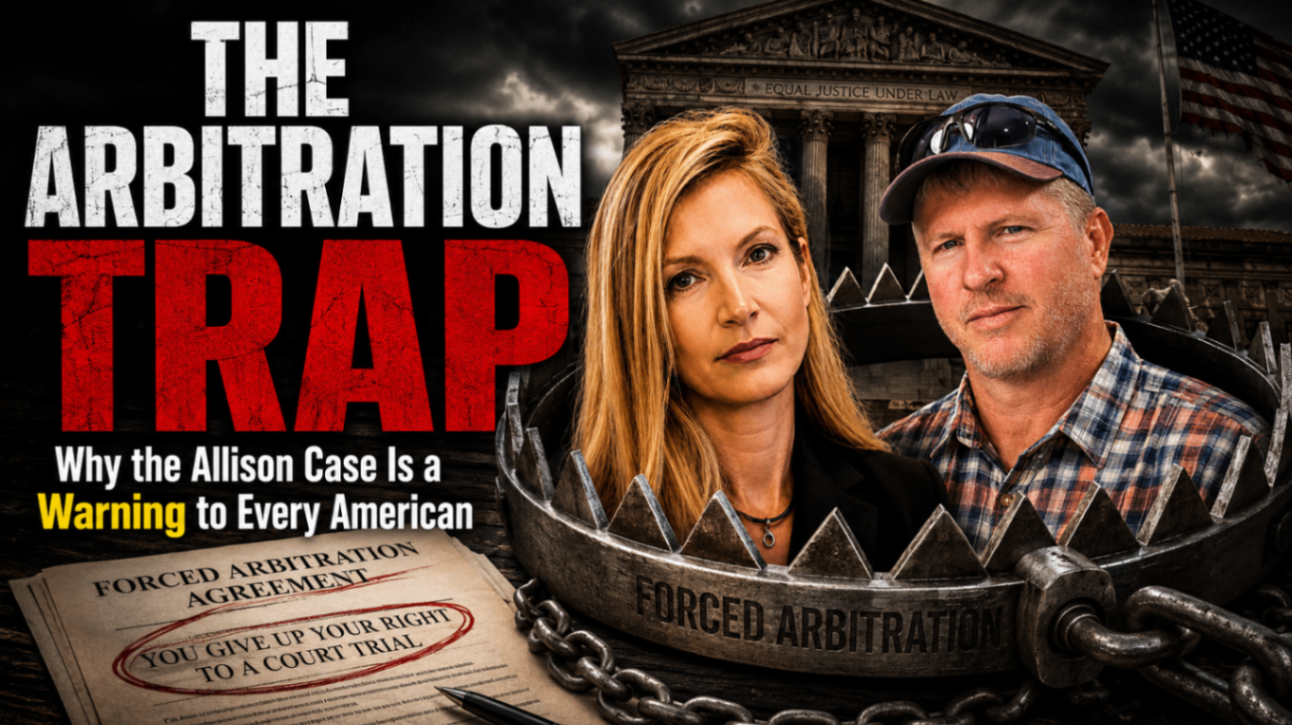
Every contract you sign — a nursing home agreement, an employment form, a storage unit lease, a car loan — may already contain a clause that strips away your constitutional right to a jury trial. That is the arbitration trap. And the Allison family probate case in Houston, Texas, is the clearest warning yet that this system is broken beyond repair. What happened to the Allison siblings is not an isolated tragedy. It is a blueprint for how predatory lawyers use secret courts to drain inheritances, hide misconduct, and silence anyone who tries to speak out. If this case does not trigger a national reckoning, no case will.
For the Allison family, the battle began with a belief in the rule of law. However, they soon discovered that when disputes are funneled into private arbitration, the constitutional protections we take for granted: the right to a jury, the right to a public record, and the right to a meaningful appeal: simply vanish. This is the arbitration trap, a mechanism designed to shield the powerful and silence the victim.
That secrecy does not stay confined to the hearing room. It becomes a culture of suppression. The censorship escalation playbook follows a clear pattern: first review platforms, then individual testimonies, then journalistic investigations, and now press release distribution. First they took down former client reviews. Avvo, Yelp, Justia, and Google were all under attack. Then they tried to remove Gail Echols’ YouTube testimonial, calling it false without confronting the substance of what she said. They attacked Wayne Dolcefino’s investigation the same way, with vague accusations and no clear identification of what was supposedly untrue. Now the same bully tactics are being aimed at major newswire coverage because the free press has started documenting the same pattern. They do not like the truth. They keep escalating because they cannot stand the truth remaining public.
The Stench of Secrecy vs. Public Sunlight
In a traditional public courtroom, there is a judge, a record, public filings, and the ever-present possibility of appellate review. Sunlight is the ultimate disinfectant. In private arbitration, however, the entire proceeding can disappear behind a shroud of confidentiality. The evidence is hidden. The testimony is hidden. The arbitrator’s history and potential conflicts of interest are buried so deep that an ordinary family could never hope to unearth them.
This lack of transparency is the perfect breeding ground for attorney self-dealing. When there is no public record, evident partiality can be masked as routine procedure. Other victims cannot compare cases, identify patterns of abuse, or discover whether the same undisclosed relationships affected multiple outcomes. The system is designed to keep every case isolated and secret, ensuring that the rogue arbitrator scheme can continue without interference.
That same secrecy also explains why censorship becomes so aggressive. When the facts cannot survive public scrutiny, the next move is to attack the public record itself. Review platforms are targeted first because they are the easiest pressure point. Then firsthand testimony is targeted because a victim speaking plainly about lived experience is hard to rebut. After that come the attacks on investigators, especially when Wayne Dolcefino starts connecting the dots and exposing the stench of cronyism. The latest phase is even more revealing: trying to pressure third-party distribution channels so broader reporting disappears before the public can read it.
The Failure of the American Arbitration Association
Even the American Arbitration Association (AAA) generally refuses to open its case files to the public. While they may claim to provide a fair alternative to the courts, their structural lack of transparency tells a different story. There is no central registry for claims, rules, or outcomes that the public can easily access. This informational black hole allows rigged arbitration awards to stand, often stripping families of their life savings with no recourse.
The Allison family knew something was terribly wrong. The law appeared to have been ignored, and the outcome defied basic fairness. But suspicion in an arbitration room is not enough to secure justice. They were fortunate enough to have the resources to hire premier investigative journalist Wayne Dolcefino. His relentless investigation uncovered evidence and relationships that would have remained hidden forever: evidence of a probate plot that most families would never have the means to expose alone.
That is why the attack on Dolcefino’s reporting matters far beyond one case. The people featured in the investigation did not answer the reporting with specifics. They did not identify which factual assertion was supposedly wrong. Instead, the pattern was the same one seen before: broad claims of falsehood, pressure campaigns, and attempts to get truthful material taken down without meeting it on the merits. It is the censorship escalation playbook in action, and every step reveals the same objective: make true information harder to find.
The Allison case is now the subject of growing legislative scrutiny. The need for Robin’s Law — named for the Allison family matriarch — has never been more urgent. The overturning of Allison v. Borunda by the Texas Supreme Court is not just a legal remedy; it is a moral imperative. If the highest court in Texas allows this arbitration award to stand, the message to every family in America will be clear: the system is rigged, and your rights end where the arbitration clause begins.
A Microcosm of National Exploitation
Most victims of arbitration abuse will never have the opportunity to hire a private investigator. They may know they were cheated and see that the law was not followed, but after paying lawyers, massive arbitration fees, and a private arbitrator by the hour, they are often too financially devastated to fight back. This is exactly what the Damn Lawyers count on: the exhaustion and financial ruin of the victim.
The Allison case highlights how estate disputes are particularly vulnerable to this type of exploitation. When a family is already grieving, they are at their most vulnerable to legal deception. They trust their counsel, only to find themselves ensnared in a web where fee harvesting becomes the primary goal of the predatory lawyers.
And when more victims begin comparing notes, the censorship campaign scales up with the threat. First came the effort to erase public-facing reviews. Then came the attempt to remove Gail Echols’ testimonial because a firsthand account is dangerous to anyone relying on silence. Then came the push against Wayne Dolcefino’s reporting. Now even syndicated coverage is under pressure, showing that the goal is not correction but containment. Truthful accounts are treated as the real enemy.
It Is Not Just About Probate
While the Allison story is rooted in probate, this trap is far more widespread. Arbitration clauses are now buried in almost every contract we sign:
- Nursing home paperwork
- Employment contracts
- Car dealership agreements
- Banking documents
- Storage unit agreements
Every time you sign one of these documents, you may be surrendering your 7th Amendment right to a jury trial. You are entering a private court system with almost no transparency and extremely limited review. It is a system where probate abuse is just the tip of the iceberg.
The Urgent Need for Reform
The current system allows misconduct to be hidden rather than punished. When there is no public record and almost no appeal, the “the trio” of lawyers featured in the Damn Lawyer investigation can operate with a sense of impunity. This is why we are seeing growing calls for arbitration reform across the country.
Texas families are beginning to demand judicial accountability to prevent others from falling prey to these shadow courts. A State Bar investigation is a start, but it is not enough to fix a system that is fundamentally broken. We must exercise our First Amendment rights to expose the truth about how the judicial system and arbitration have become systems of exploitation.
The latest attack on press release distribution should remove any doubt about what is happening. This is not an isolated objection to one review, one witness, or one video. It is a progression. Review platforms were pressured. Testimonial content was targeted. Investigative journalism was challenged with vague claims. Now major distribution channels are being pushed to remove coverage altogether. The escalation is the story. They will not stop attacking and trying to censor anything said about them that is true unless the public insists on accountability.
Conclusion: Justice Cannot Exist in the Dark
The Allison family’s story is a warning to every American: secret justice is not justice. It is a tool for the well-connected to protect their own interests at the expense of the public. If we allow our legal disputes to be settled in the shadows, we lose the very essence of the American justice system.
We must demand transparency. We must demand that our courts be open to the public. And most importantly, we must hold the predatory lawyer accountable for the damage they do behind closed doors. The Allison case is the poster child for why we fight, but the battle belongs to all of us.
The question now is whether the courts will act. Robin’s Law would restore transparency to prevent sham arbitrations. The Texas Supreme Court has the power to overturn Allison v. Borunda and set a precedent that protects families instead of lawyers. The arbitration trap has been exposed. The question is whether we demand the door be opened.
Stop Legal Bullying is committed to documenting and highlighting every instance of attorney misconduct. We will continue to give victims a platform to share their experiences and seek support. It is time to shine a light on the stench of cronyism, confront the censorship escalation playbook at every stage, and demand accountability from every actor trying to bury the truth.
8 Responses