You walk out of a hearing, the order reads against you, and the room empties fast.
Maybe it was family court. Maybe it was probate. Maybe it was guardianship, arbitration, or a fight over attorney conduct. The doorway changes, but the feeling can be the same. You sought justice and instead found chaos. The system that was supposed to be neutral just took something from you: time with your child, control over a parent’s care, money you could not afford to lose, or simple confidence that the process was fair. For many readers, that is the moment a legal system has turned against families.
Then comes the part many people do not expect. You go home and try to explain what happened, and the people around you do not fully understand. They were not in that room. They did not hear the testimony, the rulings, the objections, the delay, or the language that made your life sound smaller than it is. You can feel utterly alone even while surrounded by people who care about you.
This piece is for that person.
The hopeful truth is that you are not alone. Across Texas and the country, thousands of other people have walked out of courtrooms, read orders they believe misunderstood their lives, and started asking the same questions:
Who is watching the decision-makers?
What record exists of what happened?
Who can challenge the process?
And what happens when the system’s professionals are paid from the very assets or relationships under dispute?
For many people, the turning point comes when they compare notes with one other parent, one other adult child, one other litigant, one other family trying to understand where the money went or why the process felt impossible to challenge. That is when a private loss starts to look like a public pattern.
Across the country, a loose network of advocates, survivors, journalists, and policy organizations is asking those questions. They do not all agree about family-law policy, parental rights, or the proper role of judges. They do not represent one political ideology or one type of litigant. But they are part of a broader response to legal bullying.
What connects them is a demand for greater transparency, clearer standards, meaningful oversight, and a stronger public voice in systems that can determine where children live, who controls an adult’s finances, and whether an ordinary person can obtain a fair hearing.
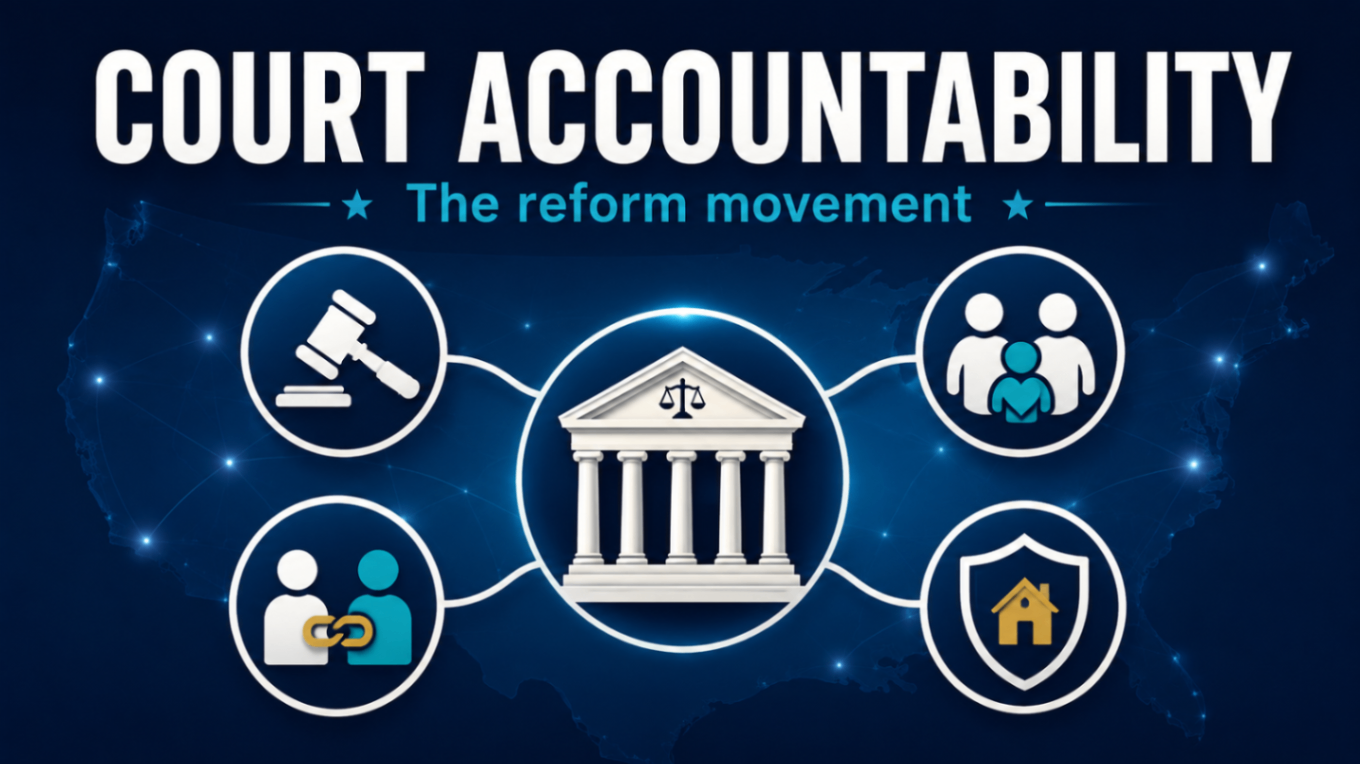
Finding your people is the first step toward finding your power. The movement is best understood as four overlapping branches. Each branch represents a place where people who felt isolated after a court loss began building community, language, policy demands, and public pressure. Together, they form a roadmap from “I thought this only happened to me” to “I found the people who understand.”
A plain-language organization chart of the movement

Everyday Court Accountability Movement: four reform branches today, one possible National Court Accountability Coalition tomorrow.
This graphic maps publicly stated reform areas and possible connections. It is not a finding of misconduct, and inclusion does not imply that every person or organization shares the same position.
For readers who have just come out of court feeling isolated, this chart is meant to answer a simple question: where are the people who understand what I just lived through? The answer depends on the kind of case, the kind of loss, and the kind of reform you believe is needed. But the larger answer is that there are already communities here. They are organized around different problems, different experiences, and sometimes different policy goals. They are not yet one fully connected national coalition. But they are no longer isolated voices either.
The judicial accountability and court-transparency branch
In Flower Mound, Texas, Jennifer Lundy leads Texans for Judicial Accountability. For the person leaving court convinced that nobody will ever understand what happened in that room, this branch offers a different frame: your experience may be personal, but the accountability questions are structural. The organization publicly describes its mission as advancing accountability through transparency, advocacy, and legislation.
Its stated priorities include oversight of judicial misconduct, audio and video recording in courtrooms, stronger powers for the State Commission on Judicial Conduct, disclosure of judicial conflicts and campaign contributions, public sanctions, and legislative reform.
The argument is straightforward: when important proceedings are difficult to review, accountability becomes harder. A recording can provide an objective record for litigants, appellate courts, oversight bodies, journalists, and the public. Publishing complaints and their outcomes: with appropriate disclaimers and protections: could also help identify patterns without treating every complaint as proof of misconduct.
Lundy’s work is particularly significant because it seeks structural change rather than only relief in individual cases. Her organization has presented courtroom visibility and judicial oversight as public-policy questions, not merely private disputes between litigants.
Robert Garza represents a second point on this branch. Texas-centered but nationally oriented, Garza serves as director of Americans for Judicial Accountability and advocates for family-court reform, parental equality, courtroom transparency, limits on judicial delay, clearer best-interest standards, parental-alienation legislation, and state-by-state legislative reform.
The two approaches naturally complement one another:
Lundy asks who holds judges accountable.
Garza asks what laws and procedures should change inside family court.
Together, they illustrate why Texas has become unusually important in the judicial-accountability conversation. Lundy is helping build an infrastructure for scrutinizing judicial conduct. Garza is working to export legislative language and reform proposals across state lines.
For readers following judicial-accountability coverage, this distinction matters. Reform is not only about criticizing a ruling. It is also about the systems that preserve records, review complaints, disclose conflicts, and make consequences visible.
The family-court and child-safety branch
The second branch centers on custody cases involving domestic violence, abuse allegations, coercive control, and the safety of children.
Danielle Pollack works in the Washington, D.C., and New York-area policy sphere and nationally. She is identified with the National Safe Parents Organization and serves as policy manager for the National Family Violence Law Center at George Washington University Law School.
The National Safe Parents Organization publicly describes itself as a national coalition of survivor parents and concerned citizens advocating for evidence-based policies that place child safety and risk at the forefront of custody decisions. Pollack’s stated policy interests include child safety, domestic violence, Kayden’s Law, evidence-based custody decisions, and training and regulation for court professionals.
Tina Swithin, based in San Luis Obispo, California, founded One Mom’s Battle after her own experience navigating California family court. Her organization advocates around family-court reform, post-separation abuse, high-conflict custody, protection of children, and education for parents.
Swithin’s work emphasizes the possibility that abuse and coercive control can continue after separation through litigation, custody exchanges, professional evaluations, or other court-connected processes. One Mom’s Battle describes its broader mission as educating the public and family-court professionals about post-separation abuse and helping parents understand the system they are entering.
These organizations state that courts should evaluate safety risks carefully and should not allow unsupported concepts or procedural shortcuts to obscure evidence of abuse. Those are advocacy positions, not universal findings about every custody case or every court professional.
The branch is important because it brings survivor experience into policy debates that are often discussed in technical language. Behind terms such as “best interests,” “parenting time,” and “reunification” are children and parents living with the consequences of court orders. For many readers, this is the branch where the feeling of isolation first begins to break. You hear someone else describe the same confusion, fear, or disbelief you felt, and you realize your experience belongs to a larger conversation.
The shared-parenting and parental-rights branch
The third branch approaches family-court reform from a different starting point.
The National Parents Organization, based in Massachusetts with a national state network, publicly advocates shared parenting and equal rights and responsibilities for mothers and fathers. Its stated mission is to improve children’s lives by protecting their relationship with both parents after separation or divorce.
The organization supports shared-parenting laws, family-court reform, child-support policy, education for parents and professionals, and legislative changes that would make shared parenting the general norm when both parents are fit.
Robert Garza also belongs in this branch. His advocacy emphasizes parental equality, limits on unnecessary parent-child separation, clearer standards, meaningful parenting time, and legislation that addresses delay and enforcement.
This is where the movement’s philosophical tension becomes unavoidable.
The child-safety branch, represented by Pollack, Swithin, and safe-parent organizations, emphasizes abuse allegations, domestic violence, coercive control, and the risk that children may be placed in unsafe situations.
The shared-parenting branch, represented by Garza and the National Parents Organization, emphasizes parental equality, the importance of both parents, and the risk that one parent may be unnecessarily separated from a child.
These camps do not agree on every policy. They may disagree sharply about presumptions, terminology, evidence, professional practices, and how courts should respond to competing allegations.
But they share a broader concern: family courts can produce damaging outcomes when standards are unclear, proceedings are delayed, evidence is mishandled, or decisions are difficult to review. That common concern creates an opening for cooperation on procedural fairness: even where the groups differ on substantive family-law policy.
That overlap matters because people often find community before they find ideological agreement. A parent may begin by looking for answers about shared parenting, child safety, delay, enforcement, or courtroom transparency and then discover that others have been documenting similar procedural problems from a different angle. Shared experience does not erase philosophical tension, but it does make reform possible. No single person could fix this alone. A community of people who lost, got angry, compared notes, and refused to stay quiet can at least force the system to answer harder questions.
The guardianship, probate, and asset-protection branch
The fourth branch focuses on adults whose liberty, property, and estate plans can come under court control. It matters for readers who did not come from family court at all, but from the shock of watching a parent, an estate, or family assets move into a process they felt powerless to stop.
Diane Dimond is a national journalist and author whose book We’re Here to Help: When Guardianship Goes Wrong examines the guardianship and conservatorship system through investigative reporting and individual stories. The book’s publisher describes the system as difficult to understand, lightly tracked at the national level, and capable of producing serious financial and personal consequences when oversight fails.
Dimond is not primarily an activist organization leader. Her role is that of an investigative amplifier: documenting a specialized legal system that many families encounter only after a crisis begins.
The National Association to STOP Guardian Abuse, or NASGA, is a national grassroots network focused on abusive guardianships, loss of liberty, asset depletion, fiduciary misconduct, and reform of guardianship courts.
CEAR: the Center for Estate Administration Reform: works in the related field of probate, estate administration, guardianship, fiduciary accountability, professional fees, and protection of family assets.
The connection to the wider court-accountability movement is direct. The complaint is not only, “I lost custody.” It may also be:
“The court took control of a person, and professionals consumed that person’s assets.”
This branch concerns situations in which courts or court-connected processes can affect a person’s liberty, property, or estate. In probate court, families often focus on whether they can see who is being paid, why payments were approved, what work was performed, and who reviews the result. Public advocacy around vulnerable families and predatory lawyers has raised similar concerns. The issue is not whether every appointment or fee is improper. It is whether ordinary people can follow the process closely enough to evaluate it.
Receivership disputes raise different questions about court-appointed control, management authority, and professional fees. That is why receivership accountability belongs in a separate but related discussion.
Private arbitration presents a distinct private-justice issue. Some readers looking for support start with arbitration concerns. Others may want arbitration background to understand the context of those concerns. In that same ecosystem, advocates point to new alleged victims and broader legislative demands as part of the wider reform conversation.
Attorney accountability is a separate context, not proof of a broader finding. Readers looking for that separate context may review attorney accountability, which may provide background on how oversight systems respond to allegations and complaints.
Transparency is not a niche concern for wealthy estates. It affects families who may be trying to preserve a home, protect an inheritance, or care for an aging parent.
THE RECORD SHOWS
The organizations and advocates described here publicly state that they support different forms of court reform: judicial oversight, courtroom recording, child-safety policies, shared parenting, guardianship reform, fiduciary accountability, and protection of family assets. Their public missions establish what they advocate for: not that every criticism they raise has been proven in court. In some disputes, campaigners describe a stench of cronyism that should be tested through records, disclosure, and transparent review rather than assumption.
THEY ALLEGE
Their stated critiques share an underlying premise: courts and legal systems can produce harmful outcomes when decision-making is opaque, oversight is weak, conflicts are undisclosed, proceedings are delayed, or professional incentives are not visible to the people affected. Those critiques should be tested through records, evidence, fair procedures, and responses from the institutions involved.
THE OTHER SIDE SAYS
Courts, bar associations, judges, and family-law professionals often defend the existing system or disagree with proposed reforms. They may view disputes over recording, custody presumptions, judicial discipline, professional fees, or guardianship standards as questions of policy rather than evidence of wrongdoing. A fair accountability movement must preserve due process for judges, attorneys, guardians, parents, and other respondents while also giving complainants meaningful procedural rights.
The coalition nobody has fully built
If the four branches show where people find their communities, the next question is what happens when those communities recognize one another.
The map points toward a possible national structure:
NATIONAL COURT ACCOUNTABILITY COALITION
- Judicial misconduct
- Attorney misconduct
- Family court
- Guardianship
- Probate
- Receiverships
- Arbitration
- Court transparency
- State Bar and licensing reform
- Court watchers
- Journalists and investigators
The existing leaders would not need to abandon their individual missions. They could become issue chairs within a larger coalition: bringing specialized knowledge, lived experience, legislative proposals, investigative reporting, or state-level organizing to a shared public framework.
That is the larger idea running through this movement map. Separate communities already exist for people harmed or frustrated by family-court outcomes, child-safety failures, shared-parenting disputes, guardianship conflicts, probate fights, opaque professional fees, and weak judicial oversight. What is still missing is the top layer that connects them. The empty national-coalition layer is not a flaw in the chart. It is the unfinished work.
That is the opportunity Stop Legal Bullying sees across its work on judicial accountability, attorney misconduct, family courts, guardianship, probate, receiverships, arbitration, and court transparency. The goal is not to erase legitimate differences between reform movements. It is to make those differences visible while identifying the procedural questions they share.
THE MONEY
Asset-protection issues matter because court involvement can change who controls money, property, and professional fees. Families need transparent records of appointments, payments, conflicts, objections, and outcomes. Without that information, patterns are difficult to identify and ordinary people may struggle to distinguish necessary administration from avoidable expense.
THE QUESTION NOBODY HAS ANSWERED
Why hasn’t anyone built the single national coalition that connects these separate court-accountability battles into one movement?
The people are already organizing. The policy ideas already exist. The stories are being documented in Texas, California, Massachusetts, Washington, D.C., and communities across the country. In many cases, the first step was painfully small: one parent, one family member, one litigant comparing notes with another and realizing the pattern was bigger than a single case.
What is missing is the bridge.
Building it would require discipline: accurate attribution, respect for due process, publicly verifiable records, and room for reformers who disagree about policy but agree that courts must answer to the people they serve.
That work should begin now. Accountability is stronger when complaints can be tracked, conflicts can be disclosed, proceedings can be reviewed, and outcomes can be measured. A national court-accountability movement would give ordinary citizens more than isolated voices. It would give them a way to see the whole system: and demand that every part of it meet a higher standard.
For the reader who has just walked out of court feeling alone, that may be the most important point in this article. Your story may feel isolating, but it is not isolated. There are people in Texas and across the country who have been where you are, built organizations around what they learned, and kept going long enough to turn private pain into public advocacy. Finding your people is the first step toward finding your power.
THE MOVEMENT IS ALREADY HERE. THE QUESTION IS WHETHER IT WILL REMAIN FRAGMENTED.
Learn more about attorney misconduct accountability and reform resources.