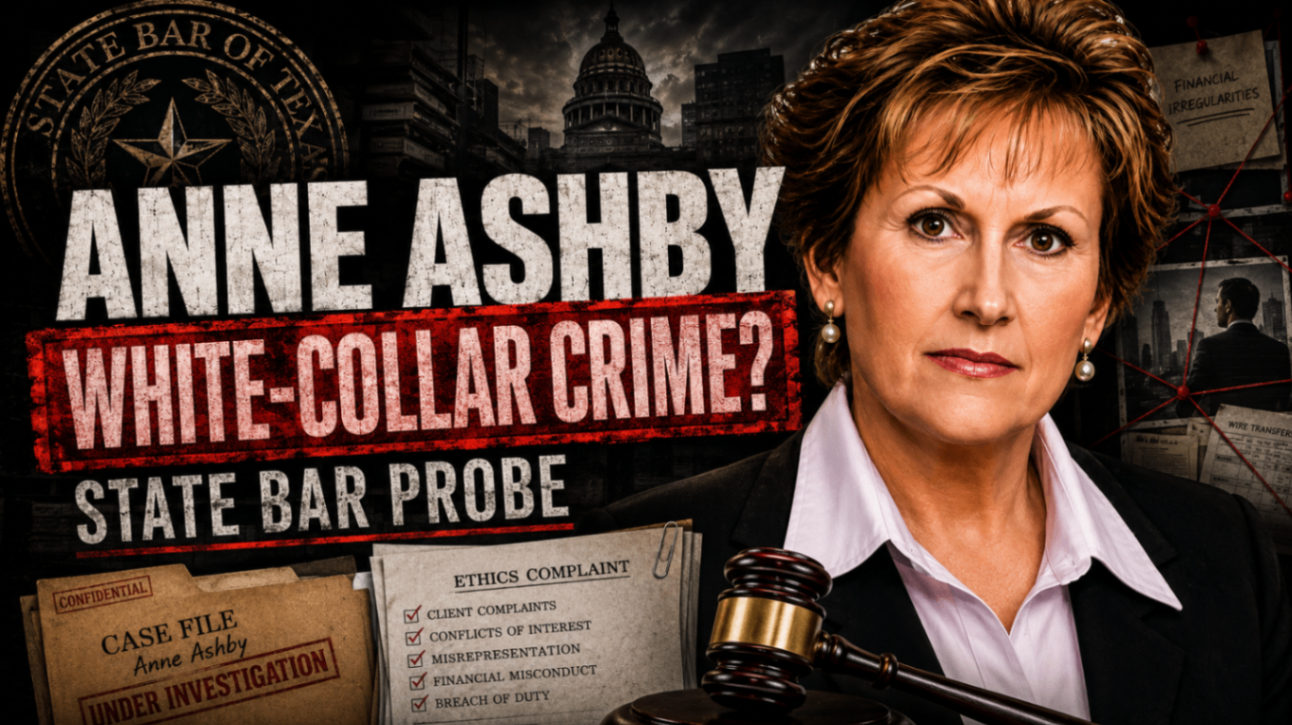
The investigation into Dallas-based arbitrator and former judge Anne Ashby has taken a sharp, dark turn. What began as a series of complaints regarding nondisclosure has evolved into something far more serious. The State Bar of Texas is no longer just looking at a disciplinary violation; they are treating the Ashby case with the clinical precision of a white collar crime investigation, according to a phone call with the investigator.
According to sources close to the investigation, a criminal referral report has been generated, signaling that the “quasi-judicial” immunity typically enjoyed by arbitrators is no longer a shield. Caroline Allison’s brother was told directly by the State Bar investigator that the Bar treats cases like Ashby’s as white collar crime investigations. That characterization is not speculation. It is what the investigator said. For years, Ashby sat in her comfortable leather chair, wielding the power of a judge without the oversight of a courtroom. But the walls are closing in. The American Arbitration Association (AAA) has reportedly removed Ashby from its roster: stripping her of her primary source of income and her professional standing. This isn’t just a slap on the wrist; it is a full-scale exposure of how arbitration corruption is used to facilitate massive financial exploitation.
The Myth of the Neutral Arbitrator
In Texas, an arbitrator is more than just a private referee. By law, they are considered officers of the court, and under Texas Penal Code § 1.07(41) they qualify as a public servant. When an arbitrator signs an award, it isn’t just a suggestion: it is a document that, when confirmed, carries the full weight of a court judgment. That status places arbitrators inside the reach of criminal statutes for bribery, perjury, and official misconduct when they abuse the authority wrapped around a supposedly neutral role. This status comes with a sacred oath. Before every case, an arbitrator must swear to disclose any conflict of interest, no matter how small, including “any past or present relationship — direct or indirect, financial, professional, social or of any other kind,” with any doubts resolved in favor of disclosure.
When Ashby was asked the standard conflict questions, her sworn answer was a definitive “No.” But the Dolcefino investigation uncovered a different story. Evidence reveals that Ashby concealed a personal and professional relationship with Michael Collins that spanned 35 to 40 years, along with ties to Keith Staubus and Steven Besly. This wasn’t a casual acquaintance; it was a deep-rooted alliance that made her “neutrality” a complete fiction. By failing to disclose this, Ashby didn’t just break the rules of the AAA; she allegedly committed attorney self-dealing on a systemic level. The Damn Lawyers series shows how those concealed alliances keep repeating across cases.
The legal implications are staggering. If a public servant makes false sworn disclosures, the issue is no longer a technical ethics lapse. It opens the door to Texas Penal Code perjury and fraud, while also implicating Texas Disciplinary Rules 8.04(a)(3) on misrepresentation, 3.05 on impartiality, 4.01 on truthfulness, and 8.04(a)(4) on conduct prejudicial to the administration of justice. These are not abstract standards. They are the rules designed to stop legal insiders from rigging outcomes while pretending to act as neutrals. The State Bar’s shift toward a white collar crime framework, including a criminal referral report, signals that investigators are treating Ashby’s conduct as potential financial and institutional fraud, not just an ethics violation.
The Secret Life of Anne Duren
The investigation into Ashby’s conduct doesn’t stop at the arbitration table. To understand the depth of the deception, investigators have had to look back at her 2009 bankruptcy filing. She filed in the Eastern District of Texas using a Beaumont address even though her homestead was in Dallas, and she filed under the name “Anne Duren,” the married name tied to Michael Duren rather than the public identity she used as Judge Ashby. The bankruptcy schedules reported her judicial pension from the Comptroller’s Judiciary Section at approximately $10,416 per month, but did not report the income she was receiving from Michael Collins’s law firm, Collins, Basinger & Pullman, which she had joined on April 1, 2009, just weeks before the April 29, 2009 filing.
That omission matters. If Ashby had reported the law firm income, she would not have qualified for Chapter 7 relief. Concealing income in a sworn bankruptcy filing is not a bookkeeping error. It raises potential bankruptcy fraud and perjury issues under federal law. In the world of federal law, hiding income while seeking a discharge is the kind of conduct that turns a financial filing into evidence of victims of Anne Ashby from creditors and the court itself.
This pattern of concealment fits the broader record surrounding Ashby. By hiding income in bankruptcy, she avoided the transparency required by law. By hiding relationships in arbitration, she gave cover to the predatory lawyers featured in the Dolcefino investigation, allowing the Damn Lawyers to pursue multimillion-dollar outcomes against families who thought they were entering a neutral forum.

The Stench of Cronyism and the AAA Fallback
For too long, the legal system has operated on a “trust us” basis. Lawyers and judges scratch each other’s backs in the dark, and when they are caught, they point to their “immunity” as a get-out-of-jail-free card. The Ashby case proves that this immunity is a sham when the entire process is built on a lie.
The Damn Lawyers featured in the Dolcefino investigation have thrived in this environment of secrecy. They rely on “friendly” arbitrators like Ashby to provide the legal cover they need for fee harvesting and asset-stripping. When the arbitrator is a partner in the deception, the victim has no chance.
Mark Logsdon learned that the hard way. He was scammed in his own arbitration with Ashby, then wrote a stern letter to the AAA documenting a familiar pattern: late disclosures, secret fee procedures, and an award that mirrored the other side’s proposed order. That letter is what got Ashby stripped from the AAA roster. Logsdon had the same problem the Allisons have. He was an outsider walking into a system controlled by connected insiders. His case matters because it proves this was not a one-off breakdown. It was a recurring pattern explored again in The Pattern of Bias.
That pattern did not stop with Logsdon. Eric Colton and Phillip Floyd are additional high-dollar victims whose matters also point to the same institutional rot: Ashby favoring the corporation, favoring the lawyer, and favoring the referrer. When the same arbitrator repeatedly benefits the insider side of the dispute, the stench of cronyism stops looking accidental and starts looking engineered. The arbitration trap investigation lays out how that machinery works when nobody is watching.
The fact that the AAA has removed Ashby from their roster is a seismic shift. The AAA was her primary source of income, providing her with steady work as a “neutral” for decades. Losing that roster status meant losing the main pipeline of arbitrator appointments that sustained her career. Their decision to distance themselves suggests that the evidence of her misconduct is so overwhelming that even the largest arbitration association in the country can no longer ignore the stench of cronyism.
Criminal law versus civil law
In Texas, crimes fall under the Texas Penal Code. They are offenses against the state, prosecuted by the government, with penalties that can include incarceration and a burden of proof beyond a reasonable doubt. Civil law is different. It governs private disputes between individuals or entities, usually with remedies such as monetary damages and a lower burden of proof based on a preponderance of the evidence.
That distinction matters here. False sworn disclosures, potential bankruptcy fraud, and service as a public servant under Texas Penal Code § 1.07(41) while concealing conflicts push Ashby’s conduct past the boundaries of a mere civil ethics dispute and into potential criminal territory. That is why the State Bar’s criminal referral matters. It signals that the conduct may warrant prosecution under the penal code, not just civil disciplinary action. It is also why the law catches up matters far beyond one scandal.
A Call for Legislative Reform
The Anne Ashby scandal is not an isolated incident; it is a symptom of a broken system. When the State Bar starts using the language of white collar crime, it is an admission that the current disciplinary measures are insufficient. We cannot allow arbitrators to exercise judicial power without judicial accountability.
We are calling for immediate legislative reforms to ensure that this never happens again. Every arbitration award must be subject to meaningful judicial review, and the “officer of the court” status must carry the same criminal penalties for misconduct that it does for elected judges. Families caught in this machine can see the broader fallout in Victims of the Trap.
The bar complaint filings against Ashby are just the beginning. As more victims come forward and the criminal referral moves through the system, the truth about how these Damn Lawyers manipulated the system will be laid bare. We won’t stop until there is full transparency and every predatory actor is held accountable. Families facing probate abuse victims stories know this damage is never abstract.
It is time for the Texas legislature to step up and end the arbitration trap. We demand a full debate on the floor and a law that protects families from being exploited by those who have sworn an oath to protect them. The era of the secret, rigged arbitration is over, and too many families have already lived through inheritance theft.
Disclaimer: This article reflects allegations and a reported conversation with a State Bar investigator. No misconduct or criminal wrongdoing has been adjudicated or proven.