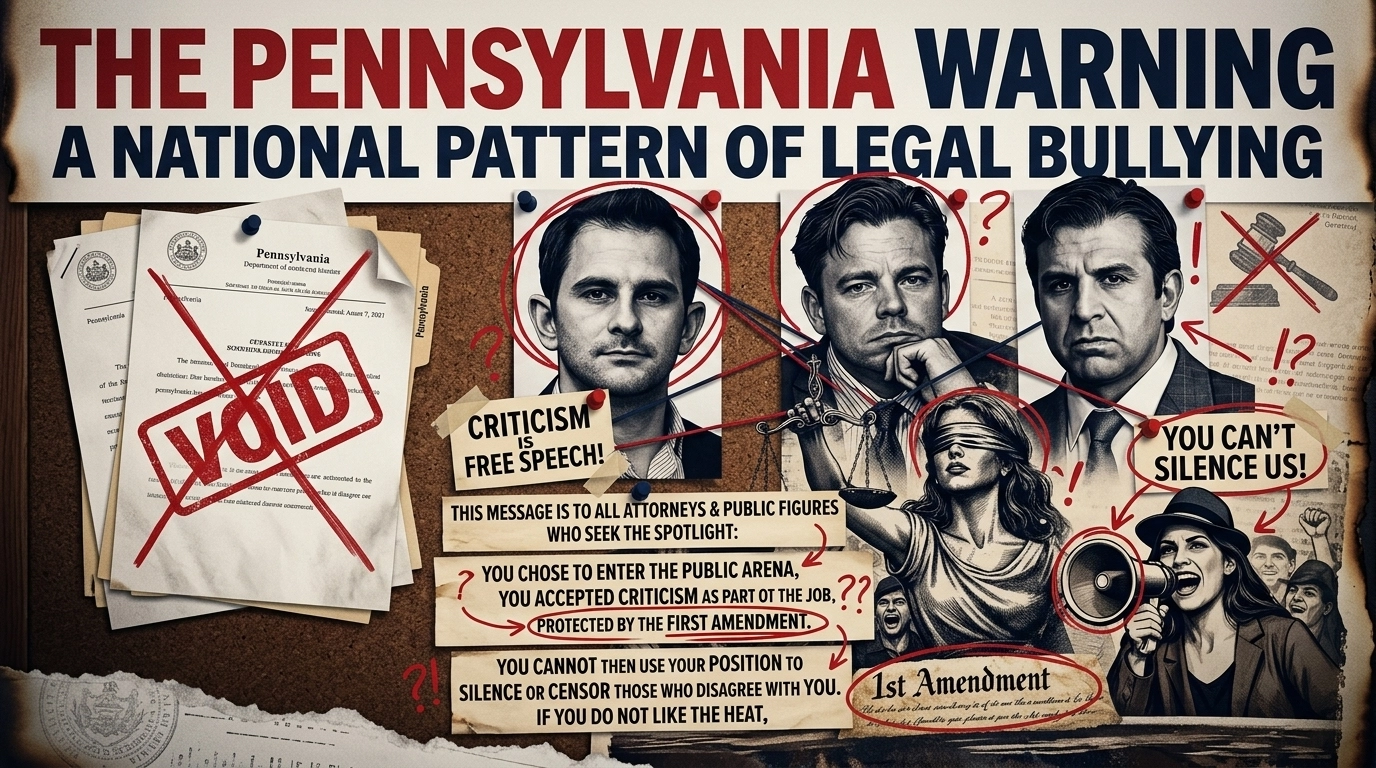
Legal bullying is often described as a local abuse carried out by a local actor against a local victim. The record suggests something more durable and more dangerous. Across jurisdictions, the same instruments appear again and again: reputation management dressed up as public trust, intimidation framed as advocacy, billing practices insulated from scrutiny, and a professional culture that too often treats accountability as an external threat rather than an internal obligation.
The Pennsylvania litigation involving Kraemer, Manes & Associates has emerged as one of the clearest warning signs in that broader pattern. The case drew attention not simply because of the allegations themselves, but because those allegations touched a central mechanism by which modern legal practices acquire power: the manufactured appearance of credibility. In pleadings and reporting surrounding the dispute, the issue was not merely whether a client had a bad experience. It was whether the public marketplace for legal services had been distorted before the client ever walked through the door.
THE PITTSBURGH WHISTLEBLOWER
Tabatha Wolfe’s allegations against Kraemer, Manes & Associates placed that question squarely before the court. Seeking counsel in a matter involving employment and sexual harassment, Tabatha Wolfe alleged that she relied on the firm’s polished digital reputation when selecting counsel. According to the allegations later aired in litigation and subsequent coverage, that reputation was not simply organic praise from satisfied clients, but part of a system that rewarded the generation of positive online reviews from people with no authentic attorney-client relationship to the firm.
That distinction matters. Online reviews in the legal market are not decorative. They function as consumer-facing evidence. Prospective clients frequently encounter them at the most vulnerable point in the decision-making process, when urgency, fear, and information asymmetry are already working against them. If those reviews are manipulated, the distortion is not cosmetic. It reaches the core of informed consent in the purchase of legal services.
Tabatha Wolfe’s case therefore resonated beyond Pittsburgh. It described, in unusually concrete form, how a law firm’s public reputation could be curated through means that, if proven, would present serious consumer-protection concerns. The significance was not confined to one firm or one city. It implicated a national vulnerability in the legal profession’s digital front door.

PTO FOR FIVE STARS: THE PRICE OF DISTORTION
According to allegations reported from the case, non-attorney staff were not merely encouraged to strengthen the firm’s online standing; they were allegedly incentivized to do so, including through offers of paid time off tied to the acquisition of favorable reviews from friends and relatives. If true, that transforms what some firms might call “marketing” into something far more consequential: the deliberate creation of false market signals in a field where trust is the product.
For the public, the consequence is straightforward. A legal consumer comparing firms online may believe a five-star wall reflects tested competence, ethical dealing, or client satisfaction. But if a portion of that wall is manufactured, then the consumer is not evaluating legal quality. The consumer is evaluating a staged performance. In any other high-stakes market, regulators would recognize the danger immediately. In law, the same conduct can remain obscured by professional deference and the assumption that officers of the court are inherently reliable narrators of their own credibility.
A LANDMARK WARNING ON ACCOUNTABILITY
The importance of the Pennsylvania matter lies in what happened next. The court did not treat the allegations as too remote, too novel, or too trivial to matter. Reporting on Judge Christine Ward’s ruling from the Court of Common Pleas of Allegheny County made clear that review-based allegations could survive an effort to dismiss them, signaling that orchestrated online deception can create genuine exposure under fraud and consumer-protection theories.
That ruling mattered because it challenged a familiar institutional defense: that online reviews are simply ambient internet noise for which firms bear little responsibility. The logic of the Pennsylvania case suggested otherwise. If a firm helps engineer the deception, the deception may be attributable to the firm. That is not a radical proposition. It is the baseline principle of accountability.
The matter later settled, with Kraemer, Manes & Associates denying wrongdoing, but the reported cleanup terms were significant. The firm agreed to remove reviews generated by employees and their associates from Facebook and Google. Even without an adjudication on the ultimate merits, the episode stands as a warning flare. A legal market built on credibility cannot tolerate reputation systems polluted by insiders, proxies, and compensated praise.
THE HOUSTON PARALLEL: IDENTIFYING THE PATTERN
The relevance to Houston is not rhetorical. It is structural. Stop Legal Bullying has documented allegations and recurring public complaints that suggest a comparable ecosystem of reputation management, pressure, and opacity surrounding a network of local attorneys often referred to as “The Trio” and their associates. In that Houston parallel, readers can review neutral background resources concerning published allegations and complaint activity involving Jorge Borunda complaint page, Richard Allison’s complaint concerning Nicholas Abaza, and Michael Trevino complaint page. Those materials are referenced here solely as allegation and accountability resources, not as proof of misconduct.
In a separate but related accountability context, Stop Legal Bullying has also published resources concerning probate victims, reported Ashby victims, and a rigged arbitration investigation. Those materials concern other published allegations and reported patterns, and they are included here only to illustrate broader accountability themes, not to convert allegations into findings.

Reports on platforms such as Google review fraud have described interlocking review behavior involving firms including the Law Office of Nicholas Abaza, Borunda P.C., and the Law Offices of Michael A. Trevino. The allegations follow a pattern that investigators, regulators, and consumer advocates should recognize on sight: reciprocal endorsements, clustered positivity, and defensive bursts of five-star postings that appear when authentic criticism threatens the façade. Related analysis in a review fraud investigation and recent FTC complaints has raised similar consumer-protection questions, although complaints and allegations are not findings.
If the Pennsylvania case exposed one operating model, the Houston allegations suggest the model may be portable. Different actors. Different geography. Similar mechanics. The core issue is not merely whether a review is flattering or false. It is whether a legal consumer is being maneuvered toward a business relationship through signals that have been curated, coordinated, or contaminated by insiders.
WHY THIS MATTERS TO THE PUBLIC
Legal bullying flourishes where information is scarce and authority is presumed. Most clients do not enter the legal marketplace as equals. They arrive injured, frightened, financially exposed, or under extraordinary personal strain. They often cannot independently test a lawyer’s claims. They rely instead on reputation, credentials, search results, and social proof. That is precisely why manipulated reputation systems are so dangerous.
At Stop Legal Bullying, we have documented how these tactics intersect with broader allegations of abuse, including fake lawyer reviews and claims involving altered fee agreements. The public harm is cumulative. Inflated trust leads to client capture. Client capture leads to leverage. Leverage, in the wrong hands, can produce financial extraction, intimidation, and silence.
FROM VICTIM TESTIMONY TO PUBLIC EVIDENCE
The Pennsylvania matter demonstrates that these cases are not beyond scrutiny and that legal institutions, when pressed with sufficient facts, can be forced to confront conduct long normalized as mere business practice. Tabatha Wolfe’s allegations did more than challenge one firm’s marketing. They illuminated how digital deception can function as the opening move in a much larger pattern of legal coercion.

That is the broader significance of this warning. What surfaced in Pennsylvania should not be read as an isolated embarrassment. It should be read as a case study in a national system that too often rewards opacity until a litigant, a whistleblower, or a judge interrupts the script.
TAKE ACTION TODAY
The answer to legal bullying is not resignation. It is documentation, exposure, and reform. If you suspect a law firm is using deceptive reviews, coercive billing, or intimidation tactics to capture and control clients, preserve the evidence and report the pattern.
This article is not legal advice, does not validate individual complaints, and allegations are not findings. A complaint, investigation, or lawsuit does not establish misconduct or liability.
- Verify before you hire: Review bar records, disciplinary history, court filings, and suspicious review timing.
- Document everything: Preserve fee agreements, invoices, emails, text messages, and screenshots of the representations you relied on.
- Report deceptive conduct: Consider a Pennsylvania attorney complaint or other consumer-protection reporting where appropriate.
- Join the accountability movement: Sustained public accountability and shared evidence are essential to systemic reform.
Accountability begins when the public refuses to look away.
#LegalReform #LegalBullying #LawyerAccountability #ConsumerProtection #JusticeReform #StopLegalBullying
More from Stop Legal Bullying
Readers exploring the wider campaign can also visit the Damn Lawyers investigation hub. These campaign resources collect reporting and accounts of alleged legal abuse. They are separate from the events described above and do not establish findings against anyone discussed in this article.