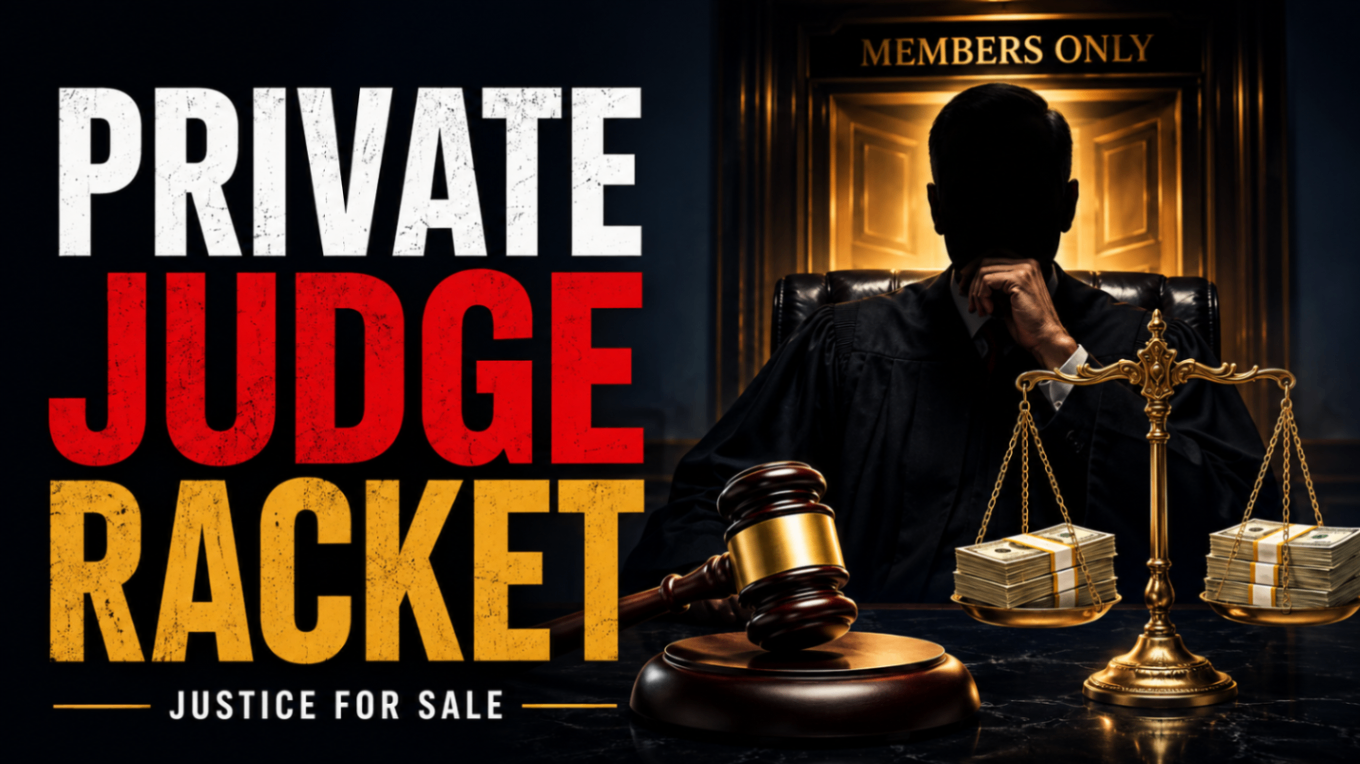
The courtroom door slams shut, and with it, the American right to a public trial vanishes. In the shadows of the Texas legal system, a new industry is thriving: one that trades the black robe for a corporate suit and the public record for a non-disclosure agreement. It is a world where the law is for sale, and the judges are on the payroll of the very people they are supposed to be policing. Welcome to the private judge racket, a system where justice isn’t found in a hall of records, but in a windowless office where calls for arbitration reform grow louder by the day.
For years, Wayne Dolcefino has been pulling at the loose threads of a stench of cronyism, and what unravels is not a procedural glitch but a business model. This is not about one bad ruling or one overheated fee dispute. It is about a pipeline designed to strip citizens of their 7th Amendment rights while enriching a private club of predatory lawyers and retired insiders who know how to keep scrutiny out and money flowing in.
The bait and the trap
It starts with a signature. Tucked deep inside an attorney-client contract is a clause most clients never negotiate and rarely understand. They think they are hiring counsel. In reality, they may be surrendering their right to put a grievance before a jury. This is the arbitration trap, a legal blackout where the public record disappears, the rules narrow, and the ordinary safeguards of open court vanish.
When a dispute erupts, whether it involves probate abuse victims or a blatant conflict, the matter can be pulled out of public view and rerouted into a private chamber. Instead of a judge answerable to law and public scrutiny, the parties can find themselves before a paid decision-maker in a system where mandatory arbitration enables secrecy, leverage, and exhaustion.
Consider the economics of that shadow court. In the Dolcefino investigation, the curtain was pulled back on the breathtaking cost of private hearings. Reports tied to this controversy describe weekly arbitrator billing that would make most public servants blanch. When a retired judge or insider can earn more in private dispute work than on the public bench, the incentive structure changes. The question is no longer whether justice is blind. The question is who is paying for the blindfold. In many cases, that money originates with firms accused of fee harvesting from families already trapped in litigation they did not expect and cannot afford.
The stench of cronyism
The private judge racket relies on a repeat-player ecosystem. If an arbitrator wants those five-figure assignments to keep coming, that arbitrator has every reason to remain in the good graces of the firms that repeatedly select and fund the process. It is a closed loop of legal deception dressed up as dispute resolution.
What matters is not just who wins. What matters is who controls the forum, who drafts the clause, who recommends the arbitrator, who pays the invoices, and who benefits when the record stays sealed. In the controversy spotlighted by Stop Legal Bullying, families describe being pushed into a process where the arbitrator was not some neutral civic referee but part of a professional orbit familiar to the lawyers on the other side. That is the heart of the racket. The game is tilted before testimony ever begins.
The corruption does not stop at the office door. The racket also depends on gatekeepers in the public system who protect private outcomes once they are issued. Under current law, overturning an arbitration award can be extraordinarily difficult even when bias or undisclosed conflicts are alleged. That narrow review standard is one reason critics argue the system functions less as justice and more as a shield, allowing the predatory lawyers to convert private advantage into enforceable public power.

A national crisis of accountability
Texas is not alone. The private judge racket is one regional expression of a national disease. In Pennsylvania’s kids-for-cash scandal, judges were convicted in a scheme that treated children as inventory for profit. In Philadelphia, pay-to-play allegations exposed how political access and judicial discretion can mingle in ways that poison public trust. In Bexar County, the McGinty scandal became another reminder that the robe does not immunize anyone from corruption.
The common thread is not geography. It is opacity. It is the old machinery of insider privilege repackaged for modern consumers as efficiency, expertise, and streamlined resolution. But when process is hidden, conflicts are easier to bury, pressure is easier to apply, and money moves with less daylight. Families caught in estate disputes or private probate warfare often discover too late that the system deciding their future is not merely expensive. It may also be structurally tilted in favor of those who know how to use delay, secrecy, and insider relationships as weapons.
That is why these investigations matter. The lawyers featured in the Damn Lawyer investigation are not counting on the strength of public confidence. They are counting on the public not reading the fine print, not understanding the forum, and not realizing how often the same players appear again and again inside the same profitable maze.
Tearing down the racket
The time for euphemisms is over. A system that pushes the public into secret forums, rewards insiders, and insulates conflicted outcomes from meaningful review deserves to be called what it is: a racket. The answer is not another polished panel discussion about reform while families are financially bled in silence. The answer is exposure, documentation, and relentless scrutiny.
That is why the record built by Wayne Dolcefino matters. It gives the public something the private system works hard to prevent: a trail. It names patterns. It shows incentives. It forces uncomfortable questions into daylight. And it reminds victims that they are not crazy, isolated, or alone.
If you have been caught in an arbitration trap, drawn into a probate plot, or believe you are among the victims of Anne Ashby, speak up. Accountability begins when silence breaks. Truth is still lawful. Exposure is still powerful. And the public record still belongs to the people.