AUSTIN, TEXAS — September 25, 2026
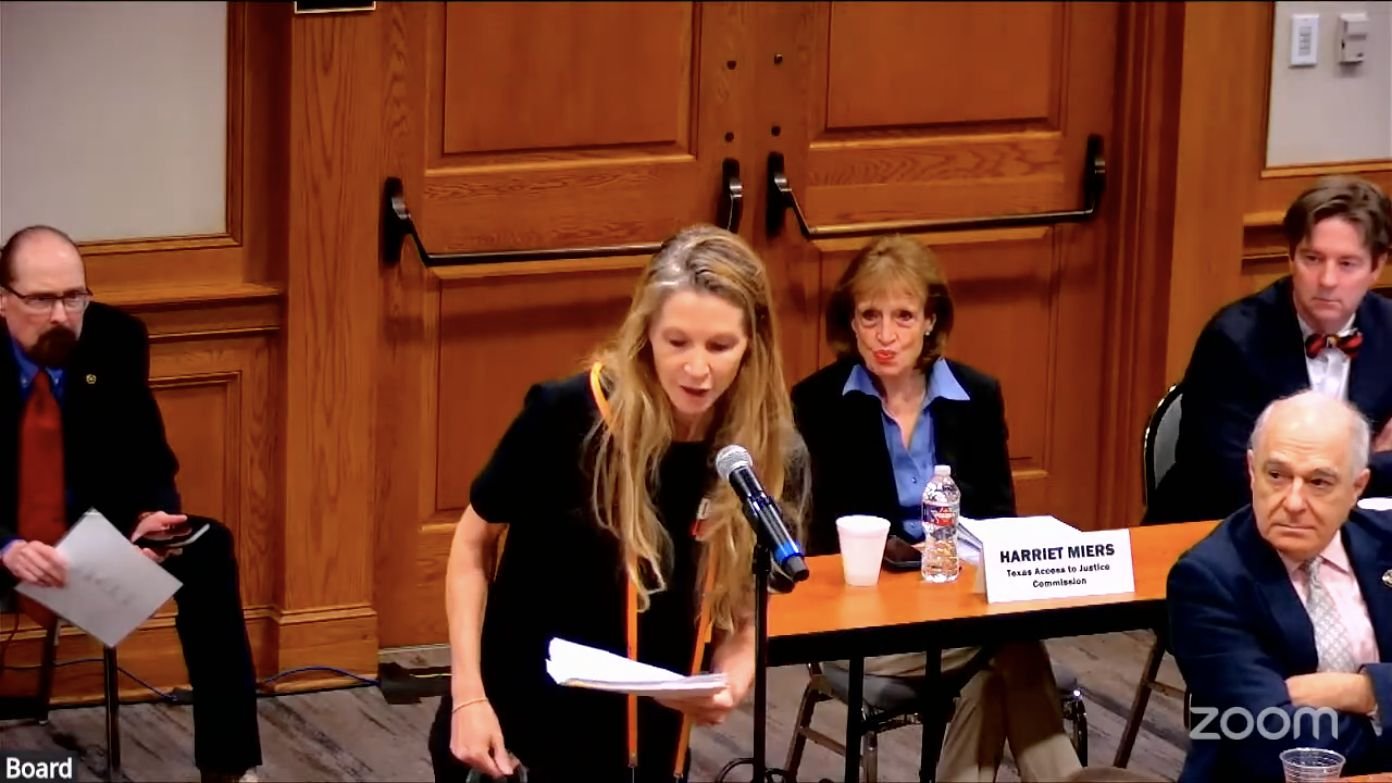
Based on Caroline Allison’s account, the State Bar’s official September 25 meeting recording and the meeting agenda. Her public-comment excerpt appears below.
Spend several hours inside a meeting of the State Bar of Texas Board of Directors and one phrase becomes almost impossible to miss:
Access to justice.
It came up again and again during the September 25 meeting at the Texas Law Center in Austin — perhaps more than any other theme of the day.
State Bar leaders, judges, young-lawyer representatives and others spoke about making legal services affordable, encouraging lawyers to perform pro bono work, reaching future lawyers, strengthening local bar associations and preparing for the upcoming Texas legislative session.
The repeated emphasis raises an important question for the public: What does “access to justice” actually mean in practice?
Who Was in the Room
This was not simply a gathering of practicing lawyers.
The room included some of the most significant figures in the Texas legal establishment.
State Bar President G. David Smith, President-Elect Sarah Clower Keathley, Board Chair Steve Alfonso Chiscano, Executive Director Trey Apffel, Chief Disciplinary Counsel Seana Willing, and numerous elected and appointed directors participated.
Members and representatives of the judiciary were also present.
Justice Evan Young delivered the Supreme Court of Texas update. Senior Justice Debra Lehrmann had an excused absence recorded during roll call.
Judge Jesse F. McClure III represented the Texas Court of Criminal Appeals, the state’s highest criminal court.
Judge David Sanchez provided the Judicial Section report, while Judge McKay provided the federal judiciary report.
A President Planning to Hit the Road
One of the more memorable moments came from State Bar President G. David Smith.
Smith told attendees he had purchased a new vehicle and wanted to put approximately 100,000 miles on it as he travels Texas.
The message behind the anecdote was more substantive than the mileage.
Smith described plans for what amounted to a statewide road show, reaching lawyers and law students and helping strengthen local bar organizations.
That focus on future lawyers was echoed elsewhere during the meeting.
Texas Young Lawyers Association President Armin Salek discussed the Texas Future Lawyers Alliance, an initiative designed to introduce aspiring lawyers to legal education, networking, career guidance and the law-school admissions process.
State Bar materials show that the program is particularly aimed at aspiring first-generation lawyers and includes virtual legal education, networking and admissions support.
“Access to Justice”
But the dominant theme was unmistakable.
Access to justice.
State Bar Executive Director Trey Apffel discussed access, affordability and protecting the public.
Other presentations focused on encouraging lawyers to provide free legal assistance to people who otherwise might not be able to afford representation.
The discussion addressed a practical gap: people can have a serious civil legal problem without being able to pay for representation.
The Bar describes protection of the public and promotion of equal access to justice as fundamental responsibilities of the organization.
That philosophy surfaced repeatedly throughout the meeting.
Pro Bono Texas and Helping Texans Who Cannot Afford Lawyers
Another presentation focused specifically on lawyers helping poor and underserved Texans.
The discussion included Pro Bono Texas, encouraging attorneys to donate their professional time and skills, as well as fundraising and infrastructure supporting access-to-justice programs.
The underlying message was simple:
Texas has people who need lawyers but cannot afford them, and members of the profession are being encouraged to help close that gap.
The meeting’s young-lawyer report described volunteer legal clinics and work on Texas Free Legal Answers. These service efforts deserve attention alongside questions about protection when representation goes wrong.
Preparing for the Legislature
The Texas Legislature was another recurring subject.
Judge David Sanchez, reporting for the Judicial Section, discussed the approaching 2027 legislative session.
Among the issues raised was judicial compensation. Sanchez told the Board that compensation for Texas judges needs to increase.
Another Board discussion addressed the importance of helping state legislators better understand what the State Bar does and the functions it performs.
That relationship bears watching as the 90th Texas Legislature convenes in January.
The State Bar does not merely administer programs for lawyers. Its sections and committees also participate in developing legislative proposals concerning the Texas legal system.
The Courts Had a Seat at the Table
The judiciary’s presence was notable.
Justice Evan Young represented the Texas Supreme Court.
Judge Jesse McClure represented the Court of Criminal Appeals and extended an unusually personal invitation: he encouraged people to visit the court, specifically mentioning Tuesdays or Wednesdays as good opportunities.
Judge Sanchez represented the Judicial Section.
Judge McKay reported on the federal courts.
Their participation illustrated how closely interconnected the State Bar, Texas judiciary and broader legal profession remain.
What Caroline raised during public comment
In the video excerpt she supplied from the September 25 meeting, Caroline Allison asked a different access-to-justice question: what happens when the reputation that leads a client to hire a lawyer is itself unreliable?
She asked whether family members, spouses, children or business associates had helped inflate a lawyer’s Google ratings, and whether that reputation was then used to market legal services. She described her family’s experience as what she contends was “review fraud, deception, and a rigged public reputation.” Those are her allegations. This excerpt does not establish a disciplinary finding or a response from the Board.
Transcript of the excerpt
Would you be shocked if family members, spouses, children, or business associates helped inflate a lawyer’s five-star ratings on Google, and that manufactured reputation was then used to market legal services to the public? That is where our story began, and is what I contend was review fraud, deception, and a rigged public reputation.
Watch the official meeting recording
The State Bar of Texas’s full September 25 Board recording is embedded below, starting at Caroline’s public comments around 25:10. Her statements are public comments, not Board findings.
The campaign’s review-manipulation coverage provides background to the concern she raised. Its video reporting on review fraud is campaign material, not a finding by the State Bar. In the longer clip she supplied, Caroline also connected her family’s experience to the Damn Lawyers investigation and allegations of financial harm in probate matters. The site’s discussion of fee harvesting addresses that separate concern.
The Other Meaning of “Access to Justice”
There is another side to the phrase that deserves examination.
Access to justice is not solely about getting someone through the courthouse door.
For members of the public, access to justice can also mean understanding what happens after they hire a lawyer.
It can mean knowing where to turn when something goes wrong.
It can mean understanding the grievance system.
It can mean knowing what happens to a complaint after it is filed. Jeff Morgan‘s campaign commentary on bar complaints raises accountability questions that many Texans share; it is commentary rather than an official filing portal or a statement from the State Bar.
And it can mean understanding what mechanisms exist to protect clients when attorneys violate their professional obligations. Campaign discussion of lawyer accountability appears on the campaign’s own channel and is similarly commentary rather than a finding about any lawyer.
That makes the presence of Chief Disciplinary Counsel Seana Willing particularly significant. Her office administers the attorney disciplinary system — the mechanism through which allegations of professional misconduct against Texas lawyers are processed.
The meeting also included a specific discussion of proposed Texas Rule of Disciplinary Procedure 2.12 revisions. The Board approved sending the proposal back to the Committee on Disciplinary Rules and Referenda for further consideration of recommended changes. That was a procedural step, not adoption of a new rule and not a decision on Caroline’s allegations.
Protecting the Public
Perhaps the two most consequential concepts heard during the meeting were therefore closely related:
Access to justice.
And:
Protection of the public.
The State Bar expressly describes both as part of its institutional mission.
The meeting showed substantial energy being devoted to pro bono representation, legal education, law students, local bar organizations, judicial resources and communication with lawmakers.
Those are significant initiatives.
But for ordinary Texans, the ultimate measure of “access to justice” may be broader.
Can they afford a lawyer?
Can they identify a trustworthy lawyer?
Do they understand the agreements they sign?
Do they understand what happens when a dispute is sent to arbitration rather than court? The campaign’s arbitration trap coverage follows a separate Texas matter and asks that same question in a different setting.
And when a client believes a lawyer has violated professional obligations, does that person have meaningful access to a disciplinary system that is understandable, transparent and responsive?
Those questions deserve a place in the access-to-justice conversation too.
Because access to a lawyer is only the beginning.
Access to justice must ultimately mean access to a legal system the public can understand, use — and trust.
Separate campaign resources
The public-protection discussion also deserves concrete questions from clients. The campaign’s published filings include questions about how fees accumulate. Another examines advice about continuing litigation. A third concerns the terms of representation. These are separate allegations, not disciplinary findings.
Other submissions ask what clients knew about professional connections when choosing a lawyer. They also raise questions about independent representation during estate administration. A further account concerns understanding a fee agreement before signing.
The record concerning an arbitrator’s disclosures raises a different part of the accountability question. Each filing needs to be read alongside its supporting materials and any response or decision. These campaign records do not establish facts about the Board meeting or any action by its members, and they imply no endorsement by the people or institutions discussed in this article.
Separate campaign materials about other matters include Damn Lawyers, resources for probate victims and materials on court-accountability resources. Assess each claim against its supporting records and distinguish allegations from findings.
General information, not individual legal advice. Rules and remedies vary by jurisdiction and circumstances. This article reports on a public meeting; nothing in it is a finding of misconduct by any named person.
Featured image: unaltered still from the State Bar of Texas’s September 25, 2026 Board meeting recording, showing Caroline Allison during public comment.